Posts

Showing posts with the label green frog

A Green Frog Gets Greener

Image
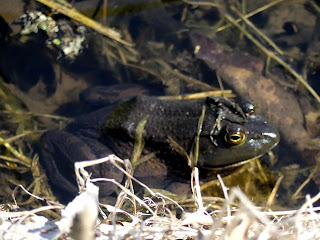
Though plenty green enough on its own, this Green Frog also got covered in what looks like watermeal. Despite having "green" as part of their name, some Green Frogs are closer to brown in coloring. This particular frog seems determined to live up to the Green Frog moniker, going to far as to get covered up with the green watermeal [1] in its vernal pond. Other than camouflage, the watermeal probably isn't very helpful to frogs. Too much watermeal can throw to the local environment out of whack, which in the long term probably interferes with a frog's ability to find food.  July 6, 2023 at Scherman Hoffman Wildlife Sanctuary Photo 301261592, (c) jpviolette, some rights reserved (CC BY-NC) [1] This could be duckweed, which is a type of watermeal. I'm using the more general watermeal though because I'm not sure what particular type of watermeal it is.
Handsome Green Frog

Image
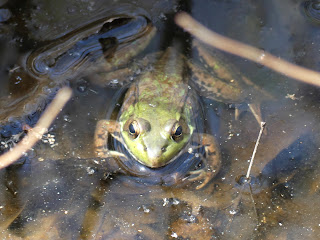
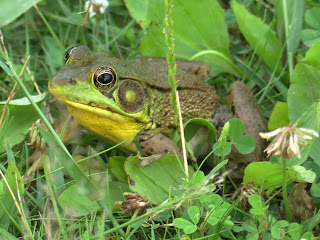
Here's a strikingly goodlooking Green Frog from last year [1]. This frog is likely a male; his tympanum (eardrum) appears to be larger than his eye, and he has a yellow rather than white throat, both being field marks for male Green Frogs. (FWIW the American Bullfrog males can also be identified by tympanums that are larger than their eyes.) June 29, 2023 at Sourland Mountain Preserve Photo 301252530, (c) jpviolette, some rights reserved (CC BY-NC) [1] And this is saying something given how goodlooking the average Green Frog is.

Green Frog

Image
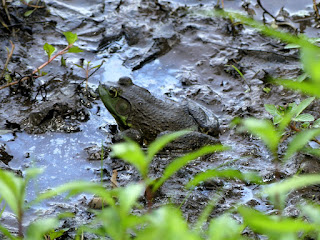
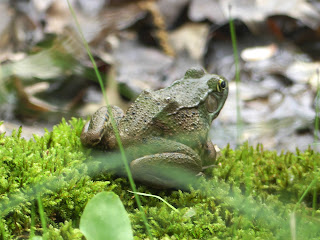
This Green Frog looks to have found a mossy spot to "fish" for flies. It's not a great angle, but it achieves 1 thing that this picture doesn't achieve: easy identifiability. One thing you can easily see is 1 of the ridges going straight down its back, clearly distinguishing it from its American Bullfrog cousin. Other than that, the moss makes an interesting spot to sit. While both the frog and moss are green, which should provide some camouflage, the shades of green aren't particularly close. The frog might actually blend in better with a muddy background, perhaps resembling some slimy vegetation in the mud. On the other hand, moss does sound like a comfortable place to sit while waiting for dinner to fly by. May 12, 2023 at Lord Stirling Park Photo 282422844, (c) jpviolette, some rights reserved (CC BY-NC)

(Presumed) American Bullfrog in a Secluded Spot

Image
This American Bullfrog thought it had found a spot where no giant, potentially dangerous animals would spot it, but then I came along. Even if you're not crazy about frogs [1] this is 1 cool-looking frog. And this spot at Lord Stirling Park gives the surrounding area an almost jungle-like vibe. Although I got an ID of American Bullfrog, I'm waffling a little on the ID. The dorsolateral ridges that usually distinguish the species can't be seen from this angle, and both American Bullfrogs and Green Frogs can have white throats/undersides [2]. May 12, 2023 at Lord Stirling Park Photo 282422437, (c) jpviolette, some rights reserved (CC BY-NC) [1] Of course I'm joking. What sort of wacky weirdo wouldn't be crazy about frogs? [2] Males of both species can have a yellow throat, making it more likely this is a female.

A Contemplative Green Frog

Image
After seeing a bunch of American Bullfrogs 1 day last May, I finally met another frog, this Green Frog . (Yeah, I know, this Green Frog isn't as green as the species name would suggest; that's just a Green Frog thing .) As I've mentioned before, the ridges going down its back [1] (you can see the right side ridge pretty easily in the picture below) distinguish it from its American Bullfrog cousins. They also speak different languages. While the American Bullfrog has a deep, foghorny call, the Green Frog has a much twangier call. Also, AFAIK American Bullfrogs don't vocalize when jumping in the water, but if a Green Frog jumps in [2] I'll frequently here a call of "Eek!". Presumably this alerts the other frogs that something dangerous is around. Why Green Frogs raise an alarm while American Bullfrogs refuse to alert others is unknown to me. What's this frog thinking about? My guess is that it's got more to do with eating an insect than it does abo...

Green Frog Colors

Image
As I've mentioned from time to time, common names can sometimes be misleading (and there are extreme examples ). Today I'll mention the Green Frog . As I've mentioned before, they're not necessarily green , their (generally) larger cousins the American Bullfrogs can be quite green, and the best way to tell them apart concerns dorsolateral ridges . On a springtime trip to Great Swamp National Wildlife Refuge I encountered a greenish Green Frog: April 13, 2023 at Great Swamp Photo 272118834, (c) jpviolette, some rights reserved (CC BY-NC) And also a brownish Green Frog: April 13, 2023 at Great Swamp Photo 272118857, (c) jpviolette, some rights reserved (CC BY-NC)

Frogs in the Shade

Image
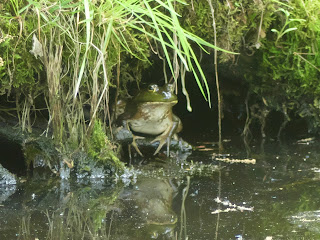
I've talked before about turtles basking in the sun; as ectotherms they need solar help to regulate their body temperature. And I've shown dragonflies that try to limit their sun exposure on hot days using body positioning . Back in mid-July I saw a couple frogs making use of shading.  Admittedly I also saw some frogs completely in the sun and others beneath the heavy shade of a tree, but these 2 appeared to be seeking out shade.  I also wonder if they're getting a little protection from avian predators. While their biggest threat from birds probably comes from herons that find prey by wading through water and would get a side view of the frogs, it's at least conceivable that guys like ospreys, cormorants, or kingfishers could be looking to swoop down from above to get a froggy meal. American Bullfrog July 15, 2022 at Sourland Mountain Preserve Photo 221317752, (c) jpviolette, some rights reserved (CC BY-NC) Green Frog July 15, 2022 at Sourland Mountain Preserve Photo...

American Bullfrog

Image
Though I got some pictures of Wood Frogs earlier in the season and had been hearing the small/elusive Spring Peepers about that time, it was only about 5 weeks ago that I started seeing one of our most visible frogs, the American Bullfrogs . I've talked before about how to differentiate them from their Green Frog cousins (hint: it's all about the dorsolateral ridges), a fairly similar frog that starts appearing about the same time of year. This wasn't my first bullfrog picture of the season but was one of the most handsome. I think they tend to look a little discolored and emaciated very early in the spring. A few weeks later they seem to regain their plumper and greener appearance. May 13, 2022 at Duke Farms Photo 199462915, (c) jpviolette, some rights reserved (CC BY-NC) By way of comparison, here's one of the 1st pictures I got last year. April 13, 2021 at Delaware Raritan Canal Photo 121031804, (c) jpviolette, some rights reserved (CC BY-NC)

Pickerel Frogs

Image
Late last summer I was finding quite a few Pickerel Frogs at the Washington Valley Reservoir. I guess you could say that things were really hopping down at the ole reservoir.  These frogs are a little smaller than the other frogs I typically run across ( American Bullfrogs , Green Frogs , Leopard Frogs ) but are fairly noticeable and distinctive looking. They're not like those Spring Peepers , who you can hear a bunch of them around you and still not find a frog. And these Pickerel Frogs were found a little way away from water; many frogs escape my camera by simply jumping in the water. The 2nd frog did try and hide in the local vegetation though. September 7, 2021 at the Washington Valley Reservoir Photo 167829440, (c) jpviolette, some rights reserved (CC BY-NC) September 7, 2021 at the Washington Valley Reservoir Photo 167829767, (c) jpviolette, some rights reserved (CC BY-NC)

American Bullfrog v Green Frog

Image
Today I want to show two different frog species, both with similar coloring and size, the American Bullfrog and the Green Frog . These are both largish frogs that tend to stay close to water and are fairly abundant in central NJ. With quite a bit of overlap in size and coloring, the easiest way to differentiate them is that Green Frogs have a dorsolateral ridge on each side going from the eye down its back. The American Bullfrog has a ridge that starts at the eye, continues just past the eardrum, and then veers downward instead of across the back. These frogs were both at Sourland Mountain Preserve. I was a little surprised that the small pond seemed to only have the Bullfrogs but when I went up the mountain to an even smaller pond I saw only Green Frogs. It's almost like these guys agreed to split the park up. American Bullfrog June 25, 2021 at Sourland Mountain Preserve Photo 141961699, (c) jpviolette, some rights reserved (CC BY-NC) Green Frog June 25, 2021 at Sourland Mountain...

Green Frog

Image
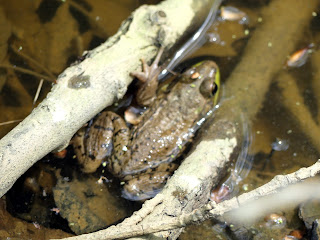
Here's a Green Frog I met at the Plainsboro Preserve almost a month ago. (At least I think that's a dorsolateral ridge I see, and not just a result of a frog in a peculiar position.) I've talked about these frogs before, so I'll just say that this little fella seems to be in an awkward position between a couple of sticks. I generally see these frogs in a prime "jumping position", with their limbs unencumbered if they need to move quickly. This guy looks like he'd have to reposition a little bit before being able to jump into the water. On the other hand, the frog probably is positioned well have its head out of the water to potentially snag a tasty flying insect while still staying wet. This may be a case where the frog is in a good hunting position while at a slight disadvantage if it becomes the hunted. Just like all of us, animals sometimes need to compromise safety to be in a better position to succeed. April 28, 2021 at the Plainsboro Preserve Photo...

Green Frog

Image
Yesterday's American Bullfrog has a similar-looking relative, the Green Frog . The main difference between them and the American Bullfrog is a pair of dorsolateral ridges that go down the back. (Most of the frogs in their genus ( Rana ) have these dorsolateral ridges, though most of the others don't look so similar to the bullfrog.) Despite the name, the Green Frog isn't necessarily green; some of them are more of a brown color. The largest Green Frogs are probably only a as big as a smallish American Bullfrog, but I seem to see a fair amount of overlap between the ones in my area. I think they're the frog I run across the most, though there are places where the American Bullfrog gives them a run for their money. Basically these seem to be similar frogs that live in the same places, eat the same food, and have the same predators. April 27, 2021 at the Delaware-Raritan Canal Photo 127321412, (c) jpviolette, some rights reserved (CC BY-NC)

American Bullfrog

Image
Here's the first American Bullfrog I've met this year. They might be the 2nd easiest-to-spot frog in NJ, probably behind the Green Frog . And the two frogs look fairly similar too. Technically American Bullfrogs can get bigger, though size can be difficult to judge from a distance, and many of our bullfrogs aren't at their maximum possible size. The most obvious difference is that Green Frogs has a pair of prominent ridges going down their backs that differentiates them from the American Bullfrog. These guys are voracious eaters of pretty much any animal small enough to swallow; it's not just flies that they eat. This guy looks a little bony; I suspect that the frog hasn't had a lot of time to eat since its winter dormancy. April 13, 2021 at the Delaware-Raritan Canal Photo 121031804, (c) jpviolette, some rights reserved (CC BY-NC)