Posts

Showing posts with the label rhizome

Anemone Encounter

Image
Anemone encounters may sound like an enemy encounter, but they're far less confrontational. This joke was done better in a sea anemone cartoon , though sea anemones are not very closely related to the anemones I've seen walking in the woods. The anemones I see are small flowering plants in the buttercup family while sea anemones are invertebrate animals that sort of resemble plants [1]. Both these plants are native to New Jersey and are spring ephemerals . Both these plants spread when underground rhizomes spread out and sprout what appears to be a new plant near the "original" one; just because you see separate stems coming from the ground, it doesn't mean they're necessarily separate plants. Both these plants can also spread with the help of ants ( myrmecochory ), who feed on elaiosomes attached to their seeds then discard the rest, usually a little way away from the parent plant. While both these plants produce pollen that many bees and flower flies fe...
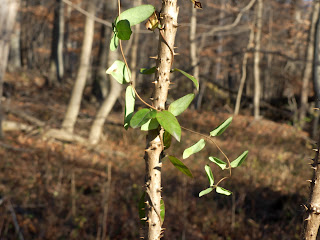
Japanese Honeysuckle

Image
Here's another invasive plant species, the Japanese Honeysuckle . And it's engaged in invasive-on-invasive violence, beginning its classic climb-and-strangle strategy on yesterday's invasive plant, the Japanese Angelica Tree . My impression is that all those prickles on the Japanese Angelica Tree won't save it; the Japanese Honeysuckle will presumably maneuver between them as it climbs. I'm not sure what happens to mature trees when Japanese Honeysuckle moves in. I'm sure they'll climb the trees and that it's foliage will compete with the tree's foliage for sunlight. I know that Japanese Honeysuckle will kill young trees as they wind themselves tightly around the trunk, so I suspect it'll also damage newer tree branches even if thick bark protects the main trunk from the Japanese Honeysuckle. If there's nothing to climb, Japanese Honeysuckle will form thick clusters that catch almost all the sunlight, making it very difficult for any other pl...