Posts

Showing posts with the label bobolink

Rusty Blackbird

Image
Okay, I have to admit when I took this picture I thought I was seeing a Common Grackle . But when I posted it to iNaturalist, it suggested a Rusty Blackbird , and other people agreed with this identification. Though in the same family , these species are in different genera and so are probably not really close relations [1]. You might wonder why they're called Rusty Blackbirds since this fella looks black, maybe with a slight bluish sheen. Rusty Blackbirds were named for their non-breeding plumage which actually does look a bit rusty, or at least an uneven brown color. This is presumably a male that may not be in his breeding range but does have his breeding plumage. With this plumage they resemble the dark, shiny, light-eyed grackles. We're supposed to differentiate them by the Rusty Blackbird being smaller (hard to judge from a distance), having a smaller tail, and having a less robust beak. These birds also resemble the Brewer's Blackbird , a close relative that isn'...
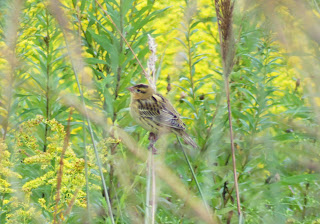
Female Bobolink

Image
Yesterday I showed a pair of male Bobolinks I met this past June. Today I'll go back a few years to show a picture of a female Bobolink. I believe the relatively dark feathering on the top of the head, the line behind the eye, and the lines on the wings are dark enough for this to represent a breeding plumage female. If the coloring in these spots was lighter, I'd be more inclined to think this to be either a male or female with non-breeding plumage (which this time of year would probably mean a juvenile born earlier in the season). Because we see Bobolinks primarily during breeding season, it's generally very easy for us to distinguish males from females. If we lived in South America though, both genders would look like a lighter version of my picture, and I'm not even sure people can distinguish the males from the females. Since female Bobolinks are polyandrous , her nestlings could have different fathers, and may actually get help feeding them from more than 1 male ...

Bobolinks

Image
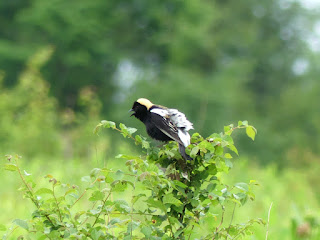
Here are a couple interesting-looking birds I encountered last month: Bobolinks . These are males in their breeding plumage; their non-breeding plumage looks awfully similar to female plumage, which is far less eye-catching. The buttery-yellow on the head and the patches of white elsewhere contrast sharply with their black plumage, making these guys extremely easy to identify. These birds like fields/meadows/pastures. They'll sometimes be seen above the vegetation line eating seeds off of plants, but they'll also hit the ground to forage for insects living within the vegetation. Bobolinks are kind of the swingers of the New World blackbird family , having polygynous males and polyandrous females. This means Bobolink nestlings might be as closely related to the "nest next door" as they are to the ones they were raised with. As a species, Bobolinks have no really close relatives, and are the only species in their genus. Bobolinks are also impressive migrators, spendin...

Armyworm Moth

Image
Here's someone I don't know that I could ID all on my own; it's fairly nondescript. It's a True Armyworm Moth . I got this picture when Duke Farms had their semi-annual mothing event last August. (Duke Farms pays a guy who lights up large sheets that attract the moths.) Similar to Goldenrod Soldier Beetles , True Armyworm Moths have no actual military training. They do have a bad reputation in the agricultural community since as caterpillars they voraciously devour crops (grains and other grasses) and then "march" in lines to the next plant; the marching is responsible for the "army" part of their name. Their other name is the White-speck Moth, getting this name from those little white specks in the middle of their wings. These moths are migratory. They head south to avoid our winters, and head north to avoid the worst heat of the summers. Apparently if you're a True Armyworm Moth, your worst nightmare is being approached by birds like the Boboli...