Posts

Showing posts with the label eastern painted turtle

Submerged Eastern Painted Turtle

Image
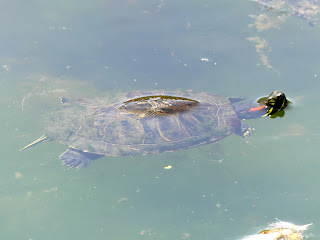
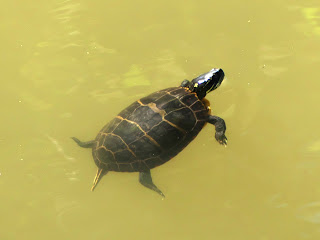
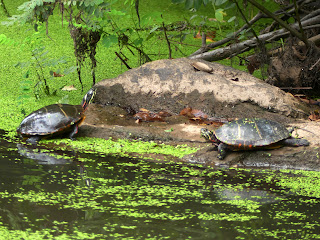
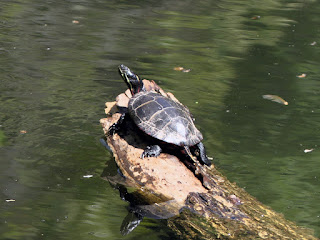
When the water is clear and the lighting is good, you can sometimes get good looks at turtles even when they're submerged like with the 1st picture of an Eastern Painted Turtle [1]. And although it can take some patience, if you can't see the turtle clearly while it's underwater, they do have to at least poke their head out of the water periodically to breathe, like in the 2nd picture. (Note this strategy doesn't work on fish.) Generally speaking, I'll usually only get decent submerged pictures when my subject is pretty close to the surface. Most ponds and canals have water that's murkier than a swimming pool [2]. Here are older underwater photo successes of a Red-eared Slider and an Eastern Painted Turtle . Don't give up on a picture just because of a little water. May 11, 2023 at Great Swamp Photo 282421257, (c) jpviolette, some rights reserved (CC BY-NC) May 11, 2023 at Great Swamp Photo 282421265, (c) jpviolette, some rights reserved (CC BY-NC) [1] Rem...

Common Map Turtle Comradery?

Image
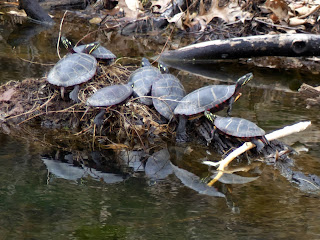
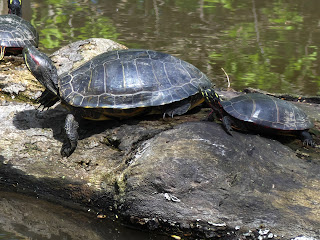
Here's a few Common Map Turtles from last spring. In the 1st picture it sort of looked like the turtle on the right was trying to put an arm [1] around its companion in an expression of comradery. While we don't know a lot about the social lives of turtles, it's possible that ( like snakes ) they may develop relationships of trust and/or comfortable familiarity with some other turtles. Still, it's probably more likely that the turtle had more selfish motivations: "I was hoping to climb up onto his back to catch some rays." Or, "I really wanted that spot on the branch, and hoped I could push him off of it." When I go turtle-watching, I do try and spot our map turtles [2], but I rarely manage to do so. I'm told they're 1 of our more skittish turtles, so maybe a lot of the turtles that jump in the water before I can get a look at them were actually map turtles. Similar to my Eastern Musk Turtle pictures posted yesterday, it's possible that...

Red-eared Sliders and Painted Turtles

Image
Here are a couple pictures both featuring a Red-eared Slider and a Painted Turtle . In both these pictures the slider is the larger turtle; although sliders are on average bigger, there are plenty of Painted Turtles bigger than the average slider. I'm told the sliders are more aggressive than painteds, though I haven't actually witnesses that for myself. I've never actually seen a turtle fight/dispute. Though turtles do have claws, it's unclear to me they've got the strength or quickness in their limbs to be slashing each other up very often. It does sound like males of both turtles will use their claws to impress females and intimidate rivals . I know people have studied pecking orders around bird feeders, carcasses, etc. AFAIK no one has documented a pecking order regarding basking spots. Still, good basking spots are a limited resource, so I wouldn't be shocked to learn that size/aggressiveness differences result in some turtles getting the best spots. May 5...

Red-eared Slider Goes for a Swim

Image
We all know most of our turtles swim better/faster than they walk (except maybe you, Eastern Box Turtle ), but most of my pictures show them basking on a rock or a log . And if I'm lucky enough to meet 1 on land , I can almost always get a reasonable picture of them. Sometimes though if the turtle's swimming at the surface and isn't vacating the area quickly, I can get a picture like this Red-eared Slider below (or this older 1 of an Eastern Painted Turtle ). Although a lot of times the turtles consider me to be too scary (or ugly?) to be around, and dive into deeper waters, this 1 stayed near the surface a bit longer. This is the 9th and final blog post for my April trip to the Sourland Mountain Preserve. Although I sometimes go someplace that turns out to be disappointing, this particular trip was pretty productive.  April 14, 2023 at Sourland Mountain Preserve Photo 272126752, (c) jpviolette, some rights reserved (CC BY-NC)

Personal Space and Turtles

Image
It's just barely spring, the weather's warming up, you want a place with ample sunlight but with easy access to water. For many turtles, this means there's some competition for a good log. I haven't seen fights over a log spot, but I'm some pushing, shoving, and even climbing atop other turtles certainly occurs. In this picture it looks like 6 Eastern Painted Turtles , 1 Red-eared Slider (in the middle, and with the red "ear"), and (probably) 1 Northern Red-bellied Cooter (the big 1 at the top). FWIW the (non-native) Red-eared Slider is considered a pushy species, though I do wonder about their ability to push around the usually-larger cooters. And AFAIK the more abundant Painted Turtles don't team up to help 1 another against the other species. Though it seems a little crowded, this is the general solution for turtles looking for some springtime sun. March 26, 2023 at the Raritan Water Power Canal Photo 269672785, (c) jpviolette, some rights reserve...

Turtle "Moms"

Image
Here's something I've heard frequently in turtle hotspots where a large turtle is with a small one: "Look at the Mother Turtle and her babies!". Depending on the situation, I'll sometimes mention: Turtle moms lay their eggs and leave. It's highly unlikely that they know who their children are, making it highly unlikely they protect/guide them. In many cases, the turtles aren't even the same species. Our Northern Red-bellied Cooters tend to be larger than most of their contemporaries, and thus get interpreted as parents to the smaller species. Both of the pictures below are cases where Northern Red-bellied Cooters are with Eastern Painted Turtles . While we can't rule out that turtles might have some tenuous social relationship with other turtles living nearby, you're probably not seeing parent-child relationships out there. March 6, 2023 at the Raritan Water Power Canal Photo 269673787, (c) jpviolette, some rights reserved (CC BY-NC) March 6, 2023...

A Bale of Turtles

Image
Basking turtles - turtles who like to bask in the sun - are frequently found together, sometimes in pretty close quarters crowded on a log or a rock. Wikipedia suggests that a group of turtles is called a bale. This picture represents the Basking Big Three turtle groups [1] around here: Sliders - The top turtle is a Red-eared Slider , a species introduced to this region from other parts of the country. There are concerns that they might out-compete our truly native turtles, though right now we have plenty of other turtles. Pond Slider is the common name for the species, and around here the Red-eared Slider is the most commonly spotted subspecies. Painteds - The 2 turtles in the middle are Painted Turtles, probably Eastern Painted Turtles , our most common Painted Turtle. They have smooth (sometimes shiny) carapaces segmented into easily distinguishable scutes . Painted Turtle is the species name, while Eastern Painted Turtle refers to a particular subspecies. Cooters - The large t...

February Turtles

Image
Since today is World Turtle Day , I'm contractually obligated to talk about turtles today. 😄🐢 Though back in April I showed you some Spiny Softshell Turtles from this year, they were not the 1st turtles I saw or photographed this year. I had actually started to see turtles basking in fairly early February, albeit only on unusually warm days. Among the first I saw were 2 of our most frequently seen basking turtles , a few Eastern Painted Turtles and a Northern Red-bellied Cooter . Though sea turtles can migrate, our turtles hibernate underwater, slowing their metabolism, and using cloacal respiration and anaerobic respiration . Anaerobic respiration sounds like what kicks in when, as the winter progresses, the water slowly becomes depleted of oxygen. While it can keep a turtle alive, it sounds like they'll experience the equivalent of muscle cramps with that form of respiration. I suspect this means that they're anxious to get out of the water to breathe as soon as the ...

Eastern Painted Turtle Goes Swimming

Image
Most of the time I get pictures of turtles who are out basking in the sun, but with a few exceptions (I'm looking at you, Box Turtles ) most of our turtles are more comfortable in the water. This is presumably a safety issue, since they're both more mobile in water and can hide from terrestrial (like these guys ) and aerial (I'm looking at you, Bald Eagles ) threats better. I suppose River Otters are still a threat, though we don't have big populations of them around here. (Given their potential predators, having a shell/carapace is probably a good idea.) Anyway, I got a pretty good look at this Eastern Painted Turtle , mostly submerged but with its head out of the water. The water here wasn't crystal clear, but wasn't inundated with green muck either. September 1, 2022 at Duke Island Park Photo 238907517, (c) jpviolette, some rights reserved (CC BY-NC)

More About Painted Turtles

Image
A couple days ago I showed a pair of Painted Turtles that I presumed to be Eastern Painted Turtles. Here's an example of a Painted Turtle where the sections of the carapace (scutes) don't align particularly well; their edges (going left to right) do more of a zig-zap thing. When I see this, I have to wonder whether this turtle has some Midland Painted Turtle heritage. (A video is here .) My guess is that unless a pet Midland is released locally, I'm unlikely to see a "pure" Midland Painted Turtle since any immigrant Midlands will interbreed with the far more numerous Eastern Painted Turtles. Here's the Painted Turtle that doesn't have its scutes lining up. Possible Midland Painted Turtle? September 1, 2022 at Duke Island Park Photo 238905615, (c) jpviolette, some rights reserved (CC BY-NC) For comparison, here's another Painted Turtle where the scutes align pretty solidly. Classic Eastern Painted Turtle September 1, 2022 at Duke Island Park Photo 238...

Eastern Painted Turtle

Image
I got this overhead view of an Eastern Painted Turtle last summer. I think it gives a really good view of the scute alignment that can differentiate the Eastern Painted Turtle from the Midland Painted Turtle . Both of these are essentially the same turtle. They're different subspecies of the same species, so interbreeding would presumably happen quite a bit except they have somewhat different ranges. August 30, 2022 at Washington Valley Park Photo 229847442, (c) jpviolette, some rights reserved (CC BY-NC) Each of those "shell pieces" is a scute; this picture illustrates that alignment I've talked about. Across the middle of the back, scutes align perfectly

Turtle Watching

Image
Though they're not as popular to watch as birds or (probably) butterflies, it's worth checking out the local turtles. Although lakes, ponds, and swamps are certainly acceptable places to look for them, canals are possibly the best place to look for them. Both the Delaware Raritan Canal tow path and the Raritan Water Power Canal (the latter going through Duke Island Park) are chock full of turtles this time of year. I've described identifying turtles before, though I suspect 80-90% of the ones you'll see basking out in the open are painted turtles, cooters (River and Redbellied), and sliders (Red-eared and Yellow-bellied). Though it's not uncommon to see a bunch of turtles of the same species together, mixed groups are probably more common at a popular basking location. In the picture below it looks like these were all our Painted Turtles . March 7, 2022 at Duke Island Park Photo 186581246, (c) jpviolette, some rights reserved (CC BY-NC)

Eastern Painted Turtles

Image
From last summer, here are a couple Eastern Painted Turtles . I suspect they were out catching some rays, basking in the sun. If you get a good look at the carapace , these turtles are pretty easy to identify by the way the scutes on the carapace create almost straight lines from side to side. I have occasionally seen turtles that look very similar but with scutes that don't align; I'm suspicious that they might be Midland Painted Turtles . These 2 turtles with similar names are actually subspecies of the same Painted Turtle species. Since they are subspecies, I suspect they can and do interbreed at times. All that green in the water may not bother these turtles; in fact they probably eat it. I'm not sure of its composition but Painted Turtles are known to eat a fair amount of "duckweed and algae".  August 19, 2021 at Duke Farms Photo 152592365, (c) jpviolette, some rights reserved (CC BY-NC)

Herons and Turtles

Image
Back in June I saw these two animal types in the same neighborhood. A Great Blue Heron is foraging along the shore, and a group of turtles (some are Eastern Painted Turtles , though I'm getting more of a Northern Red-bellied Cooter vibe from a couple of them) basking a short distance offshore. It's fairly common to see herons and turtles around one another. Although I'm told that Great Blue Herons will eat just about any animal they can swallow, I suspect that once a turtle reaches a certain size, both they and the herons know that the heron won't be able to swallow them shell-and-all. This is probably the reason the turtles tolerated the presence of the heron at a distance where they'd almost certainly have dived into the water if I were there instead of the heron. The turtles would be more at risk from a Bald Eagle. Eagles have the beak and talons to get around the shell problem by tearing the turtle apart. And I don't know why a Red-tailed Hawk couldn't...

Eastern Painted Turtle

Image
Here's a pretty good look at an  Eastern Painted Turtle  I met last spring. A few quick thoughts on the picture: You can see the large scutes on the carapace line up left-to-right and yellow/red lines on the head/neck, so it's identification is pretty clear. One difficulty with photographing (many) turtles is getting a good look at the carapace. Many times the sun reflects off them so much it's hard to make out details. This photo hints at this problem, though the angle I had alleviated this issue. (The other problem is when shells are so covered in algae or mud that you can't make out their details.) This is probably a good spot for this turtle. Its getting a lot of sunlight, but if a threat approaches the turtle can quickly jump/fall into the water where some threats (including photographers) can't follow. May 13, 2021 at the Raritan River Greenway Photo 132037746, (c) jpviolette, some rights reserved (CC BY-NC)

Basking Turtles

Image
Here's a pair of turtles sharing a log. Due to the color red, both are fairly easy identifications. You can see the red "ear" on the turtle on the left, making it a Red-eared Slider . And the red plastron on the turtle on the right (plus its size) make it a Northern Red-Bellied Cooter . There are some concerns that the guy on the left, introduced to this area from other parts of the US, may crowd out our native species (including the guy on the right). The sliders are considered a more aggressive turtle, though they do have a size disadvantage compared to our cooters. When I see turtles basking in the sun, they usually turn out to be these turtles or the Eastern Painted Turtle ; currently all 3 species seem to be doing pretty well around here. May 13, 2021 at the Raritan River Greenway Photo 132037500, (c) jpviolette, some rights reserved (CC BY-NC)

Eastern Painted Turtles

Image
Here are a group of Eastern Painted Turtles I met. I talked about identification a little earlier; the scute alignment (if you can see the carapace well) is a good identifier here in New Jersey. Of the turtles I see basking on logs, rocks, and the banks of waterways, this might be the most common turtle I encounter. It sounds like the Red-eared Slider is more aggressive and so might eventually muscle them out, but right now they're pretty well represented around here. There is some sexual dimorphism in these turtles. The females are a little bigger than the males and have a more domed carapace while the males have longer foreclaws. Still, I suspect these clues work well if you have a male and female right in front of you. In most of my pictures I don't think the differences are great enough to allow more than an educated guess as to the sex of these turtles. They are omnivorous, and will eat small fish and arthropods in addition to vegetation. Juveniles are more vulnerable tha...

Red-eared Slider

Image
Let's try and identify more turtles. The side-to-side scute alignment clearly identifies the 2 turtles in the front and on the left as Eastern Painted Turtles . I can't see the 3rd turtle from the left as well, but I think it's also an Eastern Painted. But what about that turtle on the right? The scutes don't align, so we can rule out the Eastern Painted Turtle. I think I see a slight keel going down the carapace, and I can see a fairly prominent red mark on the head. These probably mean that this is a Red-eared Slider . Those red marks are where we'd expect ears to be, though turtles have internal ears so these aren't technically ears. These turtles are native to the US but not to NJ. They're native to an area centered around Arkansas and stretching from most of TX to western WV. They reproduce faster than most turtles, tend to be aggressive (by turtle standards), and out-compete some of our native species for food and basking spots. April 5, 2021 at Rarit...

Turtle Identification - Part 2

Image
After introducing some of the key things to look for in turtle identification, I want to mention the limitations of the identifications I'm doing. Most of these pictures are taken using all the magnification my camera can provide, and they still don't always provide the detail I'd like. Depending on the position of the turtle, I rarely get a view of the plastron, and if I do it's usually at the expense of a view of the carapace. If I could examine the turtle in my hands, I'd be able to do turtle identification a lot better. Having said that, the 3 middle turtles below provide a very good clue as to what they are. My field guide tells me that the Eastern Painted Turtle is the only species in NJ where "the large scutes are lined up in even rows across the carapace". From left to right, the 3rd and 4th turtles give you a good view of the scutes on the carapace lining up. These are Eastern Painted Turtles. If you look at the 2nd turtle, the scutes near the f...