Posts

Showing posts with the label eastern phoebe

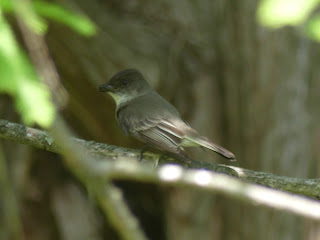
Eastern Phoebe Eating an Insect
Image
It looks like this Eastern Phoebe has caught a meal. Could it be a wasp? Although phoebes are tyrant flycatchers , I'm pretty sure they'll eat most insects including the hymenopterans . I think I see: A little bit of striping on the thorax, suggesting 1 of many bees/wasps or their mimics. An insect a little longer than a honeybee or bumblebee. This was the 2nd year in a row that I got a picture of a phoebe with food in its mouth . While we (correctly) think of phoebes as birds posing no threat to us, to many insects they are giant, ferocious predators. The Eastern Phoebe is almost certainly the tyrant flycatcher species I encounter the most, though Eastern Kingbirds and Great Crested Flycatchers aren't too hard to find either. May 18, 2023 at Willowwood Arboretum Photo 292812711, (c) jpviolette, some rights reserved (CC BY-NC)
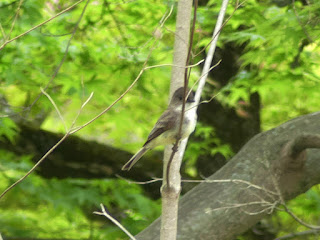
Hiding Eastern Phoebe?

Image
Here's an Eastern Phoebe I met last spring. Does the phoebe think it's hiding behind that twig? Probably not, though it's hard to get into the brain of a bird and figure out what they're thinking. Perhaps a small bird could misinterpret a small twig to be providing more protection than a human would attribute to it. Although gnats are a subset of flies , there is not really a corresponding relationship between gnatcatchers (like the Blue-gray Gnatcatcher ) and the tyrant flycatchers (like the Eastern Phoebe) [1]. And their names are both somewhat misleading, with gnatcatchers and many flycatchers being general-purpose insectivores rather than gnat and fly specialists. May 3, 2023 at Duke Farms Photo 278557410, (c) jpviolette, some rights reserved (CC BY-NC) [1] Though gnatcatchers and flycatchers both passerines , so are crows, sparrows, warblers, and many more.

Eastern Phoebe

Image
Here's another Eastern Phoebe , one of our most commonly seen tyrant flycatchers . I've talked about these birds before  but will try and augment that with information from What It's Like to Be a Bird (Sibley). These birds are tail-pumpers; you'll sometimes see them pumping their tail up and down. This is the way that phoebes tell predators "I see you. You're not sneaking up on me, and trying to attack me is just going to waste both our time/resources." (This does suggest that if you see the tail pumping, the bird's interpreting you as a predator.) Phoebes like to build nests in niches, under overhangs, and protected ledges. They are also one of the relatively few birds that reuse their nests in the same season. Most birds don't reuse nests in this way because parasites can accumulate there, but because phoebes are fairly particular about what they consider to be a good nesting location, they're probably forced to reuse nests in those good loc...

The Unknown Flycatcher

Image
Sometimes you get a pretty good picture of a bird but can't get a definitive identification. When I saw this bird I got an Eastern Phoebe vibe, probably because they're one of the flycatchers I see the most. (I also see quite a few Eastern Kingbirds , but their sharp dark-and-white plumage contrast immediately ruled them out.) Usually when I post these to iNaturalist , I have a pretty good idea of what the animal is, and usually iNaturalist confirms my identification with its identification suggestions. On this particular day, however, the iNaturalist suggestions weren't working, so I just went with my initial thought. I was a little surprised to see responses suggesting smaller but similar-looking flycatchers. When this happens, I do what I normally do: I post the picture to the What's This Bird FB page , run by the American Birding Association. Though I've sometimes seen some spirited debates there, almost all the time they settle on an identification pretty quic...

Eastern Phoebe With Lunch

Image
Here's what I believe to be an Eastern Phoebe eating lunch. (Some of the other tyrant flycatchers can look pretty similar.) I've certainly talked about Eastern Phoebes before (if you're looking for a phoebe phactoids). As flycatchers, these birds certainly have flying insects on their menu. My impression is that they're perfectly happy to eat spiders, ticks, and terrestrial insects too, though their hunting strategy generally focuses on flying insects. I'm suspicious that this little fella had some sort of wasp in its beak. (Presumably they take extra care when preying on stinging insects.) June 8, 2022 at Duke Farms Photo 209835325, (c) jpviolette, some rights reserved (CC BY-NC) June 8, 2022 at Duke Farms Photo 209835352, (c) jpviolette, some rights reserved (CC BY-NC)

Eastern Kingbird

Image
I met this Eastern Kingbird a couple weeks ago. This is a bird I usually see in a season, though rarely often. I talked a bit about them before. They're almost famous for their aggression towards other birds they consider to be a threat, including birds that are quite a bit larger than they are like hawks, crows, or herons. This tyrannical behavior is behind their scientific name of Tyrannus tyrannus. If you see a white and nearly black bird singlehandedly dive bombing larger birds, you might be seeing an Eastern Kingbird. Though they'll readily eat fruit (especially outside of breeding season), these birds are flycatchers like the Eastern Phoebe and the Great Crested Flycatcher . All 3 have closer relatives than each other, though those relatives tend to live outside New Jersey. May 18, 2022 at Duke Farms Photo 203066566, (c) jpviolette, some rights reserved (CC BY-NC)

Eastern Phoebe

Image
Here's another picture of an Eastern Phoebe , this one from last autumn. They are in the tyrant flycatcher family, so it won't surprise you that small invertebrates are on their menu. Ornithologists generally consider this to be the largest family of birds, though it's possible that the family might get split into smaller families as we learn more. Here in New Jersey we're basically at the southern edge of the Eastern Phoebe's breeding range; some of them breed well into Canada. And we theoretically don't see them in the winter, probably because of the challenges of finding invertebrates to eat in winter.  The Eastern Phoebe gets its name from its "fee-bee" call, but not all fee-bees are from phoebes; the Black-capped Chickadee makes a similar sound, though with phoebes the call is shorter than the chickadee one. These birds are generally loners, coming together to breed but then generally parting ways. Though they'll certainly catch flies, why a...

Eastern Phoebe

Image
Here's an Eastern Phoebe I recently met. This is another "harbinger of spring" bird; I'm a little too far north to see these birds year round (barring the occasional rebel bird that doesn't go along with the rest of its species). It's in the tyrant flycatcher family of birds, the largest bird family. As you'd expect for a flycatcher, the Eastern Phoebe specializes in eating little arthropods. (They may look cute to you, but to a mosquito this is like having Jaws bearing down on them.) They are considered hardier than most flycatchers, returning north sooner than most of their (extended) family. They get their name from their vocalization, which sounds sorta like "phoebe". April 3, 2021 at Duke Farms Photo 120284207, (c) jpviolette, some rights reserved (CC BY-NC)