Posts

Showing posts with the label golden-backed snipe fly

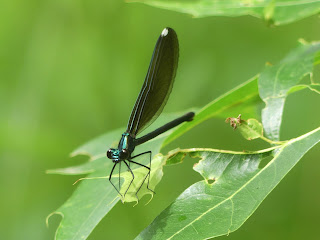
Ebony Jewelwing

Image
From Common Jewelweeds to Ebony Jewelwings  (not to mention Ruby-throated Hummingbirds ,  Golden-backed Snipe Flies , Great Golden Digger Wasps , and Silver-spotted Skippers ), there's treasure out in nature. These damselflies (relatives of, but not dragonflies) are likened to jewels because of the blue-to-green sheen that the males have. (Females look similar except they lack the sheen.) Odonates seem to have different preferences regarding perches. Many like low branches over water, others like hanging on reeds at/near water, a few are happy on the ground, and others seem content near to top of smallish plants. I'll frequently see Common Jewelwings on the leaves of low-hanging trees and shrubs. (Of course there are places they could be hanging out that I wouldn't notice, like if they enjoyed the top of tree canopies.) June 21, 2023 at Fairview Farm Photo 301211287, (c) jpviolette, some rights reserved (CC BY-NC)

Yellow-collared Scape Moth

Image
Here's another moth I met at the Duke Farms mothing program, the Yellow-collared Scape Moth . At the risk of being ridiculed, when told the name of this moth I actually confused it with the Golden-backed Snipe Fly . ( Lepidopterists and and dipterologists are laughing at me even if you're not.) Apparently these guys are active during the day but (as in this case) will check out lights during the night. You may be able to spot them doing regular pollinator stuff, hanging out around flowers looking to score some nectar. As caterpillars they'll eat grasses and sedges (plants that sort of look like grasses but aren't). They can be mistaken for the Virginia Ctenucha , a moth in a different genus but in the same subtribe so they are fairly close relatives. The main difference is that the Virginia Ctenucha has a yellow or orange head in addition to the collar. August 20, 2021 at Duke Farms Photo 157559099, (c) jpviolette, some rights reserved (CC BY-NC)

Golden-Backed Snipe Fly

Image
Here's an insect I met a couple months ago, the Golden-backed Snipe Fly . They're small enough to get overlooked by people, though they're almost certainly larger than the average fly. I think the yellow/gold thorax and striped abdomen makes them among our better-looking flies, and certainly makes them distinctive looking. While some snipe flies bite large mammals (including us), the Golden-backed is believed to eat small arthropods like aphids. I doubt they're large or numerous enough to clear aphids off your milkweed plants, though every little bit helps. This picture is probably of a male since the eyes are large and nearly touching. The females look similar but the eyes are smaller and further apart. May 28, 2021 at Duke Farms Photo 133215205, (c) jpviolette, some rights reserved (CC BY-NC)