Posts

Showing posts with the label odonate

Two Different Bluets

Image
A fair amount of the time when I see similar-looking creatures in the same picture they turn out to be of the same species, but in this case we have a Familiar Bluet (top) and a Skimming Bluet (below). Frequently I'll use the presence of a distinctive male bird to identify a far less distinctive but nearby female bird. And the dark bird among the European Starlings is usually ... another starling! But this isn't a perfect strategy. At a casual glance you might think these are the same species. You might even think that the extra blue on the top bluet is just natural variation. But there are times when these instincts lead you astray, and the odonate world is probably 1 of them. All damselflies and dragonflies lay eggs in water, so a good body of water frequently attracts multiple species, and at least some of them look similar. In our defense, sometimes the odonates themselves get confused; some of them will chase of "rivals" that don't really compete against t...
Bluets of a Different Color

Image
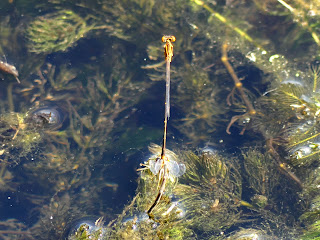
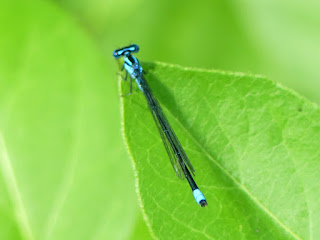
In contrast to the (frequently vividly) blue bluets I posted Wednesday and Thursday (and earlier ), I also saw a pair of  Orange Bluets  in tandem last spring. You might be thinking: "If it's orange, it should be called something else, like an oranget or something". Let me defend the name a bit: The bluets are their closest relatives, and while it's a little unfortunate that the genus was named after a trait this particular species doesn't have as adults, there are more egregious naming problems out there [1]. As you might have picked up on from the preceding bullet item, immature Orange Bluets actually are a pale blue, though they outgrow it by the time they're ready to breed. In some other species of bluet, only the males are blue. The Orange Bluet isn't the only bluet where the males are not blue either. In my area the Vesper Bluet (yellow) and the Scarlet Bluet (see if you can guess their color) are the other non-blue bluets. I suspect this partic...

A Bunch of Bluets

Image
If all the IDs I got are correct [1], here are 3 different bluets I met last spring. Bluets are damselflies , and most of the time the males have some bright blue coloring. I will try and provide the rationale for these identifications: These damselflies are all about the same size, so even if they had agreed to be measured I might not be able to ID them from the measurement. The Skimming Bluet is 1.0-1.1", the Turquoise Bluet is 1.1-1.2", and the Slender Bluet is 1.2". And each of them has blue on abdominal segments S8-S9, which are the ones almost at the end. All these bluets are considered "common", so it wouldn't be surprising to see any of them in New Jersey. All of them are active in June. And although my field guide suggests that the Slender Bluet isn't in Somerset County, 1) They are known to be in the counties north and south of Somerset County, and 2) My field guide is from 2009, so it might not reflect the exact location of current popula...

Ebony Jewelwing

Image
Here's another familiar face that's pretty common in New Jersey, an Ebony Jewelwing . No other damselfly  [1] around here has all-black wings [2], so they're among the easiest odonates to identify around here. While I think the Common Whitetail was the first dragonfly I learned to identify, I'm almost certain that the Ebony Jewelwing was the first damselfly I learned to identify. Although they are predominantly black (providing the "ebony" part of their name), the males will frequently also show a blue/green metallic sheen (which is probably where the "jewel" part of their name came from). Like all odonates, the Ebony Jewelwing is a predatory flying insect. I'm not sure they're big enough to prey on deer flies or horse flies, they probably do take down some insects we regard as pests. I frequently find odonates in areas where flies/gnats are plentiful; it makes sense that they like to be around their food source. Here's the 1st picture I...

Eastern Pondhawk

Image
Here's an Eastern Pondhawk staring right at me. Most insects seem to either flee from us or ignore us, but odonates (and mantises) will sometimes look right at you. Though they may appear to be curious, I suspect they're actually engaging in some sort of threat assessment when they look at us. (Though Eastern Pondhawks are considered voracious predators, and will attack larger prey than most odonates, I'm confident that they realize I'm way too big to eat.) Though this one was on some sort of stick, these dragonflies are more comfortable on the ground than most odonates.  July 23, 2021 at the Plainsboro Preserve Photo 148591900, (c) jpviolette, some rights reserved (CC BY-NC)

Violet Dancer

Image
Here's a Violet Dancer I met earlier in the year at the Plainsboro Preserve. The dancers aren't dragonflies; they're damselflies. Like most damselflies, they have very thin abdomens and they hold their wings straight up when at rest. And while many odonates like to rest on higher perches, the dancers seem to prefer resting on the ground instead. Numerous places consider this to be our best-looking damselfly, almost certainly because of the almost unique light purple coloring of the males. Though they're a little on the small side, their color can get the attention of the careful observer. Though my field guide says they're uncommon, I've seen them at least 8 times over the last 4 years, and I've seen them in at least 5 different locations.  June 17, 2021 at the Plainsboro Preserve Photo 141958266, (c) jpviolette, some rights reserved (CC BY-NC)

Eastern Pondhawks

Image
Here are a couple Eastern Pondhawks I met. I'm posting them together to show the way sexual dimorphism manifests itself in this skimmer dragonfly species. They are about the same size and with mostly transparent but veiny wings. But while the body of the females is bright green other than the black stripes on the tail, the males are a light, powdery blue. Note that I called them skimmer dragonflies; this means they're in the same family as the Widow Skimmers I've shown earlier. The Eastern Pondhawk is considered a fairly aggressive dragonfly in that it will attempt to prey on most insects its own size and smaller, including other odonates (odes for short, and consisting of dragonflies and damselflies). Note that both these pondhawks were found at Duke Farms on the same day, the pictures were taken a while apart, and there's no reason to believe they were a couple. July 14 at Duke Farms July 14 at Duke Farms