Posts

Showing posts with the label ring-necked duck

Bluets of a Different Color
Image
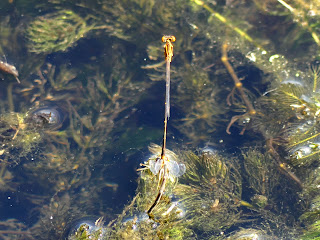
In contrast to the (frequently vividly) blue bluets I posted Wednesday and Thursday (and earlier ), I also saw a pair of  Orange Bluets  in tandem last spring. You might be thinking: "If it's orange, it should be called something else, like an oranget or something". Let me defend the name a bit: The bluets are their closest relatives, and while it's a little unfortunate that the genus was named after a trait this particular species doesn't have as adults, there are more egregious naming problems out there [1]. As you might have picked up on from the preceding bullet item, immature Orange Bluets actually are a pale blue, though they outgrow it by the time they're ready to breed. In some other species of bluet, only the males are blue. The Orange Bluet isn't the only bluet where the males are not blue either. In my area the Vesper Bluet (yellow) and the Scarlet Bluet (see if you can guess their color) are the other non-blue bluets. I suspect this partic...

Ring-necked Duck Suitors?

Image
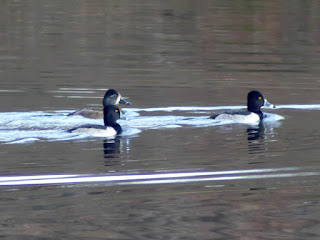
Here's a trio of Ring-necked Ducks I saw last March. Though they don't typically breed here in NJ, my impression is that they start pairing up over the winter. But seeing 2 males (the black-and-white ducks) following 1 female (the earth-toned duck) makes me suspect that these 3 haven't entirely worked out their relationships yet. (I can't judge whether the female Ring-necked Duck is considered especially vivacious/attractive, garnering extra attention.) Though ducks are considered monogamous within a breeding season, the next season they're likely to pair up differently, so every year the males need to audition for the privilege of being a dad. March 17, 2023 at Duke Farms Photo 267711174, (c) jpviolette, some rights reserved (CC BY-NC)

Buffleheads

Image
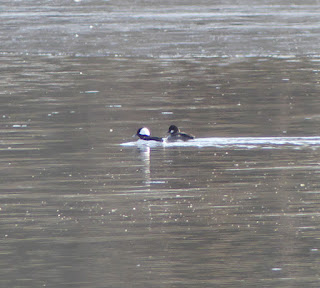
Here are some more winter ducks that you shouldn't expect to see when things warm up: Buffleheads . They're not around my area in big numbers, and most of my pictures were taken in the fall of 2020. They're small ducks [1] that are mostly black and white, so at a distance they probably blend in inconspicuously with Ring-necked Ducks and Hooded Mergansers , though their closest relatives in this area is the Common Goldeneye . The females have black heads and back with a white patch around their cheeks. A male without its breeding plumage looks similar, though the white patch is a bit larger. A male in breeding plumage though has that white patch expanding to cover pretty much all of the back of the head. These are considered one of our most monogamous ducks, so barring a death there's a pretty good chance these 2 were a couple. February 17, 2020 at Washington Valley Park Photo 66501906, (c) jpviolette, some rights reserved (CC BY-NC) [1] The only native duck that's ...

Ring-necked Ducks

Image
This was the 2nd picture I got this past season of Ring-necked Ducks . (The 1st picture wasn't a good but you can look at it if you want to.) You might be thinking "I don't see any rings on the necks - this must be a misidentification", buf  if you were close enough you would see a ring around the neck (even though it's difficult/impossible to see from a distance). This is certainly one of those instances where the bird got its common name from someone seeing the bird up close, and they almost certainly got that close look because the bird was dead. I was (mildly) victimized by these ducks being named after such a subtle physical trait. Years ago when I saw them, got some pictures, and attempted to identify them, I got to a webpage listing the names of all the ducks in my area. As I went down the list, I skipped right over the link for Ring-necked Ducks because I felt certain there was no ring around their neck. This led me to erroneously believe that the best fi...

Redhead

Image
Here's a Redhead duck I've seen this winter at the Duke Farms Reservoir. The reservoir usually has a pretty good population of Ring-necked Ducks out there, though usually far enough out that you just see little black-and-white ducks. Sweeping over them with my binoculars, I kept seeing a little bit of red out there, though with all the movement (including diving underwater and other ducks getting in the way) it took a while for me to confirm that one of those ducks was not like the others. Over the next week I took a crapload of pictures, though the first set turned out the best (presumably because the ducks were a little closer to shore that particular day). We're apparently far enough south to be considered a winter migration home, though not far enough south to be genuinely popular with Redheads. Some of them breed due north of us in southern Canada, though it's more common for them to breed in the northern midwest. This fella (a female wouldn't have a red head...