Posts

Showing posts with the label honey locust

The Shiny Blue Bird

Image
Though a number of our local birds have blue plumage [1], the Tree Swallows are almost certainly the shiniest. While some birds are bluer (like Indigo Buntings , Blue Grosbeaks , and probably Blue Jays ), when you factor in the shine, you get a Tree Swallow [2]. I'm pretty sure those thorns indicate this fella was in a Honey Locust tree. I don't know if it's a favorite perch for this bird, but it might be a little safer there than elsewhere. I suspect that any climbing predator would need to take care to avoid those dangerously sharp thorns. Of course, this tree provides little protection from an aerial attack from a hawk. Since the males are generally bluer/shinier, this is almost certainly a male. May 14, 2023 at Duke Farms Photo 292808063, (c) jpviolette, some rights reserved (CC BY-NC) [1] But they don't have blue pigment; their blue plumage is dependent on their feather structure to reflect the blue light hitting them. [2] At least that's true for New Jersey...

Kentucky Coffeetree

Image
For Throwback Thursday let's take a look at a tree that's not native to NJ but is native to the US. The Kentucky Coffeetree  originally comes from the midwest; despite having Kentucky in its name, it looks like they're much more widespread in Missouri/Illinois/Indiana. Kentucky Coffeetrees are trees in the legume family . This means that a Kentucky Coffeetree is more closely related to a string bean plant than it is to oaks, hickories, or maples. But they do have tree relatives; just in this area, Honey Locust , Black Locust , and Eastern Redbuds are fellow legume trees. I also talked about legumes in this American Senna post . Of the legume trees around here, the Kentucky Coffeetree is the one that produces the most robust pods with the largest seeds. They're supposed to be poisonous, though in theory you can roast them and then make a non-caffeinated beverage from them. March 5, 2022 at Duke Farms Photo 6535361, (c) jpviolette, some rights reserved (CC BY-NC) March 5...

Tattered Red Admiral

Image
Here's a Red Admiral butterfly that looks like it could win a tattered wing contest. I'd like to think the butterfly has some harrowing and exciting stories to tell like in the scar comparisons in Jaws : This tear here, I got that shortly after pupating. A starling got the end of my right wing in its beak. I'd have been a goner, but when the starling was focused on me, that hawk came down on the starling. I lost part of my left rear wing when that praying mantis grabbed at me. If he'd have gotten my abdomen instead of my wing, I wouldn't be talking to you here today. The rest of that wing I lost in the web of a spider. If it hadn't been torn already, I'd never have been able to escape that web before that spider got to me. That one there, a robberfly had me for a second, but let go when that starling appeared and ate the robberfly. Funny how sometimes a starling saves you and sometimes tries to eat you. And this one got ripped when a dragonfly tried to eat ...

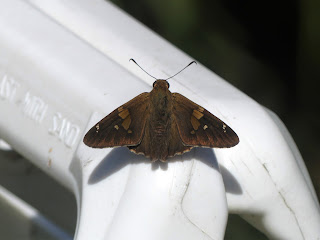
Silver-spotted Skipper

Image
Where's the silver spot [1] on this Silver-spotted Skipper ? It's (almost certainly) there, but it's really only visible on the underside of the wing. Many times these butterflies rest with their wings held up, and their silver spot actually is a pretty prominent field mark. I don't know if this particular skipper was trying to maximize its exposure to sunlight, but it had the wings held down, and the silver spot isn't in evidence. If you only see this angle, it can make identifying this butterfly trickier. Despite this view, the silver spot gives this butterfly a reputation as the country's most recognizable skipper. [2] Most of the skippers I meet are grass skippers , where the caterpillars feed on some sort of grass. Silver-spotted Skippers are definitely not in this group; their caterpillars eat plants in the legume family like Black Locust , Honey Locust , and wisterias . (Like good children, their caterpillars eat their vegetables.) The Silver-spotted Skip...