Posts

Showing posts with the label obligate brood parasite

Female Brown-headed Cowbird

Image
Like quite a few birds, this bird is easier to identify when spotted with her significant other ; she's a Brown-headed Cowbird . Due to their tendency to be monogamous plus plain old birds-of-a-feather behavior, I usually see them with prominently brown-headed males around, greatly improving my confidence in IDing them. My understanding is that Brown-headed Cowbirds are the only obligate brood parasites in my area. Obligate brood parasites have essentially lost all their parenting skills, and thus if they were ever unable to fool other birds into raising their young, they would (almost certainly) go extinct [1]. There are, however, other brood parasites in New Jersey. These are called facultative brood parasites, and these birds will usually raise their own offspring, but will also engage in brood parasitism. (Exactly when birds perform facultative brood parasitism seems variable; one source said it occurred when resources were scarce while another said it occurred when resource...

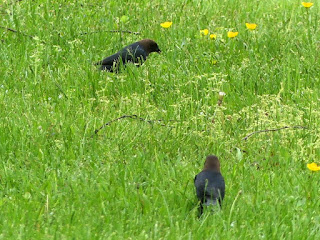
Brown-headed Cowbird Couple

Image
I'm assuming this was a Brown-headed Cowbird couple, though being obligate brood parasites (I've talked about that here ) we don't see obvious couple behaviors like nest-building or nestling-feeding. (I was a little surprised to learn that Brown-headed Cowbirds tend to be monogamous, since after mating it's unclear that a pair needs anything from their partner.) While the males tend to be black with brown heads, the females are more of a beige color. (She might look light gray to you, perhaps due to the lighting.) It should be pretty easy to identify each in the picture below. What's Mrs. Cowbird saying? Perhaps she's warning her mate that my camera and I are in the vicinity. Or maybe she's telling him to pick up some grasshoppers for dinner if he's heading out. June 12, 2022 at Duke Farms Photo 209946491, (c) jpviolette, some rights reserved (CC BY-NC)

Brown-headed Cowbird

Image
Here are a couple Brown-headed Cowbirds I met last month. As I recently mentioned while discussing Field Sparrows, these birds are obligate brood parasites , birds that lay their eggs in the nests of other bird species and wouldn't even know how to raise their own young. There's a theory that they developed this strategy so the cowbirds could follow the Bison herds, feeding on the insects the Bison stirred up. They couldn't take care of a stationary nest and also follow those Bison around, or so the theory goes. Of course with relatively few Bison around these days, the cowbirds have taken to hanging around cow herds. (I actually see them on lawns quite a bit too.) Brown-headed Cowbirds have been known to lay eggs in over 100 different species of birds. Different species react in different ways to the parasitism, ranging from not incubating the egg, expelling the egg, abandoning the nest completely, or unknowingly raising the cowbird as their own. Some species raise their ...

Field Sparrow

Image
Unsurprisingly I met this Field Sparrow in a field, or at least a grassy area mowed through a field. A pinkish bill (which doesn't show up great in the picture), white eye-ring, and uniform breast plumage help us identify these sparrows from most its sparrow relatives. (Do not identify every sparrow you see in a field as a Field Sparrow.) Unlike some birds, Field Sparrows are committed to their fields, and don't adapt to urban or suburban life. When fields disappear, their habitat shrinks. This is believed to be the primary reason their populations are declining. Field Sparrows are unfortunate victims of Brown-headed Cowbirds . The cowbirds are obligate brood parasites , meaning that over time they've lost the ability to raise their own young. Instead, they sneak their eggs into the nests of other birds (including but not limited to the Field Sparrow). The cowbird egg gets cared for by the other bird parents, generally hatches first and either pushes the other eggs out of ...