Posts

Showing posts with the label eastern gray squirrel

Fur-birds?

Image
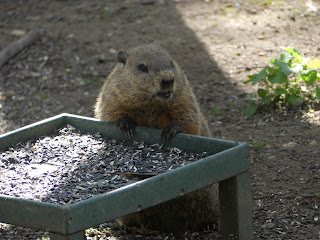
Last spring at the Plainsboro Preserve I noticed a couple of unusual "birds" at their bird feeders [1]. What was especially unusual about these birds was that their wings looked more like forelegs, and that their plumage had a furriness that you rarely see in adult birds [2]. I'm still struggling to ID them [3].

Foraging Gray Squirrel

Image
Back in early March I got a picture of this Eastern Gray Squirrel (by far the easiest squirrel to find in this area) foraging in a thicket. I'm not sure if the squirrel thought this was my bush; it looks a little guilty in there.  I'm not sure what this squirrel was eating, though those look more like buds than berries to me. And as I've mentioned in the past, squirrels will eat the buds of some plants. March 6, 2023 at the Duke Island Park Photo 267704526, (c) jpviolette, some rights reserved (CC BY-NC)

Brain-eating Squirrel?

Image
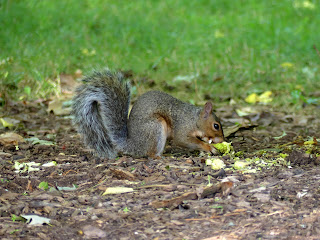
No, this isn't a post about the threat of zombie squirrels; it's just a regular old Eastern Gray Squirrel eating an Osage Orange (nicknamed "monkey brains"). My understanding is that squirrels will poke around in the (sticky, messy) Osage Orange fruit, eating the seeds while discarding the latexy flesh of the fruit. (There seems to be some Osage Orange debris on the ground near the squirrel.) I don't actually witness this very often though, perhaps because I'm not around Osage Orange trees most of the time. September 27, 2022 at Duke Farms Photo 248785674, (c) jpviolette, some rights reserved (CC BY-NC)

Eastern Gray Squirrels

Image
Here are a couple of  Eastern Gray Squirrels ready for action, all set to jump or scamper depending on what I do. Although they don't necessarily stay in poses like these for long, squirrels are frequently found in poses resembling superheroes . Another interesting thing about Eastern Gray Squirrels is that they're not necessarily gray. In fact, a little south of me the Princeton campus is known for its melanistic squirrels , basically Eastern Gray Squirrels with black coloring. It's possible that black squirrels have a slight camouflage advantage in coniferous forests which tend to be darker than deciduous forests, and it's possible they have a slight thermoregulation advantage where it's very cold. It's less clear why they seem to have carved out a home in Princeton. While they're too common to get excited about from a naturalist perspective, squirrels can be entertaining to watch. January 6, 2022 at Duke Farms Photo 176178635, (c) jpviolette, some right...
American Red Squirrel

Image
Here's an American Red Squirrel I met last fall. Though smaller and less common than our Eastern Gray Squirrels, the ARS is considered a feisty competitor for the EGS. And while we think of squirrels being all about the nuts, the ARS is more omnivorous than you'd probably expect, and will raid bird nests if given the opportunity. Despite similar-looking fur, the American Red Squirrel isn't especially closely related to Eurasia's Red Squirrel . The Eurasian Red Squirrel is actually under threat from an invasive species, our Eastern Gray Squirrel, which is taking over the ERS's territory. This is one example of one of our native species that becomes a dangerous invasive animal elsewhere. I suspect that if I paid more attention to squirrels in general, I'd probably see more of our ARSs. But since most of the squirrels I do see are the extremely common EGSs, I do fall into the habit of ignoring them unless they're doing something special. November 27, 2021 at D...

Eastern Gray Squirrel

Image
Here's an Eastern Gray Squirrel that's apparently eating the buds off of this maple tree. We all associate squirrels with eating nuts and acorns, but late winter isn't exactly a boom time for these food sources. At this time trees were starting to bud out, creating a new food source plentiful. As anyone with a bird feeder knows, squirrels are more than willing to eat the grains and other seeds in bird food. But most squirrels are pretty omnivorous, eating lots of food many of us wouldn't expect. If you're experiencing the Brood X Cicadas, don't be shocked if you see your squirrels chowing down on a few of them. Just like the nuts and acorns squirrels eat, most of the time trees can handle having some of their buds eaten like this. March 9, 2021 at the Raritan River Greenway Photo 126903994, (c) jpviolette, some rights reserved (CC BY-NC)