Posts

Showing posts with the label ebony jewelwing

Light-eyed Ebony Jewelwing

Image
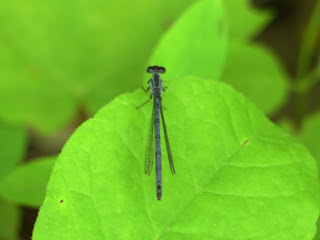
This is an unusual Ebony Jewelwing . I usually see them with black eyes, not these orange/tan ones. Though I hadn't noticed them before, these eyes aren't without precedent . Apparently eyes of this color indicate an immature Ebony Jewelwing; as they age it'll look more like 1 of these . What's trickier is trying to figure out if this is a male or a female: I think I see a sheen that's more prominent with males, but females can also have some sheen. The wings should be darker in a male, though they should also have a small-but-noticeable white spot in a female. My impression is that there should be some sign of that white spot if this was a female. Male damselflies have "claspers" at the end of their abdomens used during breeding. If I had to guess, I'd say that I see claspers on this individual, but the picture doesn't provide a good look at the (admittedly small) end of the abdomen. MS Copilot and Google Gemini seem to suggest that the absence of...

Photogenic Ebony Jewelwings

Image
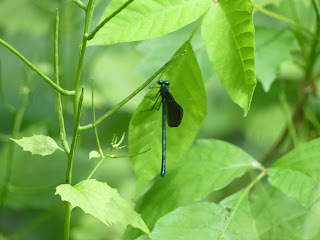
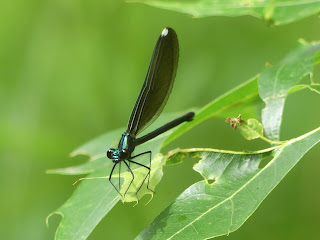
Here are 2 of the (many) Ebony Jewelwings I met last summer, the 1st a male and the 2nd a female. This mail is a shinier blue than I usually see in the Ebony Jewelwing males. The females generally aren't shiny though they still have a little white spot on the end of the wings. Both are fairly photogenic (if you like damselflies). These pictures were taken pretty close to the same time so it's entirely possible they met each other. Did they breed? That's less likely just because there were quite of few of these damselflies in this area both of them had plenty of other options available to them. July 3, 2023 at Sourland Mountain Preserve Photo 301258732, (c) jpviolette, some rights reserved (CC BY-NC) July 3, 2023 at Sourland Mountain Preserve Photo 301258760, (c) jpviolette, some rights reserved (CC BY-NC)

Ebony Jewelwing

Image
From Common Jewelweeds to Ebony Jewelwings  (not to mention Ruby-throated Hummingbirds ,  Golden-backed Snipe Flies , Great Golden Digger Wasps , and Silver-spotted Skippers ), there's treasure out in nature. These damselflies (relatives of, but not dragonflies) are likened to jewels because of the blue-to-green sheen that the males have. (Females look similar except they lack the sheen.) Odonates seem to have different preferences regarding perches. Many like low branches over water, others like hanging on reeds at/near water, a few are happy on the ground, and others seem content near to top of smallish plants. I'll frequently see Common Jewelwings on the leaves of low-hanging trees and shrubs. (Of course there are places they could be hanging out that I wouldn't notice, like if they enjoyed the top of tree canopies.) June 21, 2023 at Fairview Farm Photo 301211287, (c) jpviolette, some rights reserved (CC BY-NC)

Eastern Forktail

Image
Though some of the larger damselflies (like the Ebony Jewelwing ) are easy to spot by anyone paying attention, I'll frequently see some smaller ones like this Eastern Forktail . Unfortunately the small size of most forktails makes it easy to lose sight of them, especially when they're not moving. They get the forktail name because for most of these species the males have a slightly forked tip at the end of their abdomens but given their small size this characteristic probably won't be easily spotted if you run across one. This is a heteromorphic female forktail, which my field guide [1] defines as a "dull morph in female odonates with 2 color morphs". Some other Eastern Forktails are considered andromorphic, defined as "bright (usually male-like) morph in female odonates with 2 color morphs". These terms are apparently only used when females have 2 different morphs; if a species has no colorful morph in the females they aren't all called heteromorp...

Ebony Jewelwing

Image
Here's another familiar face that's pretty common in New Jersey, an Ebony Jewelwing . No other damselfly  [1] around here has all-black wings [2], so they're among the easiest odonates to identify around here. While I think the Common Whitetail was the first dragonfly I learned to identify, I'm almost certain that the Ebony Jewelwing was the first damselfly I learned to identify. Although they are predominantly black (providing the "ebony" part of their name), the males will frequently also show a blue/green metallic sheen (which is probably where the "jewel" part of their name came from). Like all odonates, the Ebony Jewelwing is a predatory flying insect. I'm not sure they're big enough to prey on deer flies or horse flies, they probably do take down some insects we regard as pests. I frequently find odonates in areas where flies/gnats are plentiful; it makes sense that they like to be around their food source. Here's the 1st picture I...

Ebony Jewelwing

Image
Here's probably the first damselfly I learned to identify, the Ebony Jewelwing . They're pretty common in the places I go that are near water. Depending on the lighting, the males can look mostly black or have a metallic sheen (usually blue or green) like in the picture below.  The females are black but lack the shininess. Like all damselflies and dragonflies, they're predatory. Though they'll sometimes stare straight at you, I can't believe they're sizing us up as a meal; I'm pretty sure they're watching us for their own safety. May 28, 2021 at Duke Farms Photo 133214083, (c) jpviolette, some rights reserved (CC BY-NC)