Posts

Showing posts with the label northern red-bellied cooter

Egg-laying Painted Turtle
Image
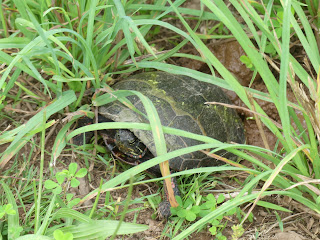
I'm pretty sure this Painted Turtle was out of the water and in loose sandy soil in order to lay eggs. (This picture doesn't show the carapace scutes well enough to tell if she's an Eastern Painted Turtle , though they are our most common subspecies of Painted Turtle.) There is another possible explanation for this turtle's presence, though it's also related to egg-laying. Apparently females will sometimes create a false nest, presumably to frustrate the many animals (like foxes, snakes, crows, raccoons, even some squirrels - basically any carnivore/omnivore that can find the eggs) that will eat turtle eggs. Sadly for turtles, a large number of them never get past the egg phase of their development. Our Eastern Painted Turtles don't lay a lot of eggs; usually a clutch will have around 5 eggs. Particularly large Painted Turtles generally lay more eggs at a time. This particular turtle seemed a little small so I wouldn't expect much more than 5. She might lay...

Red Admirals Basking in the Springtime Sun

Image
If you're an ectotherm like these Red Admirals (or an Northern Red-bellied Cooter ), nothing warms your heart like sunlight. Be careful about lumping all lepidopterans into the ectothermic camp though; some winter moths are actually considered endothermic . Back when I was a kid we were taught that all birds and mammals were endotherms and every other animal was some sort of ectotherm, which is a mostly-but-not-entirely true simplification. Red Admirals though do fall squarely into the ectotherm camp; they're not someone you'll meet in the winter. Note that these butterflies look fairly different, with the 2nd picture having faded coloring and somewhat ragged hind wings. It sounds like Red Admirals can brumate as adults, so it's possible that the 1 in the 2nd picture survived the winter while the 1 in the 1st picture may have emerged from its chrysalis within the last month. Remember, they got the "admiral" part of their name because they were admired , not...

Northern Red-bellied Cooter in the Springtime Sun

Image
If you're an ectotherm  (AKA cold blooded [1]) like this Northern Red-bellied Cooter , nothing warms your heart like the sun. By late May (I'd imagine) all turtles are out of brumation , but temperatures may still be cool, inspiring turtles to warm themselves in the sun quite often [2]. I'm thinking this individual is a female since the plastron looks way more orange than pink . (Yes, in this case pink is for boys.) May 25, 2023 at Duke Farms Photo 292818095, (c) jpviolette, some rights reserved (CC BY-NC) [1] It sounds like actual scientists don't use warm blooded and cold blooded since there are also mesotherms that regulate body temperature a little bit between ectotherms and endotherms . [2] Unfortunately, as eager as they might be to sun themselves, they're still more than willing to dive in the water if you attempt to take their picture.

Identifying a River Cooter

Image
Here's a River Cooter along the Delaware Raritan Canal last May. I'm going to try and explain how I arrived at this identification. Despite living in New Jersey, they're not documented in my Field Guide to Reptiles and Amphibians of New Jersey [1], so I went to the internet for some basic information . Here's what I can tell you: The plastron is yellow, not reddish-orange (female) or pink (male) that you would expect to see in a Northern Red-bellied Cooter . Also, Northern Red-bellied Cooters frequently have jet black heads and necks, while this turtle has noticeable yellow there. The carapace lacks the prominent lines around the scutes that you'd see in a Painted Turtle . It also lacks the rich tapestry of lines on the head/neck that you'd see in a Common Map Turtle . A Red-eared Slider normally has a prominent red blotch about where you'd expect an ear to be, and a Yellow-bellied Slider should have a prominent yellow blotch in that same spot. I also thi...

Pond Slider Moves Up

Image
This Pond Slider is determined to get to the top, and it doesn't care who it has to step on to get there. In this case it's climbing on the back of a Northern Red-bellied Cooter . Though I've seen other species of turtle do this climbing thing, Pond Sliders have some reputation for being aggressive (or at least obnoxious). There are 2 subspecies of Pond Slider here in New Jersey and it's a little difficult to tell which 1 this is: Usually the Red-eared Slider has a pretty obvious red mark on its ear [1]. This picture is a little inconclusive though, with what I think is a slightly reddish tint blending in with the dark head.  The Yellow-bellied Slider lacks the red "ear", which I initially thought was the case for this turtle. They're also supposed to have wide yellow stripes on the side part of their plastron; this turtle looks to have fairly thin yellow stripes instead. My field guide suggests that there are a small number of Red-eared Sliders withou...

Personal Space and Turtles

Image
It's just barely spring, the weather's warming up, you want a place with ample sunlight but with easy access to water. For many turtles, this means there's some competition for a good log. I haven't seen fights over a log spot, but I'm some pushing, shoving, and even climbing atop other turtles certainly occurs. In this picture it looks like 6 Eastern Painted Turtles , 1 Red-eared Slider (in the middle, and with the red "ear"), and (probably) 1 Northern Red-bellied Cooter (the big 1 at the top). FWIW the (non-native) Red-eared Slider is considered a pushy species, though I do wonder about their ability to push around the usually-larger cooters. And AFAIK the more abundant Painted Turtles don't team up to help 1 another against the other species. Though it seems a little crowded, this is the general solution for turtles looking for some springtime sun. March 26, 2023 at the Raritan Water Power Canal Photo 269672785, (c) jpviolette, some rights reserve...

Turtle "Moms"

Image
Here's something I've heard frequently in turtle hotspots where a large turtle is with a small one: "Look at the Mother Turtle and her babies!". Depending on the situation, I'll sometimes mention: Turtle moms lay their eggs and leave. It's highly unlikely that they know who their children are, making it highly unlikely they protect/guide them. In many cases, the turtles aren't even the same species. Our Northern Red-bellied Cooters tend to be larger than most of their contemporaries, and thus get interpreted as parents to the smaller species. Both of the pictures below are cases where Northern Red-bellied Cooters are with Eastern Painted Turtles . While we can't rule out that turtles might have some tenuous social relationship with other turtles living nearby, you're probably not seeing parent-child relationships out there. March 6, 2023 at the Raritan Water Power Canal Photo 269673787, (c) jpviolette, some rights reserved (CC BY-NC) March 6, 2023...

Northern Red-bellied Cooter Sex Differences

Image
I read today that there is some sexual dimorphism among our Northern Red-bellied Cooters . Though in many of our turtles the females tend to be larger, in Northern Red-bellied Cooters the difference isn't great; a large male and a medium-sized female are probably going to be about the same size, and unless you see turtles pretty close up, judging subtle size differences can be error prone. But this article suggests that it's the females that have the distinctive reddish-orange plastrons while the plastrons of the males tends to be pinkish. And my field guide says that while the sides of the females look striped, the sides of the males look more mottled. That's why I'm suspicious that the 1st turtle below is a female and that the 2nd turtle picture is of a male (with a friend). Bright orange plastron + stripey side = Female March 16, 2023 at the Raritan Water Power Canal Photo 267710927, (c) jpviolette, some rights reserved (CC BY-NC) The presumed male Northern Red-bel...

A Bale of Turtles

Image
Basking turtles - turtles who like to bask in the sun - are frequently found together, sometimes in pretty close quarters crowded on a log or a rock. Wikipedia suggests that a group of turtles is called a bale. This picture represents the Basking Big Three turtle groups [1] around here: Sliders - The top turtle is a Red-eared Slider , a species introduced to this region from other parts of the country. There are concerns that they might out-compete our truly native turtles, though right now we have plenty of other turtles. Pond Slider is the common name for the species, and around here the Red-eared Slider is the most commonly spotted subspecies. Painteds - The 2 turtles in the middle are Painted Turtles, probably Eastern Painted Turtles , our most common Painted Turtle. They have smooth (sometimes shiny) carapaces segmented into easily distinguishable scutes . Painted Turtle is the species name, while Eastern Painted Turtle refers to a particular subspecies. Cooters - The large t...

February Turtles

Image
Since today is World Turtle Day , I'm contractually obligated to talk about turtles today. 😄🐢 Though back in April I showed you some Spiny Softshell Turtles from this year, they were not the 1st turtles I saw or photographed this year. I had actually started to see turtles basking in fairly early February, albeit only on unusually warm days. Among the first I saw were 2 of our most frequently seen basking turtles , a few Eastern Painted Turtles and a Northern Red-bellied Cooter . Though sea turtles can migrate, our turtles hibernate underwater, slowing their metabolism, and using cloacal respiration and anaerobic respiration . Anaerobic respiration sounds like what kicks in when, as the winter progresses, the water slowly becomes depleted of oxygen. While it can keep a turtle alive, it sounds like they'll experience the equivalent of muscle cramps with that form of respiration. I suspect this means that they're anxious to get out of the water to breathe as soon as the ...

Spiny Softshell Turtles

Image
I found a trail near the intersection of South Bridge Street and Route 206 in Somerville. I think it's considered a part of the Raritan River Greenway that seemingly connects to the Peter's Brook Greenway [1]. I noticed some large turtles basking on the opposite side of the river, figured they were Northern Red-bellied Cooters , and followed a side trail to get a better look. As I approached (but still being across the river) most of the turtles scurried into the river. But a couple stayed on the riverbank, and they weren't cooters. They were a species I had only photographed once before at the Raritan Water Power Canal, Spiny Softshell Turtles . While my previous sighting gave me an impression of a smallish spotted turtle though, these turtles were large and (mostly) uniform in color [2]. Apparently young Spiny Softshells have spots, and some of the males retain those spots. This means my previous sighting was either young, male, or both. Interestingly, my Field Guide to ...

River Cooter

Image
Here's someone that, according to my Field Guide to Reptiles and Amphibians of New Jersey, doesn't exist here: a River Cooter . For years I didn't realize these turtles were in NJ, though iNaturalist would frequently offer this as an ID for some of my pictures. Apparently this generally southern species has been in my state for decades (though perhaps in small numbers and a few localities). Their existence does complicate the turtle identification process here, especially between the cooters and the sliders. It's not entirely clear how they got here, though some form of human introduction seems most likely. Their original range was considered to be as far north as Maryland though, so a gradual natural range expansion could also be plausible. FWIW, iNaturalist does not list them as an introduced species. I have certainly encountered their relative, the Northern Red-bellied Cooter , which is listed in my field guide as NJ's largest "basking turtle" (turtles...

Dekay's Brownsnake

Image
I'm surprised I haven't shown one of these Dekay's Brownsnakes  (aka Northern Brown Snake) before; let's remedy that today. These are small non-venomous snakes that are generally light brown or grayish-brown. They tend to have lighter coloring along the top of the back bordered by darker spots. They're usually about a foot long but slender enough that you won't think of it as big. Because of their small size they are frequently misidentified as a young version of our larger snakes. Though they have a southern relative called the Florida Brown Snake , they also have a fairly close relative here in NJ: the Northern Redbelly Snake . Unfortunately I have yet to meet a Northern Redbelly Snake (though I routinely meet Northern Red-bellied Cooters .) The Northern Redbelly Snake has a red/orange belly and is otherwise darker than the Dekay's Brownsnake, but otherwise these are pretty similar snakes. Though they're said to be secretive, on cool spring or autumn d...

Herons and Turtles

Image
Back in June I saw these two animal types in the same neighborhood. A Great Blue Heron is foraging along the shore, and a group of turtles (some are Eastern Painted Turtles , though I'm getting more of a Northern Red-bellied Cooter vibe from a couple of them) basking a short distance offshore. It's fairly common to see herons and turtles around one another. Although I'm told that Great Blue Herons will eat just about any animal they can swallow, I suspect that once a turtle reaches a certain size, both they and the herons know that the heron won't be able to swallow them shell-and-all. This is probably the reason the turtles tolerated the presence of the heron at a distance where they'd almost certainly have dived into the water if I were there instead of the heron. The turtles would be more at risk from a Bald Eagle. Eagles have the beak and talons to get around the shell problem by tearing the turtle apart. And I don't know why a Red-tailed Hawk couldn't...

Northern Red-bellied Cooter Laying Eggs

Image
A couple months ago I was on Fox Hollow Lane at Duke Farms and I saw a Northern Red-bellied Cooter who apparently laid her eggs on a cleared patch of ground. (I don't know if the vegetation was removed to make it a better location for turtle eggs or if it had another purpose.) Unless she was an outlier, she laid 5-17 eggs. They're supposed to incubate over 80 days, so they're scheduled to hatch around August 16. I may try and visit around that time, though: Duke Farms is closed to the public (Su+Mo) on August 15 and 16. We've had a fairly hot summer; it's possible that will speed up the hatching. My impression is that many predators find and eat these eggs; it's unclear there will be anything to see. May 28, 2021 at Duke Farms Photo 133214583, (c) jpviolette, some rights reserved (CC BY-NC) The mother lays her eggs and buries them. It'll initially look like a small muddy patch, though I'm sure that dries up pretty fast. Buried turtle eggs Photo 13321474...

Basking Turtles

Image
Here's a pair of turtles sharing a log. Due to the color red, both are fairly easy identifications. You can see the red "ear" on the turtle on the left, making it a Red-eared Slider . And the red plastron on the turtle on the right (plus its size) make it a Northern Red-Bellied Cooter . There are some concerns that the guy on the left, introduced to this area from other parts of the US, may crowd out our native species (including the guy on the right). The sliders are considered a more aggressive turtle, though they do have a size disadvantage compared to our cooters. When I see turtles basking in the sun, they usually turn out to be these turtles or the Eastern Painted Turtle ; currently all 3 species seem to be doing pretty well around here. May 13, 2021 at the Raritan River Greenway Photo 132037500, (c) jpviolette, some rights reserved (CC BY-NC)

Turtle Identification - Part 2

Image
After introducing some of the key things to look for in turtle identification, I want to mention the limitations of the identifications I'm doing. Most of these pictures are taken using all the magnification my camera can provide, and they still don't always provide the detail I'd like. Depending on the position of the turtle, I rarely get a view of the plastron, and if I do it's usually at the expense of a view of the carapace. If I could examine the turtle in my hands, I'd be able to do turtle identification a lot better. Having said that, the 3 middle turtles below provide a very good clue as to what they are. My field guide tells me that the Eastern Painted Turtle is the only species in NJ where "the large scutes are lined up in even rows across the carapace". From left to right, the 3rd and 4th turtles give you a good view of the scutes on the carapace lining up. These are Eastern Painted Turtles. If you look at the 2nd turtle, the scutes near the f...