Posts

Showing posts with the label great egret

Great Egret Striking a Pose

Image
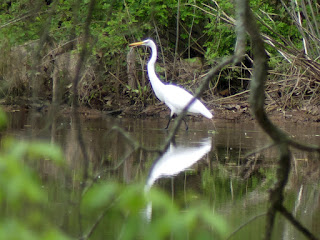
Green Herons and Great Blue Herons weren't the only herons I spotted on this day; this Great Egret struck a pose as it waded over to its fishing spot. Since there's no taxonomic difference between herons and egrets, I'm going to claim that I hit the Heron Trifecta this day. Great Egrets are, anatomically speaking, slightly short and thin Great Blue Herons, and since the Great Blue Heron has virtually no avian predators [1], the same is probably also true of the Great Egret. If a coyote or bobcat caught 1 on land, my guess it wouldn't go well for the Great Egret. In the water, there are probably somewhat rare attacks by Common Snapping Turtles , though between scavenging and eating vegetation, snapping turtles usually find easier prey. May 25, 2023 at Duke Farms Photo 292819218, (c) jpviolette, some rights reserved (CC BY-NC) [1] It sounds like Golden Eagles will sometimes prey on Great Blue Herons but Bald Eagles rarely will. Since my area is largely devoid of Golde...
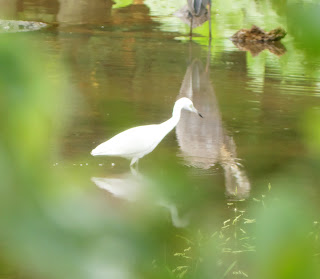
Both Blue Herons

Image
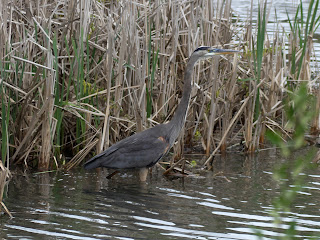
For Throwback Thursday, here's a bird I rarely encounter along with a bird I frequently encounter. The 1st 2 pictures are of a Little Blue Heron while the last picture is of a Great Blue Heron . Notice how dark all over the Little Blue Heron is, with its purple-maroon head and slaty-blue body. Wait, that's not what you're seeing? Sorry, that was a description of an adult Little Blue Heron; juveniles start out looking all white, and could be confused with a smallish Great Egret . In fact, the main reason I didn't make that mistake was because I had heard that a Little Blue Heron had been sighted here, so I was halfway to the right ID before I even saw it. Having said that, there are differences between Great Egrets and juvenile Little Blue Herons: Size: Normally I'd hesitate to even mention this since judging size from a distance can be error-prone. But in this case (see below) there was a Great Blue Heron standing nearby to use as a reference. Bill: The bill of the...

Green Heron Foraging in the Muck

Image
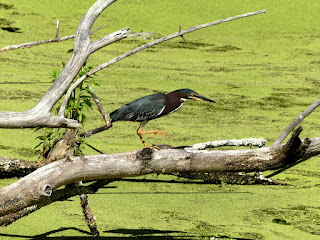
As they're wont to do, this Green Heron was standing outside the water; they prefer not to get their feet wet until they have to. Given the relatively shallow muddy water, I'm thinking the heron might have been hunting for frogs or crayfish more than regular fish. This is 1 of our 3 easiest-to-spot herons, and the only 1 without "great" in their name: Great Blue Heron and Great Egret . What they lack in greatness, they make up with in greenness [1]; they are a bit more colorful than those other herons [2]. May 11, 2023 at Great Swamp Photo 282421692, (c) jpviolette, some rights reserved (CC BY-NC) [1] Admittedly Green Herons aren't exactly a classic green, though it's not too far from being a midnight green . [2] I know white light is a mix of all the other colors, but us humans don't usually consider white to be particularly colorful, and so I'm claiming the Green Heron is more colorful than the Great Egret.

Ghostly Heron?

Image
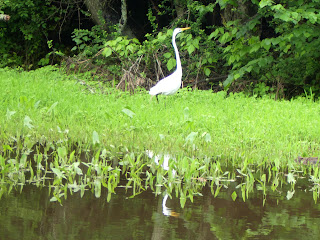
For my 1st post during our spookiest month (peaking at the end of the month with Halloween), here's a picture of what has to be the spirit of a dead heron haunting this wetland. It was slowly, silently gliding along the shoreline, intent on wreaking vengeance upon the fish it failed to catch while alive. Unlike human ghosts, heron ghosts can be found in broad daylight, at least during the warmer months. Okay, just kidding, this of course is a picturesque but very much alive Great Egret . They do quietly and slowly walk along shorelines in a slightly ghost-like way though, so if I did see a heron apparition I would likely mistake it for a Great Egret. I hope my macabre post of horror didn't frighten you too much. May 4, 2023 at Duke Farms Photo 278563357, (c) jpviolette, some rights reserved (CC BY-NC)

Heron Cousins Go Fishing

Image
Last May at Washington Valley Park I met bird cousins who were both fishing there (though not together). They were a Great Blue Heron and a Great Egret . They are usually placed in the same genus ( Ardea ); the Great Blue Heron is always placed there, though some ornithologists place the Great Egret with other white-plumaged herons. I'm going with the more mainstream classification where they're in the same genus, which makes them each other's closest relative living in New Jersey . The Great Blue Heron definitely has closer relatives elsewhere. The Grey Heron of Eurasia/North Africa is easily confused with it ... except for that different-parts-of-the-world thing. (If you think you see a Great Blue Heron on your trip to Europe, you're more likely to be seeing a Grey Heron.) They're both also considered very close relatives of Cocoi Heron of South America [1].  The Great Egret is slightly shorter, considerably lighter, and lacks the head plumes of the typical Gre...

Great Egret

Image
With the return to warm weather, one of our larger herons, the Great Egret , can now be found around here. Though nowhere near as common as their Great Blue Heron cousins, their size and almost completely white coloring makes them striking birds as they wade through shallow water. The yellow bill, lack of a plume, and black legs/feet differentiate it pretty well from most other heron/egret candidates, and it looks too lithe to be a Cattle Egret without breeding plumage. Another reason it's not a Cattle Egret is that it shouldn't have its non-breeding plumage right now. And finally, of the white herons in my area, by far the one I've seen this most is the Great Egret. I've mentioned before that though there seems to be a correlation between non-white herons having "heron" in their name and white herons having "egret" in their name, there's no real taxonomic distinction between the 2. In fact, the Great Egret is more closely related to the Great ...

Great Egret

Image
Last summer I saw this stately looking bird strutting around the shoreline; it's a Great Egret . This is their preferred way of foraging for food, to walk along shallow water and gobble up fish. Similar to its Great Blue Heron cousin, they'll generally eat pretty much any animal small enough to swallow whole. (They don't have the tools to tear something up.) I'm not sure how well it tolerates poisonous species though, so it's possible it leaves some of our butterflies and toads alone. While wading in shallow water for food is their specialty, a hungry egret might swim after fish or even try and hover over the water and dive after one. Though the latter attempts might be done a bit awkwardly, they're better than going hungry. Did you know that there's really not a biological distinction between herons and egrets? The closest relative of the Great Egret in my area is the Great Blue Heron, and vice versa. They're both in the Ardea genus. September 18, 202...

Great Egret

Image
Here's a Great Egret foraging at the end of Duke Island Park last summer. Though a lot of egrets are white, they're really not a different type of bird from the ones called herons. So even though the Great Egret may get confused with the Snowy Egret , Cattle Egret , or Reddish Egret , they're closest relative around here is the Great Blue Heron . (There is a white morph of the Great Blue Heron found in the Florida Keys that could also be confused with a Great Egret.) You might think that a white bird would stay up north during the winter, finding camouflage during snowy periods. But these guys like things warmer, and I've never seen them in the winter. Some maps suggest they could be found in southern NJ in winter though. This bird was almost driven to extinction for its feathers; their plumes were considered quite the fashion statement in the 19th century, and the birds were hunted mercilessly. Nowadays this hunting is illegal, and although they're less common tha...

Green Heron

Image
Here's a Green Heron at Duke Farms. The heron looks a little like it was stalking something, slowly approaching while focused on prey. But it was probably a false alarm; I didn't see the heron catch - or even lunge at - anything. Most herons are happy to wade in water, but the Green Heron prefers to stand outside of water when hunting for prey. I suspect this perch is a little too far above the water to allow the heron to reach the water with a strike with its beak, though other spots on this downed tree could be a perfect fishing spot for it. As I've mentioned before, there's no taxonomic difference between herons and egrets. In this area the Green Heron's closest relatives aren't the Great Blue or the Little Blue Herons, it is the Cattle Egret. (The Great Blue Heron's closest relative in this area is the Great Egret.) June 23, 2021 at Duke Farms Photo 141961334, (c) jpviolette, some rights reserved (CC BY-NC)