Posts

Showing posts with the label autumn meadowhawk

Common Whitetail Resting Before Battle

Image
Here's one of our male Common Whitetail dragonflies taking a breather on some vegetation protruding from Dukes Brook. He'll probably be busy later defending his area of the brook. This wasn't the 1st Common Whitetail I photographed last year - this 1 from the day before was - but my understanding is that you can spot them around here as early as April, making them one of the earlier dragonflies to make the scene. (Certainly you shouldn't be seeing Autumn Meadowhawks this early.) Like many species of dragonfly, the males are not only aggressive towards males of their own species that could compete against them for a chance to mate, but will frequently also attack males of other species, especially if there's a vague resemblance between them. While this seems like a waste of energy, I guess when your only job is territorial defense, you don't want to take a chance that someone you thought was harmless turns out to be a breeding rival. May 26, 2023 at Duke Farms...
Male Autumn Meadowhawk

Image
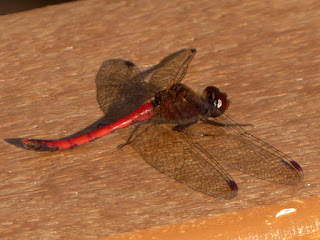
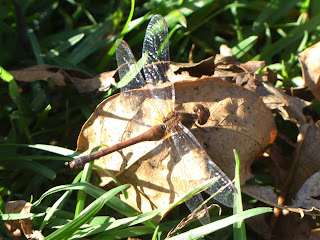
Here's the only other Autumn Meadowhawk (besides this (probable) female ) I got a picture of last autumn. The bright red indicates this one is a guy. Both were (unsurprisingly) seen in meadows. Though like any self-respecting dragonfly, the eggs are laid in water, but some prefer to live in water-adjacent areas. As is typically the case, the Autumn Meadowhawk was the last species of dragonfly or damselfly that I saw last year. I'm assuming that they've adapted to handling colder temperatures in order to avoid a lot of the dragonfly/damselfly competition that goes on in earlier months, and that some predators (robber flies, mantises, spiders) have left the scene too. (They still have to worry about those birds though.) Because they live so late into the season, they need to bask in the sun more than the average odonate. They'll probably survive until the first hard frost of the season (hopefully after having mated). November 16, 2022 at Duke Farms Photo 251084818, (c) j...

Autumn Meadowhawk

Image
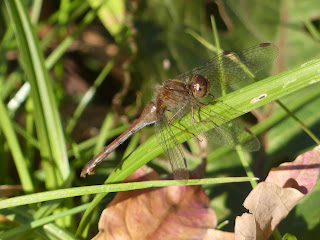
I met this Autumn Meadowhawk (surprise!) ... last autumn! I was starting to worry that I'd go the entire season without seeing 1 of these, then 1 Saturday 1 of the Duke Farms educators spotted this 1 on the lawn (and adjacent to a meadow). It obviously wasn't a mature male since they're a rich red color. With a side view I would be better able to tell you whether this is a female or an immature male . Unfortunately I couldn't/didn't get a picture from that angle, but I think I see a hint of a subgenital plate near the rear of the abdomen, so I'm leaning towards this being a female. November 12, 2022 at Duke Farms Photo 251084548, (c) jpviolette, some rights reserved (CC BY-NC)

Autumn Meadowhawk

Image
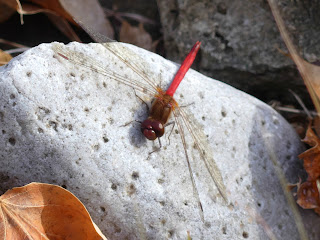
Here's another Autumn Meadowhawk , but unlike the non-red female a recent post or the immature male from an earlier post , this fella has the bright red color of a mature male. We're supposed to look for yellowish tan legs to help distinguish these dragonflies from other meadowhawks (most of which are also red), though most of the other meadowhawks are declining in numbers in October and it would be a bit of a surprise to see them a week and a half into November. Though I can't claim that Autumn Meadowhawks were everywhere last November, if you found one of their favored locales you could probably count on seeing them there pretty regularly for a couple weeks. The fella in the picture is doing one of his favorite things: basking on a rock in the sun for warmth while watching the air for a possible insect meal to come by. I'm sure that basking is more important for this species just because it's active during colder months than most other dragonflies. November 11, 2...

Autumn Meadowhawk

Image
Here's an Autumn Meadowhawk I met well into last autumn. While the males usually get attention from their bright red coloring, females like this one are more of a yellowish tan color. Besides being the most common dragonflies around well into autumn, these dragonflies are also known for their tan legs. The last time I showed one of these dragonflies I said I thought it was an immature male - they do look similar to adult females - but that I suspected it was a male due to the lack of what's called a subgenital plate . In today's picture, the subgenital plate is actually visible protruding down near the end of the abdomen. November 10, 2021 at Duke Farms Photo 169043854, (c) jpviolette, some rights reserved (CC BY-NC)

Autumn Meadowhawk

Image
It's frequently easy to identify Autumn Meadowhawks ; they're the bright red dragonflies I see well into autumn. Even the females turn at least orange, sometimes red (assuming they live long enough). But they don't start their adulthood that color. They start like this, mostly light brown with a little green on the underside of the head and thorax. I suspect this is a male; it sounds like we'd be able to see something called a "subgenital plate" hanging down near the end of the abdomen if this was an immature female. While it's not unusual to see these dragonflies in early August, they really come into their own a month or two later when they're more likely to be flashing their red color, and when other dragonflies are scarce. August 3, 2021 at Washington Valley Park Photo 149026626, (c) jpviolette, some rights reserved (CC BY-NC)