Posts

Showing posts with the label mud-puddling

Red Admiral

Image
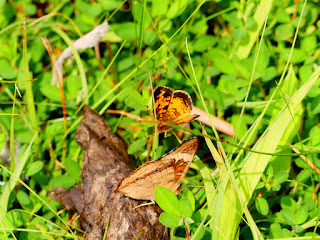
Here's a Red Admiral butterfly I met in late spring. As I suggested in an earlier post , a better name for them might be an Orange Admirable. (They were almost certainly named before we defined orange as a separate color from red, and "admiral" is probably a corruption of the term "admirable".) I've occasionally seen these butterflies together, but most of the time I see the lone Red Admiral. At least the males are considered pretty territorial, so seeing only one male in an area probably makes sense. This is a butterfly that will sometimes land on people. I suspect that they're males looking to drink up some sweat; this is another version of mud-puddling behavior . June 10, 2021 at Duke Farms Photo 136368803, (c) jpviolette, some rights reserved (CC BY-NC)
Cloudless Sulphur

Image
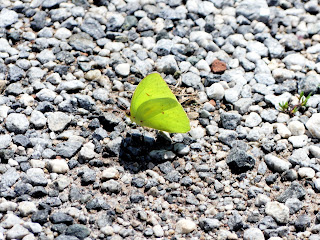
Here's another Cloudless Sulphur . I know I've shown them before, but the picture came out pretty good. One webpage suggested that the name butterfly came from people observing a Cloudless Sulphur in flight and thinking it resembled a slab of flying butter. I was skeptical: I didn't think this species of butterfly was found in Eurasia (it isn't), so for this to be true English settlers would have needed to arrive in the Americas to name it, and this name would have needed to supplant whatever the English used to call butterflies. Although it's possible that a name inspired by a "flying slab of butter" could have occurred from some sulphur butterfly relative of the Cloudless Sulphur, it sounds at least as plausible that it came from a belief that butterflies ate milk/butter . And it seems possible that butterflies would try and drink nutrients from milk/butter. I've talked before about butterflies mud-puddling, a generic term for when they attempt to su...

Mud-puddling

Image
Here are a pair of butterflies, a Common Buckeye and a Pearl Crescent , mud-puddling on dung. Though the name mud-puddling conjures up a dirty activity, insects that do this are looking for nutrients that are more abundant on scat or, less easily noticed, areas with urine. Sometimes you'll even see them mud-puddling on rotting fruit or decaying animals. A good mud-puddling location is a good place to find a bunch of butterflies congregating together. Even a small flower patch is more dispersed than fox dung, so the action is sometimes concentrated into a very small area.  I'm not exactly sure how butterflies find a good mud-puddling location in the first place, but there's some evidence that once a butterfly finds a good location the other butterflies (even of different species) take notice and join in. Naturalists have been known to put a fake butterfly in a location in order to convince other butterflies to check the location out. August 15, 2020 at Negri Nepote Native ...

Common Buckeye Butterfly

Image
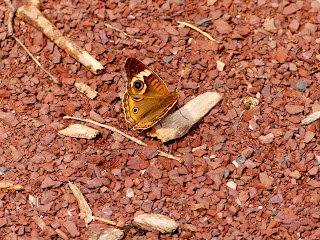
Here's a cool-looking butterfly around here, the Common Buckeye . This one seems a little browner though sometimes they'll grayer. They don't have a really close relative around here but as brush-footed butterflies , they have lots of distant relatives around. They're probably one of our best-looking butterflies that are mostly earth-toned in coloring. I'll frequently find them on open ground like this one. I suspect it's basically mud-puddling for nutrients even where there's not much moisture. August 15, 2020 at Negri Nepote Native Grassland Preserve