Posts

Showing posts with the label red-winged blackbird

Female Passerines

Image
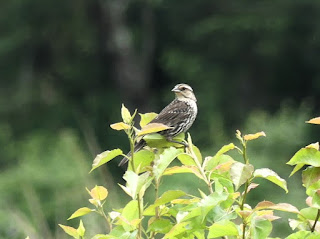
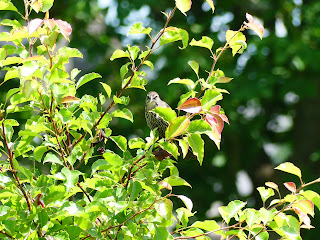
Here are a couple female birds who look quite a bit less gaudy and distinctive than their male counterparts. The top is a Red-winged Blackbird (not quite black, not close to red-winged) and an Indigo Bunting (no visible indigo). (Technically it can be tricky to distinguish adult females with immature birds of both sexes, but I'm going with female IDs unless someone can say otherwise.) Of course, I've shown female Red-winged Blackbirds and Indigo Buntings before, and they're certainly not the only sexually dimorphic birds flying around (including but not limited to Brown-headed Cowbirds ). It may seem chauvinistic to name birds after the appearance of the males, but: Most of the time the males are more distinctive-looking, leading to more unique names. Imagine names like Beige Bunting #2 and Dark-streaked Bird #4 as names instead. What's the alternative? Naming the birds after people comes with a whole other set of baggage . June 29, 2023 at Sourland Mountain Preserv...
Red-winged Blackbirds Like Wetlands

Image
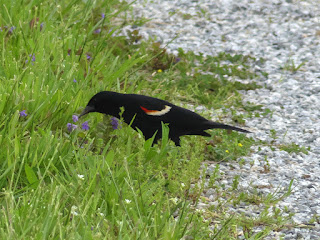
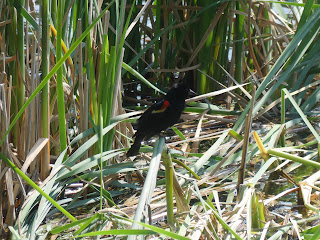
Though you'll also find them in meadows, Red-winged Blackbirds are also quite happy in a wetlands environment. It sounds like there can be insects hiding near the base of some aquatic plants, and that Red-winged Blackbirds are fairly adept at finding/eating them. And of course there are usually insects flying around near water too, some of which also potentially end up as blackbird snacks. I wouldn't be at all surprised if this Red-winged Blackbird was poking around this vegetation specifically to scare up a tasty bug. I'm sure Red-winged Blackbirds would happily eat a cooperative bluet , though I also suspect that most of the time damselflies and dragonflies are a little too quick and maneuverable to end up as a blackbird snack. As birds that like to feed near water, it should come as little surprise they're also comfortable nesting near water. The females will usually find some dense vegetation near or within water and build a nest relatively close to the ground ther...

Red-winged Blackbird Spouses?

Image
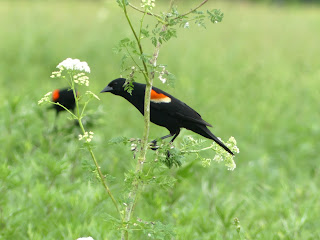
I met these male and female Red-winged Blackbirds about 2 minutes apart - could they soon be in wedded bliss? Well, it's possible, though as you can see in the background of the 1st picture (the male) there was competition in the meadow. (My recollection is that that wasn't all of his competition either.) And while Red-winged Blackbird pairs form more of a relationship than yesterday's Zabulon Skippers do, they're not exactly monogamous either. The males attempt to claim and hold a territory they think the females will want to live in. Only the toughest, fittest males can hold onto these prime spots. The males will then mate with as many females as there are who want to raise their children there, so a male will frequently have more than 1 "wife". (The females probably do cheat on the males a bit too, so maybe this evens out?)  While the female will do most of the work of raising her nestlings, it does sound like the male whose territory she's in will he...

Two Lead Singers?

Image
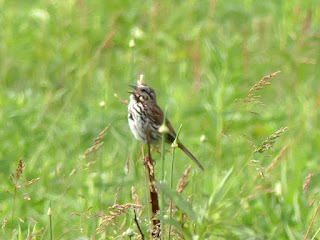
The Grassland Birds were putting on a meadow concert last spring. While the Red-winged Blackbird's song may be a bit louder, the Song Sparrow's song is more classically melodious. And as far as I could tell, neither was really trying to harmonize with the other. If anything, they seemed to be trying to sing over 1 another. Such is life when the birds are throwing a concert. Their goals are also somewhat different. While the Song Sparrows look for that 1 special female, the Red-winged Blackbirds think that the more females they can attract, the better. June 3, 2023 at John Clyde Native Grassland Preserve Photo 300857827, (c) jpviolette, some rights reserved (CC BY-NC) June 3, 2023 at John Clyde Native Grassland Preserve Photo 300857865, (c) jpviolette, some rights reserved (CC BY-NC)

Red-winged Blackbird Working on His Post

Image
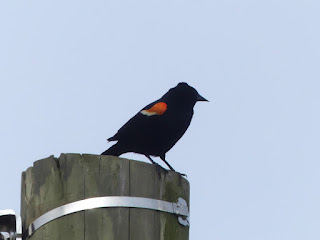
Though birds don't have much of a social media rep, you could argue that this Red-winged Blackbird is working on his post. Okay, technically he's not creating a social media post, but his job this time of year is to find a perch and defend a territory and attract eligible female Red-winged Blackbirds. And this post looks like a perch that provides good visibility for spotting rival males and attracting interested females.  FWIW the post joke has been done better here . June 3, 2023 at the John Clyde Native Grassland Preserve Photo 300857731, (c) jpviolette, some rights reserved (CC BY-NC)

Female Red-winged Blackbird Under a Bridge

Image
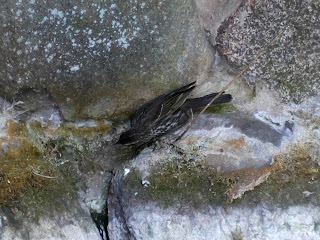
If you were wondering if the male Red-winged Blackbirds had any females around to impress, here's 1 of those female Red-winged Blackbirds . Sexual dimorphism is strong in these birds, sometimes fooling people into thinking the males and females are of different species. This particular bird seemed to be pretty busy under a stone bridge [1]. My 1st thought - this picture being from the spring - was that maybe she was building a nest under there. It would have the advantage of keeping her and her eggs out of the rain, and might be a location that aerial predators (hawks and owls) wouldn't find. And although they're not aquatic, Red-winged Blackbirds do like their lakefront properties. Thinking about it more though, I think this is unlikely. Red-winged Blackbirds don't generally gravitate towards man-made structures, and it seems unlikely there's enough vegetation under there for her to build a water-adjacent nest . Finally, I didn't see her bringing any material...

Perched Red-winged Blackbird

Image
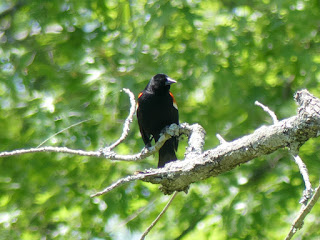
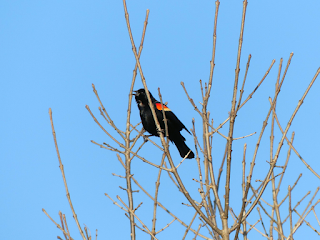
Last May the eligible Red-winged Blackbird bachelors were making their presence known. They display their flashy red wings and sing for 2 related reasons: To let other males know that this is their territory, and that the other males should stay away if they know what's good for them. My guess is that actual fighting is rare, but threats and intimidation are common in the leadup to breeding season. To let females know that there's a handsome male holding/defending a territory that would be great for raising a clutch of nestlings. Males with good territories will usually breed with more than 1 female that's decided to nest within his territory. Unfortunately for the males, a non-trivial number of a female's eggs were fertilized by a different male. Not unlike a soap opera, there's a lot of cheating going on in the Red-winged Blackbird world.  More about these birds can be found in this video . May 25, 2023 at Duke Farms Photo 292818050, (c) jpviolette, some rights r...

Swainson's Thrush is Lichen That Branch

Image
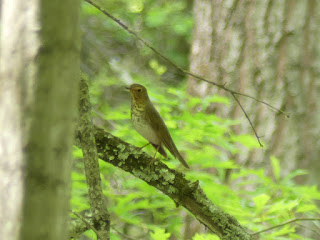
This Swainson's Thrush (perhaps due for a renaming) was perched on a fairly heavily lichened branch. Though there are a lot of thrushes around here, American Robins and Eastern Bluebirds are the ones I see the most (though I have met some Hermit Thrushes  on occasion). This is another bird that's not easily identified, mostly because there are other thrushes that look pretty similar. I think you're supposed to identify the Swainson's Thrush based on a little more light coloring around the eyes and a back that's slightly grayer than similar thrushes. In the foreseeable future, you won't see Swainson's Thrushes around because ... they're in line to have their name changed . The American Ornithological Society wants to rename all birds named after people. Though the subject came about due to some birds named after unsavory characters, it was also noticed that while names like Red-winged Blackbird tells you a lot about the bird's appearance [1], name...

Red-winged Blackbirds Claiming Territory

Image
One day late last April I didn't see a lot with 1 exception: the male Red-winged Blackbirds were out in force. I didn't see any females (who look a lot different ); I believe that the males arrive in a habitat earlier, establish their territories [1], and then the females arrive and pick a mate largely based on his territory. The love life of a Red-winged Blackbird is complicated and would probably make a pretty good soap opera plot. The males aggressively claim and defend territories and mate with the females that nest within their territories. Males with a good territory typically have 5 females to mate with, though apparently they could have as many as 15 females residing there. But these females aren't exactly faithful; between 25-50% of their kids had someone else as a father. My understanding is that a territory is claimed by finding a local perch, flashing the red/orange of their wings, and singing about how tough they are . (It sounds like this is usually suffici...

First Red-winged Blackbirds

Image
Though I believe I had spotted Red-winged Blackbirds a little earlier in the year, this was my 1st photographic evidence of their return from their winter homes. Though food brought them together, after their meal they might be fierce rivals, each trying to establish a territory that their future wives - male Red-winged Blackbirds usually have multiple wives [1] - will be drawn to [2].  Red-winged Blackbirds don't limit their aggression to avian rivals either; it's not uncommon for them to attack people as well [3]. These are fun birds to identify for people because their common name is almost exactly the way you'd describe them: a black bird with red on the wings. Not even any fancy language, like if they were called Crimson-shouldered Ebonybirds.  March 1, 2023 at Duke Farms Photo 267700847, (c) jpviolette, some rights reserved (CC BY-NC) [1] Female Red-winged Blackbirds frequently breed with more than 1 male too. You could probably map out a plot of a soap opera based...

Northern Mockingbird

Image
Here's a Northern Mockingbird taking in the scenery from a low perch. I've talked about their mimicry and eating habits in prior posts, which suggests I see/hear them a lot. Today I'm going to write this stealing information from a book I borrowed from the library: What It's Like to Be a Bird - Sibley. Apparently mockingbirds will "attack" people, at least if you define an attack as "making a lot of noise and flying towards you only to veer off before getting to you". I've personally been attacked like this by Red-winged Blackbirds , Tree Swallows , and even an American Robin , but never by a mockingbird [1]. In virtually every 1 of these situations the attacking birds were trying to harass me into leaving an area, almost certainly because they perceived a threat to their nest or a fledgling. One foraging tactic they (and some other birds) use to find food is " wing flashing ". Here's the way it works. The bird lands someplace t...

Stern Bluebird

Image
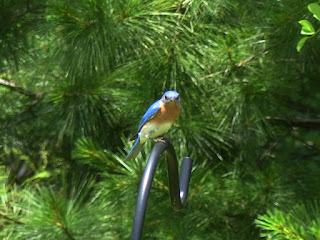
Here's an Eastern Bluebird who didn't know if I was going to be trouble, but he was certainly going to keep his eyes on me. This fella was at Duke Farms, where I'm told there is a thriving community of bluebirds raising families; it wouldn't surprise me if this was a dad scoping out the neighborhood for threats to his nestlings. One false move on my part and I'd be subjected to 1.1 ounces of unrelenting feathery fury. (In actuality Eastern Bluebirds are less aggressive nest protectors than Tree Swallows or Red-winged Blackbirds , both of which have "attacked" me.) Previous bluebird posts are here and here . June 8, 2022 at Duke Farms Photo 209834311, (c) jpviolette, some rights reserved (CC BY-NC)

Red-winged Blackbird

Image
I saw this Red-winged Blackbird who "stopped to smell the flowers" earlier in the month. Or did it? Although birds do have olfactory glands to be able to smell, they're not well developed in most birds including our passerine friend here. Similarly, these birds have extremely few taste buds. For most birds, smell and taste presumably aren't a big part of their lives . There are exceptions. We know our Turkey Vultures have quite good senses of smell which they use to find dead animals. And there are questions. It's believed that birds learn to avoid eating Monarch butterflies after tasting them, which doesn't sound compatible with a weak sense of taste. So what's this bird doing? I'm assuming it's about seeds and insects; birds know that pollinated flowers tend to produce seeds, and that the flowers attract both insects that eat the plants and that pollinate the flowers. Stopping to check out the flower could scare up a meal. May 15, 2022 at Duk...

Red-winged Blackbird

Image
Oddly, I usually consider sightings of Red-winged Blackbirds as a sign of spring even though all my documentation implies they're here in NJ all winter too. I'm not sure what to attribute that to: The non-breeding plumage of the males has far less distinctive red patches than in breeding season, which certainly makes them stand out less. Perhaps they retreat to wooded areas and vocalize less, making them harder to spot. NJ is towards the northern part of their winter range. Maybe the Red-winged Blackbird community does shrink in winter even though some hardier ones will winter here. In any event, they're definitely out and about now. April 5, 2022 at Duke Farms Photo 186782543, (c) jpviolette, some rights reserved (CC BY-NC)

Female Red-winged Blackbird

Image
Here's a Red-winged Blackbird I met a couple months back. The astute observer will notice that isn't black and doesn't have red on the wings. This is the issue with identifying many female birds, especially when the species was named after the much-differently-feathered males, a form of sexual dimorphism .  These birds can be misinterpreted as European Starlings or sparrows or finches. I find it very helpful to see what male birds are around when I'm trying to identify the females since many times the males have more distinctive plumage.  Female Red-winged Blackbirds do have plenty of company in getting misidentified. Northern Cardinals, Indigo Buntings, and Baltimore Orioles are just a few species where the females look a lot different than the males. June 2, 2021 at Negri-Nepote Native Grassland Preserve Photo 136367750, (c) jpviolette, some rights reserved (CC BY-NC)

Confrontational Red-winged Blackbird

Image
Back in early June, this Red-winged Blackbird was sizing me up. These birds are pretty close to harmless, though if they mistake you for a predator that's a threat to their nest-bound young they could dive at you. Unfortunately sometimes a nest is close enough to a trail/path I've been attacked briefly. (I survived.) I'm pretty sure there were multiple males involved in the attack. Though the males are archrivals in mating season, it does appear the Red-winged Blackbird community will band together if the threat is considered grave enough, like if I'm walking by with my camera. (I've also seen them harassing an actual threat, driving a Great Blue Heron away from their nest.) In this particular case, I think that I escaped with nothing more than a cold stare from this male. He was certainly mentally prepared for an escalation though. June 2, 2021 at Negri Nepote Native Grassland Preserve Photo 136367420, (c) jpviolette, some rights reserved (CC BY-NC)

Red-winged Blackbird

Image
Though the American Robin is considered a harbinger of spring despite frequently being spotted in the middle of winter, here's someone who's probably a more accurate harbinger of spring (at least around me): the Red-winged Blackbird . This is a male on a high perch singing to help establish a territory. If he's lucky, a small number of females will be interested in him and his territory, and will breed with him. Despite having a territory of his own, males are still usually part of a loose colony, and multiple males will help drive out threats real (Great Blue Heron) or imagined (me and my camera). They don't have a really close relative around here, though the west coast has a Tricolored Blackbird that's clearly a close relative. Spring 2021 at Duke Farms

Red-winged Blackbird

Image
 Here's a female  Red-winged Blackbird . She looks quite a bit differently than her male counterparts. And they're not terribly distinctive looking (some people say they look like European Starlings, though I think of them as more speckled than striped), and so I identify them best when they're hanging around with their more flamboyant males. June 16, 2020 at Duke Farms Photo 86051419, (c) jpviolette, some rights reserved (CC BY-NC) June 16, 2020 at Duke Farms Photo 86051463, (c) jpviolette, some rights reserved (CC BY-NC)