Posts

Showing posts with the label milkweed

Monarch on Milkweed

Image
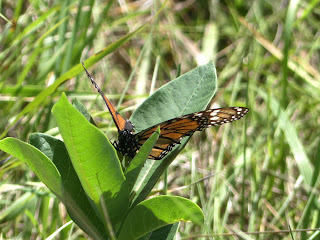
I got this picture of a Monarch landing on a milkweed (probably Common Milkweed). Although this plant looked pretty young, most milkweeds had blossomed earlier in the summer [1], and I don't see flowers on it. My suspicion is that this is a female looking for a good spot to lay an egg, which will hatch into a milkweed-eating caterpillar. I'm told that under favorable conditions a Monarch can go from egg to adult butterfly in a little over 25 days: 3-8 days to hatch 3-5 days for each instar X 5 instars = 15-25 days as a caterpillar 8-15 days in chrysalis 26-48 days to become a butterfly Any egg laid on this day should be a functional adult by either mid-September or very early October. Both these dates most likely mean it would be in the super generation that migrates down to winter in Mexico [2]. August 15, 2021 at Duke Farms Photo 152591256, (c) jpviolette, some rights reserved (CC BY-NC) [1] You can see flowering milkweed any time of the summer. If a plant is cut before it...

Monarch Caterpillars

Image
They're so cute at that age - here are a couple Monarch caterpillars I saw during a late July trip to the Sourland Mountain Preserve. I believe that both of these guys are facing down; the front tentacles are usually longer than the back tentacles. They're probably eating Common Milkweed; I think that's the most commonly seen milkweed at Sourland. We might consider Monarch caterpillars to be picky eaters, only eating milkweed plants. But look at it from their perspective: They'll eat Common Milkweed, Butterfly Milkweed, Swamp Milkweed, etc. New Jersey has 12 species of milkweed (though I think I've only seen 5 species myself). Both caterpillars seemed pretty mature, and I suspect they'll be going the chrysalis route pretty soon. The first caterpillar mostly had the milkweed to itself, while the second caterpillar was forced to share with a group of aphids. July 28, 2021 at Sourland Mountain Preserve Photo 148654450, (c) jpviolette, some rights reserved (CC BY...

Milkweed Tussock Moth

Image
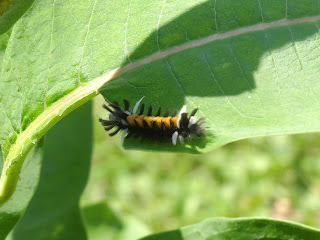
This is a fairly common caterpillar, though this was the first one I saw this summer. It's a caterpillar of the Milkweed Tussock Moth , one of the numerous denizens of our local milkweed plants . As moths, they're a little on the plain side, but as caterpillars they look a little like an arts-and-crafts project made from pipe cleaners. Like most insects that use milkweed as a host plant, they're somewhere on the bad-tasting/poisonous side of the edibility spectrum. The caterpillar's unique look makes it easy for would-be predators to identify them as poisonous.  Since they're also considered to be poisonous as adult moths, I'm a little surprised they don't have a more distinctive look as adults. Instead of appearance, they apparently signal their unpalatability by making distinctive sounding ultrasonic clicking noises that bats recognize. They don't normally compete directly with Monarch butterfly caterpillars because while Monarch caterpillars prefer y...

Lady Bug and Aphids

Image
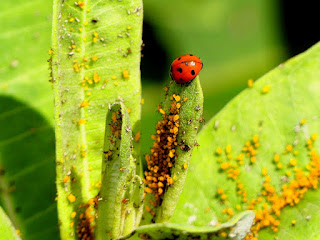
These are almost certainly invasive  Oleander Aphids (aka Milkweed Aphids) meeting their worst nightmare, a ladybug . Our milkweeds are hosts for lots of native insects (Monarch Butterflies being the most famous), but these non-native aphids not only crowd out the natives but also seem to do more damage to the milkweeds. Fortunately for us, ladybugs in particular consider aphids to be delicious. (Although I think ladybugs can eat a lot of aphids, it looks like this milkweed has more aphids than this ladybug will be able to eat.) There are a lot of similar-looking ladybugs; this one might be yet another non-native species, the Seven-spotted Ladybug . It sounds like they were intentionally introduced to the US specifically to control plant-eating insects, though as they out-compete native insects it's unclear whether they're more of a benefit or a problem.

Dogbane Leaf Beetle

Image
Here's one of my favorite beetles, the Dogbane Leaf Beetle . If you like shiny things, you're going to love Dogbane Leaf Beetles. They're almost like jewelry for plants. These guys are one of those insects that will feed on both dogbanes and milkweeds; in fact I suspect this little fella is probably on a Common Milkweed. (The leaves look a little large for a dogbane.) Both dogbane and milkweed (two types of plants in the  Apocynaceae family ) have a sticky, poisonous latex-ish substance you can see if you break a leaf. Many insects that eat these plants end up being poisonous, or at least foul-tasting, to eat. And most of these signal their poisonousness to potential predators by flaunting red/orange coloring (e.g. Monarch Butterflies, Large and Small Milkweed Bugs). It's likely that the Dogbane Leaf Beetle accomplishes the same thing with its shininess - predators are able to distinguish them from tastier, more nutritious insects. They do look a little like an invasive...

Monarch

Image
Here's a Monarch butterfly. This was the first one I photographed in 2020, and it was spotted on July 14. I suspect they could have been seen earlier. (My bout with Lyme Disease was keeping me at home for a while.) These mostly orange-and-black butterflies are pretty easy to spot, though we do have another similar-but-unrelated butterfly in the NJ area, the Viceroy . (The Viceroy is a little smaller and has a slightly different wing pattern.) Still, in most areas the Monarchs greatly outnumber the Viceroys, so if you see a butterfly that looks like this it's usually a Monarch. The Monarch caterpillars are dependent on milkweed plants - their leaves is all they'll eat. I don't know if they have preferences among the milkweed species (we have several in NJ), but it needs to be a milkweed. Even the similar dogbane species aren't acceptable to a growing Monarch caterpillar. Milkweed plants help Monarchs twice; milkweed nectar from the flowers is popular with adult Mona...

Large Milkweed Bug

Image
Here’s a Large Milkweed Bug I met. Around me, this is probably the most common milkweed-eating insect other than aphids (and the aphids are so small you might mistake them for a rust or other fungus). They can be confused with the Small Milkweed Bug or the False Milkweed Bug . Both lack the straight black bar across the top of its wings, and the latter isn’t found on milkweeds (which are poisonous to many animals). Note the orange/red on these bugs. Like Monarch butterflies, these insects eat the poisonous milkweeds and obtain a certain amount of poisonous protection for themselves. And the distinctive red coloring signals to predators that these guys aren’t good to eat. (Of course, sometimes orange/red coloring is a fake. AFAIK the False Milkweed Bug is safe to eat, and benefit from Batesian mimicry .)