Posts

Showing posts with the label thrush

Juvenile Eastern Bluebirds
Image
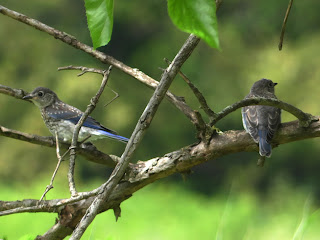
While Eastern Bluebirds are spotted in central NJ fairly often, this time I got a picture of juvenile Eastern Bluebirds. Though there's some blue plumage that's come in, they have the white speckles of a juvenile. Their thrush cousins, the American Robin , also look speckly as juveniles; presumably this is better camouflage than adult plumage. Though they have a fair number of thrush relatives, their closest relatives, the Western Bluebird and the Mountain Bluebird , live on other parts of the continent. One of the biggest challenges for bluebirds is to find a place to nest. As cavity nesters, nesting boxes are a good substitute for the tree cavities that used to exist when this area was mostly forest. Duke Farms provides nesting boxes for bluebirds, and my understanding is that the bluebirds on the property successfully raised an above average number of kids this summer.  July 6, 2022 at Duke Farms Photo 221313845, (c) jpviolette, some rights reserved (CC BY-NC)
Northern Waterthrush

Image
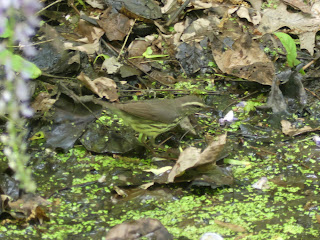
A couple weeks ago I ran across a bird I don't usually see, a Northern Waterthrush . At least I'm pretty sure that's what it was; the Louisianna Waterthrush is an awfully similar bird. With a name like "waterthrush", you're probably thinking that this bird is related to thrushes like the American Robin ... but you'd be wrong. The waterthrushes (both Northern and Louisianna) are a type of warbler . Though the "thrush" part of their name is a little misleading, the "water" part is a more helpful description of the bird; they are usually found around still waters. There's a pretty good chance that this waterthrush was just passing through during migration. It looks like northwestern NJ is just barely in their breeding range. Still, we're probably close enough to their breeding range that if a male/female pair met here, they might consider staying. (We are more firmly in the breeding range for the Louisianna Waterthrush, though ...

Eastern Bluebird

Image
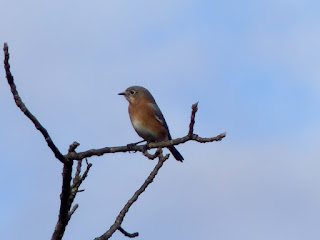
Last fall I met a little flock of Eastern Bluebirds . Our bluebirds are frequently found in these small flocks, at least when they haven't paired off to start a family. They are fairly small thrushes , noticeably smaller than their American Robin cousins. (Robins outweigh bluebirds more than 2:1, though the size difference may not be apparent when you see them.) Like robins, our bluebirds are year-round residents in New Jersey. While both our robins and bluebirds have orangish breasts, I can't tell you this typical of thrushes; most other thrushes lack this characteristic. November 21, 2021 at Duke Farms Photo 170814186, (c) jpviolette, some rights reserved (CC BY-NC)
Juvenile American Robins

Image
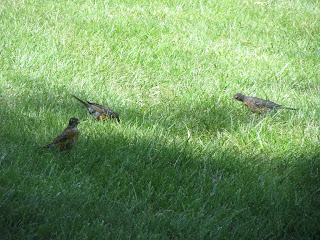
Here are some of my friendly neighborhood American Robins foraging through the grass - I wouldn't want to be an earthworm in that area. American Robins are in the thrush family of birds. Other thrushes in my area are Wood Thrushes, Hermit Thrushes, and Veeries, though the 2nd most seen is probably the Eastern Bluebird. Our robins do have closer thrush relatives, but they mostly live in different parts of the world. Somewhat confusingly though they're not closely related to the European Robin for which the American Robin was named. The two robins do share orangish feathering on the breast, and at one time were categorized in the same family, but DNA tests indicated they belong in separate families. You may think these birds are too speckled to be American Robins, and you'd be sorta right. Adult American Robins wouldn't have speckles, but juvenile American Robins do. I'm assuming that this camouflages them a bit when they're young and haven't learned how to...