Posts

Showing posts with the label canada goose

Canada Goose Family Out For a Swim
Image
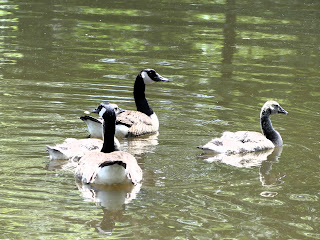
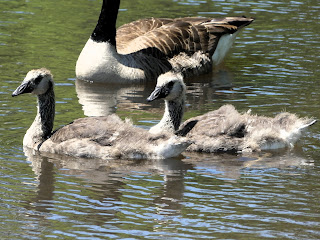
Here are 2 adult and 2 juvenile Canada Geese out for a swim. I don't recall if they jumped into the water to avoid getting their picture taken by me. (If that was the plan, it didn't work.)  Canada Geese and most ducks have opposite strategies towards reproduction. Ducks are famous for large broods with little adult supervision and thus high attrition rates. Canada Geese tend to go the opposite route, having smaller broods which the parents attentively teach and defend, leading to a higher percentage of goslings making it to adulthood. Both strategies can work since we have quite a few ducks and Canada Geese kicking around. This is probably a family of geese, though my understanding is that at some point the male goslings are taken under the wing of other male geese, and a symmetrical thing happens with the female goslings. Since there's virtually no sexual dimorphism in Canada Geese, I can't tell you exactly what's going on. My guess though is that these goslings ...

Mallards Out for a Swim

Image
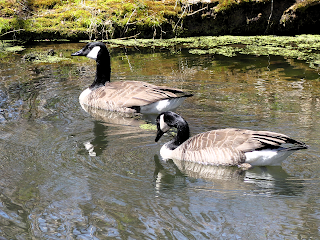
I saw this guy and his girl out for a swim in the Delaware Raritan Canal. (Don't try this yourself; the rangers have rules against this.) I've certainly talked about Mallards before, and they and the Canada Goose are the easiest-to-find year-round waterfowl in New Jersey, so unless you spend your days in a sensory deprivation tank you've probably seen plenty of them [1]. There is a belief among hunters that a northern group (subspecies?) of Mallard are larger, and thus more desirable to hunters, but given the way they breed it's virtually impossible for there to be an isolated population of Mallards that don't mix with their cousins. Basically female Mallards hook up with males regardless of the male's birthplace and lead him back to her childhood neighborhood. Mallards are not only common and widespread across the Northern Hemisphere, they're also the ancestors of most domesticated ducks, probably making them the most abundant waterfowl species. And Ma...

Get Off My Back

Image
From a distance it almost looks like 1 Canada Goose on the back of another. Are they playing piggyback? Or is 1 scouting the area by getting a higher vantagepoint? A closer look reveals 1 goose is simply standing behind the other. While some waterfowl will carry others on their back, this is a sometimes-risky strategy for moving their offspring . March 11, 2023 at Duke Farms Photo 267704783, (c) jpviolette, some rights reserved (CC BY-NC)

Splashing Duck

Image
Boys will be boys. In this picture a male Mallard may well be splashing (what I believe to be) a male Common Merganser . These are our 2 most frequently seen green-headed ducks (though they're not closely related). Though it might look a little obnoxious, this is frequently a way for ducks to clean their feathers, though apparently males will also do it to attract the attention of females. It's unclear whether female ducks find this attractive, but it is at least attention-getting. March 16, 2023 at the Raritan Water Power Canal Photo 267710089, (c) jpviolette, some rights reserved (CC BY-NC) This Canada Goose was also having a splashing good time that same day. March 16, 2023 at the Raritan Water Power Canal Photo 267709364, (c) jpviolette, some rights reserved (CC BY-NC)

Canada Goose

Image
Canada Geese have a wide range of behaviors towards people. Some (possibly migrant) Canada Geese will fly away as readily as most other waterfowl. Many seem to cautiously walk or swim away, sort of the way you might if you saw a bear approaching you. And some of them have clearly been around humans a lot and aren't all that impressed with the danger we present [1]. This particular goose didn't flee but seemed to exhibit an air of confidence standing on its log. Perhaps it surmised that I was extremely unwilling to risk falling into near-freezing water with an approach? I need to use "it" to describe my goose friend since Canada Geese are essentially sexually monomorphic. March 6, 2023 at the Raritan Water Power Canal Photo 267703395, (c) jpviolette, some rights reserved (CC BY-NC) [1] It's discouraged these days, but I'm sure some people feed the geese, making our presence a somewhat welcome sight.

Are You Heron About All the Great Blues?

Image
Around here if you're around open water it's fairly likely you'll run across 1 or more Great Blue Herons . While they're certainly not as plentiful as omnivorous waterfowl like Mallards or Canada Geese , their tendency to forage alone causes them to spread out so that a lot of our wetlands have a Great Blue Heron patrolling it. One day last winter while visiting Duke Island Park/Raritan River Greenway [1] I'm pretty sure I encountered 3 of these birds. How do I know these aren't the same bird? I guess I really don't know for sure. Different posture and lighting could give a single heron 3 different looks. Still, none of these birds left on my account, so I suspect they'd have no compelling reason to leave the general area as I moved on. February 10, 2023 at the Raritan Water Power Canal Photo 263680969, (c) jpviolette, some rights reserved (CC BY-NC) February 10, 2023 at the Raritan Water Power Canal Photo 263680834, (c) jpviolette, some rights reserved...

Mother (Canada) Goose

Image
For Mother's Day , here's a Canada Goose family I met last week at Lord Stirling Park. Technically I can't be sure the mother was in this picture - there was a 3rd adult Canada Goose that wasn't in the picture - but there's a 2/3 chance at least 1 of these was a mother goose [1]. My impression is that geese are considered to be pretty good parents. Compared to ducks, they tend to have smaller broods but devote more time and energy into raising them. And overall they seem to be doing a good job; our Canada Goose population has been rising steadily since the mid-60s [2]. May 12, 2023 at Lord Stirling Park [1] Finding a mother goose is also harder since Canada Geese are not sexually dimorphic ; males and females are phenotypically very similar, or sexually monomorphic. [2] They might be doing a little too well. Just the volume of their bodily waste probably has negative consequences in high population areas.

Mute Swan

Image
For Throwback Thursday, let's look at someone I saw around a decade back, a Mute Swan . The first thing to know about them is that they aren't mute. They may say things like "Kheorrr" or "Kloorrr", and also do some grunting, snorting, and hissing. Your Mute Swan's silence probably means they have nothing to contribute to the conversation; perhaps you should consider changing the subject to something more interesting to swans. The Mute Swan isn't native to North America but was introduced here by those meddling Europeans. And while they are extremely photogenic, they can be pretty aggressive, bullying our native waterfowl out of an area. (I do wonder what happens when a belligerent Mute Swan comes upon a lake with a couple hundred Canada Geese . My guess is that a heavily outnumbered Mute Swan is going to show a certain amount of discretion around moderately large waterfowl.) I've heard that Mute Swans are especially aggressive towards other water...

Goose Families

Image
Back in June I met a couple families of Canada Geese . These pictures were taken on the same day and at the same location (Washington Valley Reservoir), but one set of goslings was clearly more mature than the other. In the 1st picture the goslings are far smaller than their parental unit and are a nearly uniformly gray in color. June 28, 2022 at Washington Valley Reservoir Photo 211849901, (c) jpviolette, some rights reserved (CC BY-NC) In the next picture the juveniles are much closer to the adult in size and have the feather markings of an adult (though those markings look slightly washed out). If I had seen these juveniles in the absence of an adult, I might have interpreted them as adults and attributed the duller color to bad lighting. June 28, 2022 at Washington Valley Reservoir Photo 211850102, (c) jpviolette, some rights reserved (CC BY-NC) Clearly these 2 goose families weren't on exactly the same breeding schedule.

Canada Geese

Image
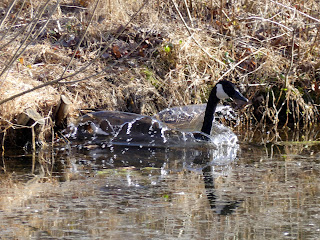
Probably because I was nearby, these 2 Canada Geese splashed their way into the water. This is one of the few native species that we have an overabundance of here in New Jersey, so seeing them isn't much of an event. Even though they're cool-looking in their own way, they're just too common to get very excited about. I did kind of like the action scene of them doing a sort of gentle bellyflop into the water in these pictures. Once in the water, they presumably felt less threatened by me and my camera. When this was taken breeding season must have been on geese's minds, though I don't know if these 2 were a couple. March 11, 2022 at Duke Farms Photo 186585535, (c) jpviolette, some rights reserved (CC BY-NC) March 11, 2022 at Duke Farms Photo 186585553, (c) jpviolette, some rights reserved (CC BY-NC)

Snow Goose

Image
Here's someone I hadn't seen at Duke Farms before, a pair of Snow Geese . This probably isn't outside their range, though they were new to me. They were on Heron Lake. Snow Geese are known to congregate in large flocks. I don't know how this pair got separated from a larger group of Snow Geese, but I suspect that in the absence of other Snow Geese they joined in with the next best thing: a flock of Canada Geese . There are also a pair of Mallards in the back, but they were just passing through; before and after the picture the Mallards were in different parts of the lake. Although Canada Geese have some reputation for being aggressive, I don't think I've ever seen them mistreating other waterfowl. I suppose the dynamic changes if they had vulnerable goslings around, but this time of year they seem accepting of the presence of the Snow Goose cousins. December 17, 2021 at Duke Farms Photo 174171294, (c) jpviolette, some rights reserved (CC BY-NC)  

Juvenile Canada Goose

Image
I saw a juvenile Canada Goose  (accompanied by 2 adults) early in the summer. This might be the awkward age for Canada Geese; they're not the cute, fluffy guys they were shortly after hatching, but they also don't have the sharp black-and-white necks/heads that give the adults a handsome look. You can see this fella just starting to get it's adult plumage, and is still a little smaller than the adults. Fast forward to today, I'm thinking we'd have a hard time distinguishing it from an adult. Canada Geese are considered to be pretty good parents. They don't have as many young as some of our ducks, so they have more time to devote to showing their individual kids how to be functioning adults. June 25, 2021 at Sourland Mountain Preserve Photo 141961502, (c) jpviolette, some rights reserved (CC BY-NC)

Find the Goose

Image
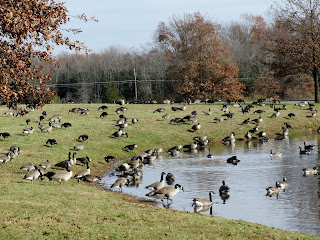
I'm doing a Throwback Thursday picture today from autumn of 2011; see if you can find the goose in this picture. 😃 At the time, this was probably the most Canada Geese I had seen in a single place. (Since then, I think a meadow at the Plainsboro Preserve had the biggest Canada Goose population I've seen.) I tried to identify a non-Canada Goose in the picture and try a where's Waldo ("where's Robby the Robin?", "where's Donald Duck?") sort of contest, but wasn't able to find any. The geese really were dominating this pond. Though these geese are too populous to be good for animal diversity here in NJ, they are kind of handsome looking birds. If they were rare, I could imagine people ooo-ing and ahh-ing over them. November 19, 20211 at Sourland Mountain Preserve Photo 11329538, (c) jpviolette, some rights reserved (CC BY-NC)

Canada Goslings

Image
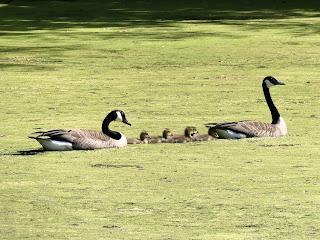
Here's a family (presumably) of Canada Geese I met a couple months ago, this time at Duke Farms. If they've all survived (even at Duke Farms there are predators), the goslings would be much larger today. They probably look sorta like adults by now, just grayer and a little smaller. But at this age they're cute little guys. I count 5 goslings here, which seems to be right about in the middle for a Canada Goose brood; 2-8 eggs are typical. Canada Geese are fairly diligent parents as animals go; they may have a role in raising their kids for as long as a year. Certainly what they're doing seems to be working; the population of the Canada Geese has been rising for decades. May 18, 2021 at Duke Farms

Canada Goslings II

Image
Here's a second set of Canada Goose goslings I saw at Sourland Mountain Preserve in May. Yesterday I showed a pair of much more mature goslings ; these goslings are obviously younger. Apparently Canada Geese don't breed at exactly the the same time, though I have to admit I don't know the ages of either sets of goslings. If all goes according to plan, about 70 days after hatching Canada Goose goslings will both look like adults and be able to fly. Right now though both sets of goslings are under the supervision of adult geese. Both sets of goslings live around the little pond near the Sourland Mountain Preserve parking lot off of East Mountain Road. Besides the geese, the pond (despite being small) were home to Mallards, frogs, turtles, a watersnake, and various dragonflies. (There were a surprising number of photography opportunities for such a small area.) May 27, 2021 at Sourland Mountain Preserve Photo 133210379, (c) jpviolette, some rights reserved (CC BY-NC)

Canada Goslings

Image
A couple weeks ago at the Sourland Mountain Preserve, I met these juvenile Canada Geese siblings swimming near a parent. They're still a little less than half the size of an adult, but they've lost the yellow feathers they had when they were newly hatched. This is one of the stages a Canada Goose goes through on the way to adulthood. Although they're clearly on the path towards adult feathering, the feathers still look pretty fluffy to me. I suspect these feathers are geared more for warmth than flight. Though they swim well now, they probably won't be able to fly until they have their adult plumage. May 27, 2021 at Sourland Mountain Preserve Photo 133210217, (c) jpviolette, some rights reserved (CC BY-NC)

Canada Goose

Image
Here's a Canada Goose that seems to be embracing its inner dabbling duck ; I'm not sure I could have identified it from this angle. Although I don't usually see them in this position, dabbling is apparently a feeding strategy they'll commonly employ to get at food that's a little further below the surface they can get to in an upright posture. Or perhaps the goose was just mooning me - it's hard to know exactly what it intended. 😀 May 6, 2021 at Sourland Mountain Preserve

Waterfowl Relations

Image
One fairly common sight is to see Canada Geese and Mallards swimming around together. Generally speaking, my impression is that most waterfowl coexist together fairly well - though I've heard that Mute Swans may be an exception - and these two very common species are a good example. My impression is that waterfowl gather together primarily for safety; extra eyes means they're less susceptible to a surprise attack. In the winter I'll see fairly big flocks or Ring-necked Ducks with some American Black Ducks, Hooded Mergansers, and/or Buffleheads mixed in too. And last fall I saw a grebe (neither a duck nor a goose but with a similar lifestyle) that seemed to like to hang with whatever ducks happened to be around. I found an article on their interactions , though it talks about their differences as much as their interactions.  March 9, 2021 at the Raritan River Greenway

Canada Goose vs Canadian Goose

Image
Let the Canada Goose I met at Duke Island Park segue into a talk about the name of this bird. Many people call these birds Canadian Geese, though virtually all authoritative sources use the Canada Goose term. I've heard people correct others during birdwatching programs; I'm sure there are a variety of motivations for making those corrections. Some people justify this noting the definition of " Canadian ", suggesting that unless the bird resides in Canada, the term Canadian Goose is a grammar sin. If you subscribe to that theory though, I'm assuming you would want to rename the American Robin, American Crow, European Starling, and Eurasian Collared Dove as America Robin, America Crow, Europe Starling, and Eurasia Collared Dove - but I've never heard of such an effort. Generally speaking, although I think Canada Goose is a slightly better grammatical term, there isn't a lot of consistency in the common names of birds, and you'll probably need to memo...

Canada Goose

Image
Here's a Canada Goose I met. This is an extremely common bird found in water or in grassy areas, but there's plenty about them that many of us don't know. Originally this was a primarily migratory species, and some of them are still migratory today, spending their summers in the northern US and in Canada (hence the name). But in the early 20th century habitat loss and overhunting threatened the Canada Goose with extinction in the Atlantic coast states. Since then a few things have happened: We imported subspecies of Canada Geese from other parts of the US (I've heard the came from "plains states" and Michigan). Though very closely related to our original Canada Geese, this subspecies doesn't believe in migration, and took up permanent residence where we used to only have seasonal visitor geese. Some habitat protection and tighter hunting laws allowed the migratory Canada Geese to make a comeback, so we now have Canada Geese that are permanent residents an...