Posts

Showing posts with the label red-eared slider

Egg-laying Painted Turtle
Image
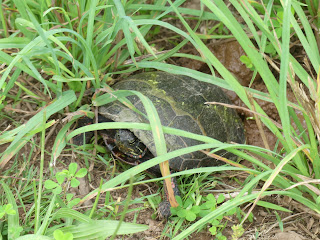
I'm pretty sure this Painted Turtle was out of the water and in loose sandy soil in order to lay eggs. (This picture doesn't show the carapace scutes well enough to tell if she's an Eastern Painted Turtle , though they are our most common subspecies of Painted Turtle.) There is another possible explanation for this turtle's presence, though it's also related to egg-laying. Apparently females will sometimes create a false nest, presumably to frustrate the many animals (like foxes, snakes, crows, raccoons, even some squirrels - basically any carnivore/omnivore that can find the eggs) that will eat turtle eggs. Sadly for turtles, a large number of them never get past the egg phase of their development. Our Eastern Painted Turtles don't lay a lot of eggs; usually a clutch will have around 5 eggs. Particularly large Painted Turtles generally lay more eggs at a time. This particular turtle seemed a little small so I wouldn't expect much more than 5. She might lay...

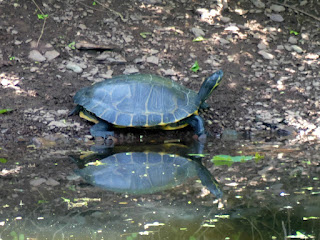
Submerged Eastern Painted Turtle

Image
When the water is clear and the lighting is good, you can sometimes get good looks at turtles even when they're submerged like with the 1st picture of an Eastern Painted Turtle [1]. And although it can take some patience, if you can't see the turtle clearly while it's underwater, they do have to at least poke their head out of the water periodically to breathe, like in the 2nd picture. (Note this strategy doesn't work on fish.) Generally speaking, I'll usually only get decent submerged pictures when my subject is pretty close to the surface. Most ponds and canals have water that's murkier than a swimming pool [2]. Here are older underwater photo successes of a Red-eared Slider and an Eastern Painted Turtle . Don't give up on a picture just because of a little water. May 11, 2023 at Great Swamp Photo 282421257, (c) jpviolette, some rights reserved (CC BY-NC) May 11, 2023 at Great Swamp Photo 282421265, (c) jpviolette, some rights reserved (CC BY-NC) [1] Rem...

Identifying a River Cooter

Image
Here's a River Cooter along the Delaware Raritan Canal last May. I'm going to try and explain how I arrived at this identification. Despite living in New Jersey, they're not documented in my Field Guide to Reptiles and Amphibians of New Jersey [1], so I went to the internet for some basic information . Here's what I can tell you: The plastron is yellow, not reddish-orange (female) or pink (male) that you would expect to see in a Northern Red-bellied Cooter . Also, Northern Red-bellied Cooters frequently have jet black heads and necks, while this turtle has noticeable yellow there. The carapace lacks the prominent lines around the scutes that you'd see in a Painted Turtle . It also lacks the rich tapestry of lines on the head/neck that you'd see in a Common Map Turtle . A Red-eared Slider normally has a prominent red blotch about where you'd expect an ear to be, and a Yellow-bellied Slider should have a prominent yellow blotch in that same spot. I also thi...

Red-eared Sliders and Painted Turtles

Image
Here are a couple pictures both featuring a Red-eared Slider and a Painted Turtle . In both these pictures the slider is the larger turtle; although sliders are on average bigger, there are plenty of Painted Turtles bigger than the average slider. I'm told the sliders are more aggressive than painteds, though I haven't actually witnesses that for myself. I've never actually seen a turtle fight/dispute. Though turtles do have claws, it's unclear to me they've got the strength or quickness in their limbs to be slashing each other up very often. It does sound like males of both turtles will use their claws to impress females and intimidate rivals . I know people have studied pecking orders around bird feeders, carcasses, etc. AFAIK no one has documented a pecking order regarding basking spots. Still, good basking spots are a limited resource, so I wouldn't be shocked to learn that size/aggressiveness differences result in some turtles getting the best spots. May 5...

Red-eared Slider Goes for a Swim

Image
We all know most of our turtles swim better/faster than they walk (except maybe you, Eastern Box Turtle ), but most of my pictures show them basking on a rock or a log . And if I'm lucky enough to meet 1 on land , I can almost always get a reasonable picture of them. Sometimes though if the turtle's swimming at the surface and isn't vacating the area quickly, I can get a picture like this Red-eared Slider below (or this older 1 of an Eastern Painted Turtle ). Although a lot of times the turtles consider me to be too scary (or ugly?) to be around, and dive into deeper waters, this 1 stayed near the surface a bit longer. This is the 9th and final blog post for my April trip to the Sourland Mountain Preserve. Although I sometimes go someplace that turns out to be disappointing, this particular trip was pretty productive.  April 14, 2023 at Sourland Mountain Preserve Photo 272126752, (c) jpviolette, some rights reserved (CC BY-NC)

Slider Scute Shedding

Image
Here's a Red-eared Slider that's shedding some of its scutes . These are the carapace segments you can see on many of our turtles. You can see 3 that are in the process of flaking off, and I suspect a spot near the back where a scute flaked off completely. I don't know if Red-eared Sliders shed their scutes more noticeably than other turtles, but the last time I showed a turtle shedding its scutes , it was also a Red-eared slider. Though it might look like something that could be caused by sickness or injury, it's actually a natural way of life for most turtles. April 12, 2023 at Duke Farms Photo 272113876, (c) jpviolette, some rights reserved (CC BY-NC)

Pond Slider Moves Up

Image
This Pond Slider is determined to get to the top, and it doesn't care who it has to step on to get there. In this case it's climbing on the back of a Northern Red-bellied Cooter . Though I've seen other species of turtle do this climbing thing, Pond Sliders have some reputation for being aggressive (or at least obnoxious). There are 2 subspecies of Pond Slider here in New Jersey and it's a little difficult to tell which 1 this is: Usually the Red-eared Slider has a pretty obvious red mark on its ear [1]. This picture is a little inconclusive though, with what I think is a slightly reddish tint blending in with the dark head.  The Yellow-bellied Slider lacks the red "ear", which I initially thought was the case for this turtle. They're also supposed to have wide yellow stripes on the side part of their plastron; this turtle looks to have fairly thin yellow stripes instead. My field guide suggests that there are a small number of Red-eared Sliders withou...

Personal Space and Turtles

Image
It's just barely spring, the weather's warming up, you want a place with ample sunlight but with easy access to water. For many turtles, this means there's some competition for a good log. I haven't seen fights over a log spot, but I'm some pushing, shoving, and even climbing atop other turtles certainly occurs. In this picture it looks like 6 Eastern Painted Turtles , 1 Red-eared Slider (in the middle, and with the red "ear"), and (probably) 1 Northern Red-bellied Cooter (the big 1 at the top). FWIW the (non-native) Red-eared Slider is considered a pushy species, though I do wonder about their ability to push around the usually-larger cooters. And AFAIK the more abundant Painted Turtles don't team up to help 1 another against the other species. Though it seems a little crowded, this is the general solution for turtles looking for some springtime sun. March 26, 2023 at the Raritan Water Power Canal Photo 269672785, (c) jpviolette, some rights reserve...

A Bale of Turtles

Image
Basking turtles - turtles who like to bask in the sun - are frequently found together, sometimes in pretty close quarters crowded on a log or a rock. Wikipedia suggests that a group of turtles is called a bale. This picture represents the Basking Big Three turtle groups [1] around here: Sliders - The top turtle is a Red-eared Slider , a species introduced to this region from other parts of the country. There are concerns that they might out-compete our truly native turtles, though right now we have plenty of other turtles. Pond Slider is the common name for the species, and around here the Red-eared Slider is the most commonly spotted subspecies. Painteds - The 2 turtles in the middle are Painted Turtles, probably Eastern Painted Turtles , our most common Painted Turtle. They have smooth (sometimes shiny) carapaces segmented into easily distinguishable scutes . Painted Turtle is the species name, while Eastern Painted Turtle refers to a particular subspecies. Cooters - The large t...

Pond Slider

Image
Most of the slider turtles I see in my area are the subspecies of Red-eared Slider . This is a turtle that usually - but not always - has a red blotch about where you'd expect an ear to be [1]. This particular turtle does have some red in this area, but it blends in with some yellow too. This might be a turtle with both Red-eared Slider and Yellow-bellied Slider  [2] heritage. Since both those turtles are subspecies of the Pond Slider , I'm inclined to identify it at the species level. Though both the Red-eared Slider and the Yellow-bellied Slider are native to the US (and for the former, Mexico too), neither is native to New Jersey. Both subspecies are in NJ today because they're fairly popular pet turtles. Since they're both the same species, it's not surprising that they interbreed pretty happily when they meet here. September 1, 2022 at Duke Island Park Photo 238904480, (c) jpviolette, some rights reserved (CC BY-NC) [1] Though most turtles hear pretty well, the...

Red-eared Slider on a Walkabout

Image
In July I spotted this Red-eared Slider walking around. As I've discussed before , Red-eared Sliders are a subspecies of Pond Slider , and with a name like that you generally see them in, on, or adjacent to water. So what's the turtle doing out of the water? Well, I can't rule out that the turtle simply felt it needed to find a better habitat. If a body of water gets polluted, or is drying out, or is simply too crowded, some intrepid turtles will look for a better place to live, even if it means journeying on land. Having said that, there is another time when female turtles absolutely need to leave the water. All turtles, even ones that will spend most of their lives in the water, need to lay eggs on land. I wouldn't be surprised if that's what's going on here. I considered following the turtle, though it's possible that a turtle looking to lay eggs would not do so if I were around. This is the 2nd time that I suspect I met a future mom Red-eared Slider . J...

Turtle Shedding

Image
A couple weeks ago I spotted 5 turtles (almost certainly Red-eared Sliders  except for the right-most one) basking on a rock. One thing a little interesting was that the turtle in the upper left had scutes on its carapace that were peeling . Though there are diseases associated with peeling scutes, it's generally a common way for water turtles to: Grow their shell as the turtles themselves grow. Preserve buoyancy by losing the weight of their old scutes. A turtle's carapace consists primarily of rib/vertebrate bones, though the outer layer of scutes are made of keratin , similar to our fingernails and toenails. As aquatic turtles grow, their shell grows but their scutes are no longer large enough to cover the enlarging shell. Their solution is to grow new scutes underneath the old ones and then shed the old scutes. This scute shedding helps keep a turtle streamlined and lighter for swimming in water. Land tortoises don't shed their scutes but instead add a new scute layer...

Pushy Red-eared Slider

Image
I've mentioned that the Red-eared Slider , while a North American species, is not native to New Jersey . When I said they can "aggressively bully other turtles for resources", it could mean out-competing them for food, but it could also mean taking the most desirable basking locations. Here's an example of a Red-eared Slider that found another turtle [1] in a prime basking location, and how the Red-eared Slider dealt with the problem. It just climbed up on the first turtle's carapace, hogging most of the sunlight. Of course, if the bottom turtle is sufficiently bothered by the top one, nothing prevents it from dropping into the water, almost certainly taking the top turtle with it. (I'm thinking that this Red-eared Slider is the equivalent of the annoying coworker that you don't like working with, but also don't complain to management about.) March 21, 2022 at Duke Island Park Photo 186773930, (c) jpviolette, some rights reserved (CC BY-NC) [1] I'm...

Red-eared Slider

Image
Let's show another commonly seen turtle around here: the Red-eared Slider . Most of the time this "species" can be reliably identified by ... (wait for it) ... their red "ear". Why the quotes? First, the Red-eared Slider isn't a species in its own right but is a subspecies of the Pond Slider . Second, the Pond Sliders don't have external ears, red or any other color, though the red mark is about where you'd expect an ear to be if they had external ears. There is another Pond Slider subspecies, the Yellow-bellied Slider , that I'm told is in NJ too, though I can't authoritatively say I've seen one. These turtles are popular as pets, and pets that have escaped or been released are the main reason the Red-eared Slider is an invasive animal in many parts of the US and other parts of the world. Their popularity peaked when it was revealed that the Teenage Mutant Ninja Turtles were Red-eared Sliders. As an invasive species they potentially imp...

Potential Red-eared Slider Mom?

Image
In basically the same spot I met the Northern Red-Bellied Cooter laying eggs , I met a Red-eared Slider that was surveying the same area. This turtle didn't seem to be looking to leave Great Falls Lake for another lake, so I'm very suspicious this was another female looking for a desirable spot to lay eggs of her own. You should be able to see the red spot behind the eye that identifies the turtle as a Red-eared Slider. I didn't stick around to confirm this suspicion. While the Northern Red-bellied Cooter was in the process of laying eggs and thus committed to the spot she was in, it's at least possible that my presence might have caused the turtle to decide to go somewhere else to lay her eggs.  Red-eared Sliders lay 3-17 eggs, or 2-30 eggs, depending on what source you're using. The number of eggs correlates to the size of the turtle. The turtle eggs hatch in 59-112 days, and apparently are influenced by temperature and rainfall. My impression is that we've h...

Basking Turtles

Image
Here's a pair of turtles sharing a log. Due to the color red, both are fairly easy identifications. You can see the red "ear" on the turtle on the left, making it a Red-eared Slider . And the red plastron on the turtle on the right (plus its size) make it a Northern Red-Bellied Cooter . There are some concerns that the guy on the left, introduced to this area from other parts of the US, may crowd out our native species (including the guy on the right). The sliders are considered a more aggressive turtle, though they do have a size disadvantage compared to our cooters. When I see turtles basking in the sun, they usually turn out to be these turtles or the Eastern Painted Turtle ; currently all 3 species seem to be doing pretty well around here. May 13, 2021 at the Raritan River Greenway Photo 132037500, (c) jpviolette, some rights reserved (CC BY-NC)

Red-eared Slider

Image
Let's try and identify more turtles. The side-to-side scute alignment clearly identifies the 2 turtles in the front and on the left as Eastern Painted Turtles . I can't see the 3rd turtle from the left as well, but I think it's also an Eastern Painted. But what about that turtle on the right? The scutes don't align, so we can rule out the Eastern Painted Turtle. I think I see a slight keel going down the carapace, and I can see a fairly prominent red mark on the head. These probably mean that this is a Red-eared Slider . Those red marks are where we'd expect ears to be, though turtles have internal ears so these aren't technically ears. These turtles are native to the US but not to NJ. They're native to an area centered around Arkansas and stretching from most of TX to western WV. They reproduce faster than most turtles, tend to be aggressive (by turtle standards), and out-compete some of our native species for food and basking spots. April 5, 2021 at Rarit...

Turtle Identification - Part 2

Image
After introducing some of the key things to look for in turtle identification, I want to mention the limitations of the identifications I'm doing. Most of these pictures are taken using all the magnification my camera can provide, and they still don't always provide the detail I'd like. Depending on the position of the turtle, I rarely get a view of the plastron, and if I do it's usually at the expense of a view of the carapace. If I could examine the turtle in my hands, I'd be able to do turtle identification a lot better. Having said that, the 3 middle turtles below provide a very good clue as to what they are. My field guide tells me that the Eastern Painted Turtle is the only species in NJ where "the large scutes are lined up in even rows across the carapace". From left to right, the 3rd and 4th turtles give you a good view of the scutes on the carapace lining up. These are Eastern Painted Turtles. If you look at the 2nd turtle, the scutes near the f...