Posts

Showing posts with the label red-tailed hawk

Red-tailed Hawk Looks Over Its Menu
Image
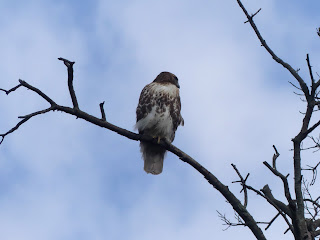
This Red-tailed Hawk may have been hungry, and there was a Woodchuck  (AKA Groundhog) and an Eastern Cottontail in the vicinity [1]. And while Woodchucks can be somewhat tough and feisty [2], rabbits are certainly on the Red-tailed Hawk's menu. Though it's hard not to sympathize with the prey animals when predators are hunting, to our hawks eating small animals isn't a choice as much as a necessity. To them our little furry friends are just food, like a burger, fries, and a shake. June 10, 2023 at Duke Farms Photo 300986026, (c) jpviolette, some rights reserved (CC BY-NC) June 10, 2023 at Duke Farms Photo 300986041, (c) jpviolette, some rights reserved (CC BY-NC) June 10, 2023 at Duke Farms Photo 300986076, (c) jpviolette, some rights reserved (CC BY-NC) [1] I'm using the phrase "in the vicinity" a little loosely; I think I saw the Woodchuck and rabbit within 20 minutes of seeing the hawk. [2] I kind of wonder if Red-tails mostly sneak-attack adult Woodchuck...
Red-tailed Hawk Sternly Scanning the Area

Image
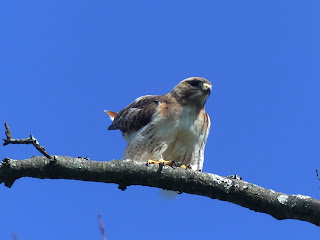
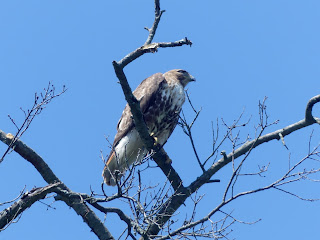
This Red-tailed Hawk was intensely surveying its surroundings last spring. They do spend a fair amount of time staring off into the distance (like this hawk and this hawk ), presumably because: Their ability to see things at a distance is quite a bit better than ours. You never know when you're going to spot your next breakfast/lunch/dinner out there. Though the red (actually orange) tail isn't really in evidence with this particular Red-tail, it does have a very prominent "belly band", the dark speckles going across the belly of the hawk. In this area, that belly band is probably a somewhat better field mark for identifying Red-tails than a red/orange tail.  I do end up showing Red-tailed Hawks quite a bit; fortunately for you guys, they are fairly photogenic birds. June 5, 2023 at Duke Farms Photo 300862081, (c) jpviolette, some rights reserved (CC BY-NC)

Soaring Red-tailed Hawk

Image
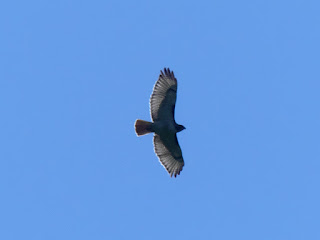
Here's a Red-tailed Hawk scanning the area. You might be able to see a little orangish coloring on the tail. If the tail was a light as the wing feathers, I'd probably be suspicious of a Turkey Vulture . This is also an example of a Red-tailed Hawk where the speckled belly band doesn't show up very well. The lesson: sometimes lighting can fool you into a misidentification. May 25, 2023 at Duke Farms Photo 292819087, (c) jpviolette, some rights reserved (CC BY-NC)

Red-tailed Hawk

Image
It's almost like this Red-tailed Hawk wanted to avoid a misidentification so its prominently displaying its red [1] tail. Since I'm pretty confident that birds don't really care what we identify them as, I'm assuming this positioning was a prerequisite to a good tail-preening session. Still, when people can't see that iconic red tail [2], misidentifications can run wild. The most over-enthusiastic people will claim to have seen an eagle, and I have to admit that a Golden Eagle does look a bit like a very big Red-tailed Hawk [3]. Probably the only thing that prevents more widespread misidentification is that the Red-tailed Hawk is quite a bit more common than our other hawks, like Red-shouldered Hawks , Cooper's Hawks , and Northern Harriers . May 13, 2023 at Duke Farms Photo 282423074, (c) jpviolette, some rights reserved (CC BY-NC) [1] Yeah, I know, it's more of a burnt orange tail than a red one, but people used to refer to colors differently . [2] Techn...

Red-tailed Hawk Surveying the Area

Image
This Red-tailed Hawk was looking around the area, presumably checking for both potential threats and potential meals. (I'm assuming it wasn't sure whether I was the former, and was more confident that I wasn't the latter.) This hawk had the size and shape of a Red-tailed Hawk, but didn't obviously display either of my favorite field marks for the species: Maybe you can interpret there to be a little burnt orange color on the tip of tail that's visible in the 1st picture, but it looks more brown in the 2nd picture. I'm not sure whether to attribute this to youth or lighting. While young Red-tailed Hawks do have brownish tails, the better look at the tail looked like it was shaded by the hawk's body, perhaps obscuring some orange coloring. Most of this area's Red-tailed Hawks have a brown-speckled "belly band". When I enlarge the picture I think I see a speckle or 2, but far less than usual for these hawks. My explanation for this is that some s...

Red-shouldered Hawk

Image
I have to admit that I didn't recognize who this was at 1st. (I don't see a lot of Red-shouldered Hawks , and iNaturalist says they're critically imperiled in New Jersey.) The thin even stripes on the breast/belly reminded me of our accipiters , our Cooper's Hawk and Sharp-shinned Hawk , but their heads would have more color and their tails wouldn't have white stripes. Instead it turned out to be the buteo that resembles an accipiter. Though this is considered of our most vocal hawks (listen to its soothing music stylings here ), this 1 wasn't talking. Perhaps because it had its mouth full; it was clearly tearing apart and eating some small animal. This was taken adjacent to a canal, so frogs, small turtles, snakes, squirrels, rabbits, muskrats, and any number of small birds could have been its victim. Though some old-time birders considered Red-shouldered Hawks and Red-tailed Hawks to be arch enemies that wouldn't share a habitat, the Red-shouldered Hawk...

American Kestrel Perching

Image
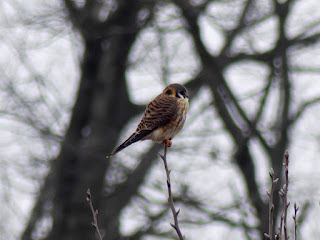
Here's another American Kestrel  I encountered, this one in January. This one was closer than the one I saw in October , and both closer and with better lighting than the couple sightings in November . I'd expect to see a lot more blue (especially on the wings) if this was a male, so I'm pretty confident that this is a "she". We don't always appreciate just how light most birds are. This falcon is able to perch on the top of what's basically a twig because she only weighs about a quarter of a pound (117 grams). She was at Farm Barn Lane at Duke Farms. With a few kestrel boxes set up for them and surrounded by meadows with small prey, this is a fairly popular place for American Kestrels. In fact, when I was there yesterday a photographer said he had spotted a pair mating on one of the boxes. Unfortunately I failed to spot - let alone photograph - this kestrel romance. Still, this area does have its drawbacks. I've spotted a Northern Harrier and a few R...

Hawk Fight

Image
It's Throwback Thursday, so let's talk about something I saw 4 years ago. (Some of you might be familiar with this story already.) A few years ago while wandering through a patch of woods trying to walk off my lunch, I encountered a hawk version of mixed martial arts. Initially I had heard a Red-tailed Hawk screaming [1] overhead, which I considered a little puzzling since I'd expect the noise to be advertising to all their potential prey to be on alert. I didn't get a visual of the hawk in flight though, and soon forgot about it. Then 15-20 minutes later, I heard a commotion in a little clearing off the trail. It turned out to be a couple of Red-tailed Hawks battling on the ground. (I don't know if the fight started in the air, though I wouldn't be surprised if it did.) Initially I couldn't tell what was going on. I saw 1 hawk that seemed to be thrashing around and I wondered if it was hurt. Looking closer it became clear that there were 2 hawks involved, ...

"Singing" Red-tailed Hawk

Image
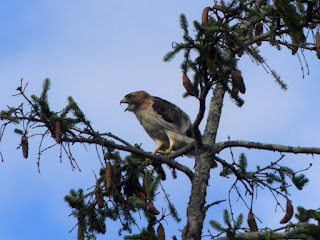
I doubt most of you would consider this Red-tailed Hawk to be singing [1] if you heard it, though for all I know it could have been the hawk equivalent of a love song advertising their availability for courtship. Or maybe it's a defiant warning to other hawks that this territory is taken. The warning call may be more likely since I'm not sure Red-tails are looking for mates in September.  For most of our hawks and eagles, the females are larger than the males. It's not completely clear why that's the case. One theory is that since the males and females are different sizes, they may each be a little better at hunting certain types of prey; the larger female might be better able to handle a fully grown skunk while the smaller and more agile male might be able to catch an incautious starling. So why wouldn't the male be larger? Maybe because the female spends more time incubating the eggs, and her larger size covers the eggs better [2]. September 22, 2022 at Duke Farm...

Great Horned Owl

Image
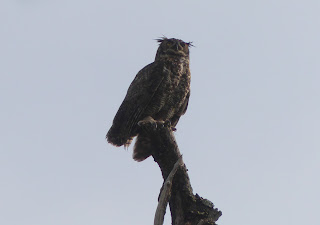
On iNaturalist I got a validation today for one of my owl pictures from 5 years ago, so let's do a Great Horned Owl for Throwback Thursday. I suspect this picture came from back when Duke Farms was running periodic bird watching programs since the picture was taken before the core part of the property is open to the public (7:58 am). Great Horned Owls is probably our largest year-round owl, and thus near the top of the nocturnal food chain. They're presumed to have little sense of smell (like most birds) which probably makes them one of the few animals to prey on skunks. (I suspect Red-tailed Hawks would also go after skunks, but since skunks are nocturnal they're more likely to be found by owls.) Crows understand the predacious nature of Great Horned Owls; if crows discover a GHO in their area, they'll almost certainly get together and try and harass the owl into leaving. They have an attention-getting relative. Despite the lack of "horns" and their white c...

Red-tailed Hawks

Image
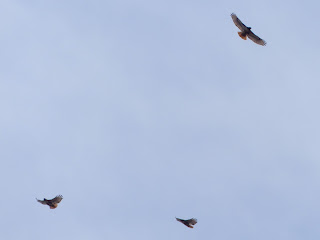
Back in March I saw a trio of Red-tailed Hawks overhead. I've read that "spring circling of a pair can be a prelude to copulation", though obviously this is more than a pair. Seeing them together like this in the spring makes me think that breeding was on their minds, though presumably one of them will have to look elsewhere for love. I don't think I'd even guess at the genders of these hawks. I'm sure the females are (generally) larger, but without knowing how close each individual is I'm not confident in saying whether there are 2 females or 2 males in the picture. If I had to guess, I'd guess there are 2 males attempting to court the same female, and that 2 females wouldn't be in the same vicinity for very long without a decisive territorial battle ensuing. The hawks eventually soared out of sight, so I have no knowledge of how things settled out between them. March 10, 2022 at Duke Farms Photo 186582487, (c) jpviolette, some rights reserved (C...

Common Raptor IDing

Image
Many people would like to think that the birds they see soaring above them are Bald Eagles , though Turkey Vultures , Black Vultures , and Red-tailed Hawks are much more common. And since the birds are frequently pretty high up in the sky, you aren't necessarily going to get a really good look at them. Here's sort of a beginner's guide to IDing these birds, where I'll stay away from the subtle points. First up is a Turkey Vulture. Sometimes like in this picture you'll see a flash of their red heads, but even from much further away you can usually see pale feathers starting from the ends of the wings, going along the backs of the wings, finally ending at the body itself. In this picture the pale feathers contrast quite a bit from the dark feathers to look white; most of the time the difference in feathers is more subtle than this, though the outline is always there, and this unusual amount of contrast demonstrates it well. February 1, 2022 at Duke Farms Photo 184269...

Red-tailed Hawk Spots Something

Image
Last autumn I saw this  Red-tailed Hawk  up in a tree near my apartment. (I don't recall if the local Blue Jays or crows alerted me to the hawk, though many times when I hear them making a commotion there is a hawk in the area.) What I found cool about these pictures is that you see the difference between when I hawk is scanning the vicinity for a meal and when the hawk actually sees something it's interested in. If I were a squirrel foraging in the direction of that 2nd gaze, I'd be pretty nervous about now. FWIW I didn't actually see the hawk attack anything that day. November 12, 2021 in Bridgewater Photo 169044287, (c) jpviolette, some rights reserved (CC BY-NC) November 12, 2021 in Bridgewater Photo 169044304, (c) jpviolette, some rights reserved (CC BY-NC)

Dark-eyed Junco

Image
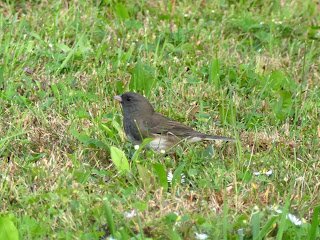
While people have long considered the American Robin a harbinger of spring, there's some justification in considering the Dark-eyed Junco as a harbinger of winter (though perhaps identifying them as such would adversely affect their popularity). This was almost certainly one of the 1st juncos I saw last autumn. (The Cornell Lab of Ornithology implies that juncos are here all year round, though I've never actually seen one in the summer.) This species is a little like the Red-tailed Hawk in that different subspecies across the continent have quite different plumage, probably making early ornithologists think they were different species. In our area, we generally have the "slate-colored junco", the subspecies that's got a whitish belly and is gray (males) or grayish-brown (females) above. Another thing they have in common with Red-tailed Hawks is that red-tails are among our most common raptors, and the Dark-eyed Junco is one of our most common birds overall. The...

Another Red-tailed Hawk

Image
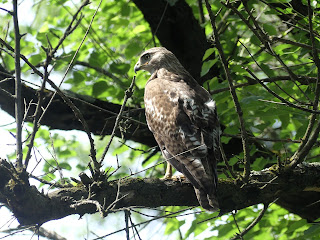
Though fairly common, Red-tailed Hawks are cool-looking birds. I got this picture last autumn; perhaps the hawk regretted the autumnal leaf-dropping since the sparse foliage left it more exposed than earlier in the summer. There's an obscured view of the belly band that my area's Red-tailed Hawks are known for. There's not a great view of the tail, though it looks to have more of a light brown color. I suspect this hawk may be young and hasn't yet acquired the burnt orange tail for which they're named. It's worth mentioning that while the tail and the belly band are very reliable field marks here in NJ, in other parts of the continent there are subspecies too dark to have a noticeable belly band and/or may have dark brown or white tails. October 2, 2021 at Duke Farms Photo 168357965, (c) jpviolette, some rights reserved (CC BY-NC)

Red-tailed Hawk

Image
Last September I saw this fella flying around, a Red-tailed Hawk . They are one of our most commonly seen raptors, behind only the Turkey Vulture and (probably) Black Vulture . Both our vultures give a much darker look up in the sky. I'm not sure how many owls (especially Screech Owls ) we have, but they're much less likely to be seen during the day. You shouldn't be looking for a truly red tail; adults have tails that are more like a burnt orange, juveniles are a light brown. The ones in our area usually have a fairly distinctive "belly band", basically speckles that go across the belly. No other raptor in my area should have this band of speckles. You can see the belly band well in the 1st picture while I think you've got a hint of the burnt orange tail in the 2nd picture. September 19, 2021 at Duke Farms Photo 168281295, (c) jpviolette, some rights reserved (CC BY-NC) September 19, 2021 at Duke Farms Photo 168281320, (c) jpviolette, some rights reserved (C...

The Hawk and the Sparrow

Image
I took these pictures 40 minutes apart and in somewhat different areas, so these individuals many have never met (which would be fortunate for one of them). First, here's a picture of one of our most commonly seen large birds, a Red-tailed Hawk . July 25, 2021 at Duke Farms Photo 148652475, (c) jpviolette, some rights reserved (CC BY-NC) And following that, I spotted one of our most commonly seen sparrows, a Song Sparrow . July 25, 2021 at Duke Farms Photo 148652819, (c) jpviolette, some rights reserved (CC BY-NC) There's no chance of these guys being friends, though the Red-tail probably does like Song Sparrows as a side order. My impression is that Red-tails aren't maneuverable enough to rely on catching passerines (and similarly-sized birds like woodpeckers and pigeons), though if they can get the drop on an unwary one they won't hesitate to do so. I'd expect the Red-tail to have more hunting success with rabbits, rodents, and maybe some snakes or turtles. In its...

Blue Jay

Image
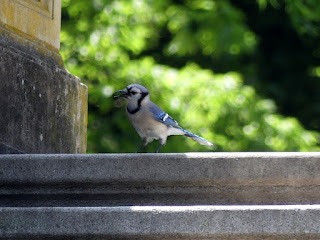
Here's a Blue Jay I met a couple months ago. Though these guys abundance, vivid color, and noisiness make Blue Jays one of the easiest birds to spot, I don't really get a lot of pictures of them. As corvids, they're probably smart enough to be leery of humans, and tend to move around quite a bit making it harder to focus a camera. This picture came out pretty good though. Blue Jays aren't versatile mimics - they're unlikely to imitate other passerines - but they are considered to do an excellent imitation of at least 2 birds: Red-tailed Hawks and Red-shouldered Hawks . It's possible they developed this as a warning call, though they might use it to scare other birds away from a good food source too. Certainly this call will get the attention of most birds (and birdwatchers) in the area. I talk a lot about species that exhibit sexual dimorphism , where color or size easily distinguish the males from the females. Blue Jays are a good example of the opposite, mon...

Red-tailed Hawk

Image
Here's a Red-tailed Hawk I met a couple months ago at Duke Farms. In other views the tail looked brown and the eyes yellow, suggesting that this is a somewhat young Red-tailed Hawk. I doubt that a Red-tailed Hawk that hatched this year would have been hunting on its own in mid-May, so I suspect this hawk was born in 2020. If that's true, it might have a handsome orange tail by late fall as it molts. Could this be the same Red-tailed Hawk that I photographed near the Orchid Range in mid-June? It's possible, though it's worth remembering that the Red-tailed Hawk is one of the most common raptors in the state. This fella wasn't staring straight at me, but definitely in my general area. I'm not sure what it saw, but it's possible my presence inadvertently saved the life of some small critter. May 18, 2021 at Duke Farms Photo 132040010, (c) jpviolette, some rights reserved (CC BY-NC)

Red-tailed Hawk

Image
Here's a Red-tailed Hawk that was at Duke Farms last weekend. When I went to the Outdoor Education booth at noon, I was told there was a lot of activity earlier in the morning. A juvenile Red-tailed Hawk was flying close by before being chased out of the area by surprisingly small birds. Four hours later, it looked like the hawk had returned, letting people get pictures (like the one below) fairly close up. Perhaps because it's a youngster, the hawk flew fairly close to humans and let humans walk even closer. It may be surprising to see a hawk being chased by a single small bird, but I've seen it happen fairly often. I suspect that the small birds are quick and maneuverable enough that larger birds generally can't successfully turn on their attacker, though I also suspect that the small bird has little margin for error. I'm sure fatal mistakes have been made by mobbing birds. June 12, 2021 at Duke Farms Photo 136371956, (c) jpviolette, some rights reserved (CC BY-N...