Posts

Showing posts with the label mite

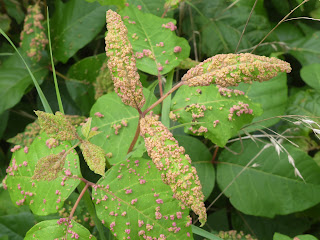
Poison Ivy Leaf Mites
Image
Last weekend at Duke Farms the Outdoor Education topic was "Nature's Nasties", mostly focusing on stuff to avoid like Poison Ivy , Stinging Nettle , and Deer Ticks [1]. We weren't exactly sure what to make of the pinkish growths on some of the Poison Ivy growing nearby. (While 1 of the staff theorized they could be some sort of galls - which turned out to be correct - some sort of fungus also sounded feasible.) Of course there's a natural reluctance to handle Poison Ivy to try and figure out what the stuff was, which didn't help the investigation. After getting home, a quick search showed me a webpage with Poison Ivy with almost exactly the same condition, which they attributed to Poison Ivy Gall Mites. (FWIW iNaturalist uses the name Poison Ivy Leaf Mites.) Although I can't imagine that covering a leaf with these galls doesn't have some impact on Poison Ivy's ability to photosynthesize, this article suggests that the galls aren't particula...

Eastern Calligrapher

Image
Meet an Eastern Calligrapher , an insect I probably haven't shown you before. (At least I hope it's an Eastern Calligrapher; some of its relatives look similar.) Eastern Calligraphers are part of a very large group of insects sometimes called hover flies (the males will hover around, either defending a territory from other males or just hoping to get the attention of a female), sometimes called flower flies (the adults feed off of the nectar and pollen of flowering plants), and sometimes called  syrphid flies (pronounced SUR-fid, which appears to come from Greek and Latin words loosely meaning "descended from gnats"). These flies have a waspy look, are considered wasp mimics, and since they can't sting, they're a good example of Batesian mimicry . Notice though that as flies, they have only 1 pair of wings whereas wasps, bees, and most flying insects have 2 pairs of wings.  They're considered pollinators , though they're probably not as effective as...