Posts

Showing posts with the label eastern comma

Contradictory Looks of the Red Admiral Butterfly

Image
This post demonstrates the extremely different looks that Red Admiral butterflies can present to the world. (Being fairly common yet attention-getting, I've shown them before, like here and here .) Today I want to demonstrate how they can (not so magically) disappear. The trick is in the color pattern of the top and bottom of their wings. When you see the tops of the wings, you see a mostly-black butterfly with vibrant orange lines and sharply contrasting white spots. July 5, 2022 at Duke Farms Photo 221312289, (c) jpviolette, some rights reserved (CC BY-NC) But when it raises its wings, abracadabra, it's disappeared! Okay, it hasn't quite disappeared, but it sure blends in with a dirt-stick-leaf background, doesn't it? July 5, 2022 at Duke Farms Photo 221312326, (c) jpviolette, some rights reserved (CC BY-NC) Although not closely related to the Red Admiral, our Eastern Comma and Question Mark butterflies also have earthy-looking underwings. Sometimes I'm follow...
Eastern Comma in Winter

Image
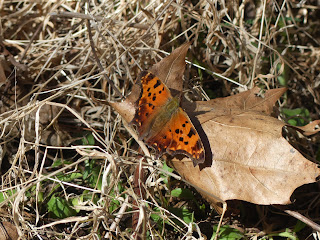
Even before I saw my 1st Mourning Cloak butterfly this spring, I saw my 1st Eastern Comma butterfly when it was still technically winter (though I'm sure it was an unseasonably warm day). With a little luck you might run across one of these guys yourself. The reason you can see these butterflies so early in the year is similar to why you can see Mourning Cloaks so early: They overwinter as adults, presumably hiding under bark or in leaf litter as they go dormant during cold temperatures. They don't rely on nectar (which is rare in winter and early spring) for sustenance, actually preferring to drink sap, the fluids of rotting fruit, or scat. They don't need flowers to survive. Note that we had some pretty cold weather after this date, but that doesn't necessarily harm this butterfly. It can re-enter a dormant state without much of a problem, and then become active again when things warm up again. March 11, 2022 at Duke Farms Photo 186583629, (c) jpviolette, some right...

Punctuation Butterflies

Image
While September 24 is National Punctuation Day , July 31 was my personal Punctuation Day when I photographed 2 Question Mark butterflies and 2 Eastern Comma butterflies. The "punctuation butterflies" were definitely out and about on this day. [1] Eastern Comma July 31, 2021 at Duke Farms Photo 149014716, (c) jpviolette, some rights reserved (CC BY-NC) Eastern Comma July 31, 2021 at Duke Farms Photo 149014866, (c) jpviolette, some rights reserved (CC BY-NC) Question Mark July 31, 2021 at Duke Farms Photo 149015240, (c) jpviolette, some rights reserved (CC BY-NC) Question Mark July 31, 2021 at Duke Farms Photo 149015674, (c) jpviolette, some rights reserved (CC BY-NC) [1] I'm pretty sure these were taken during the annual Duke Farms Butterfly Count.

The Flying Away Problem

Image
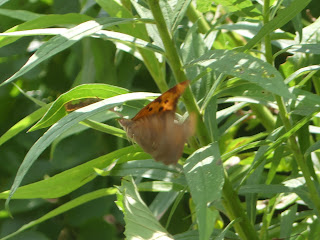
Sometimes I almost get an identifiable picture. This frequently happens when the subject doesn't disappear entirely (like frogs/turtles diving into water), but when wings of a fleeing animal obscure details. In this first instance, I can tell this is one of our commas just from shape/color and visible patterns. But I can't distinguish between our 2 most common commas: The small pattern of the top view of the wing seems closer to the spots I'd see on an Eastern Comma . There seem to be 2 blurred pale lines on the moving underwing, which suggest the 2 marks (dot and curved line) that I'd see on a Question Mark . In this case I'm stuck with being able to tell the genus (Polygonia) but not the species. July 30, 2021 at Negri Nepote Native Grassland Preserve Photo 149012466, (c) jpviolette, some rights reserved (CC BY-NC) The next one shows a bird trying to avoid getting its picture taken, though not in time. Though there's not much detail of the face, the yellow bo...

Question Mark Butterfly

Image
Here's a pretty good look at how the Question Mark butterfly got its name - the almost-white dot and curl may not be oriented the way you'd expect a "?" to be, but that sideways question mark dot-and-curl is classic for this butterfly. (Note that if you see just the curl without an accompanying dot, you're looking at a comma. In my area, the butterfly usually turns out to be the Eastern Comma .) July 10, 2021 at Duke Farms Photo 148186128, (c) jpviolette, some rights reserved (CC BY-NC) Though you can't see the curl and/or dot when they open their wings, they're actually more colorful with that view. Technically you can distinguish the Question Mark from its comma cousins by looking at the dark blotches on the top of the wings. I discussed that in a prior post . July 10, 2021 at Duke Farms Photo 148186079, (c) jpviolette, some rights reserved (CC BY-NC)

Question Mark

Image
Here's another Question Mark Butterfly I met. As I've mentioned before, they are fairly easy to mistake for a close relative of theirs that's also in my area, the Eastern Comma . Here's a way to identify the Question Mark. Six prominent spots surrounding one larger spot Notice both wings have in the enclosed areas have: A large spot/blob near the edge of the wing. This is present in both species. The pair of large spots are both surrounded by 6 smaller but fairly observable spots, and the one closest to the point of the wing is longer/thinner than the others. This extra longer/thinner spot is absent in the Eastern Comma (and the less common Gray Comma and Green Comma). Here's the original picture too. August 18, 2020 at Duke Farms

Question Mark

Image
Meet a Question Mark butterfly. On the underwing they can be differentiated from the similar-looking Eastern Comma butterfly (which is a relative, and shares traits, food choices, and behaviors) because of a curve mark and a dot mark, while the Eastern Comma has only the curve mark: These marks are responsible for the names "question mark" and "comma". Personally I think that a Semicolon butterfly would be a slightly better name for the Question Mark given their appearance, though admittedly the question mark is a much more recognizable punctuation mark. But what happens when you only have the more colorful top wing view? While the color and spot patterns are similar, there is a subtle difference in the spot patterns. On the Question Mark there is a straighter and extra spot on the forewing; I've attempted to point to it here. One of the cool things about both the Question Mark and its Eastern Comma cousin is that both of these guys survive the winter, and you...