Posts

Showing posts with the label eastern tailed-blue

Blue and Admiral

Image
Here are a couple butterflies I saw last summer that don't have a lot to do with 1 another, but were both too photogenic not to share. The first is another Red Admiral butterfly while the 2nd is an Eastern Tailed-blue . Since I don't see a hint of violet/blue on the top of the wings of the Eastern Tailed-blue, I'm pretty sure this is a female butterfly; here are some males for contrast. (AFAIK there isn't an easy way to tell the gender of Red Admirals ... though the butterflies themselves do it pretty routinely.) June 24, 2023 at Duke Farms Photo 301212473, (c) jpviolette, some rights reserved (CC BY-NC) June 24, 2023 at Duke Farms Photo 301212623, (c) jpviolette, some rights reserved (CC BY-NC)
Summer Azure

Image
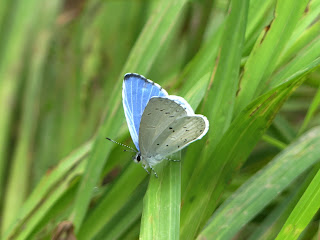
Here's a Summer Azure showing how they got the azure part of their name. (Since this picture is from June, I'm considering it to be a Summer Azure rather than a Spring Azure.) Though I'm sure I benefited from particularly favorable lighting, this picture shows off the blue you can see when they open their wings. (I wish I had gotten a fully-open wing shot, but this was the best I could do.) This is a butterfly that would probably impress people more if they were larger and thus harder to overlook. Similar to birds, I'm fairly confident that the brightness of the blue in this picture indicates this is a male; generally I'd expect females to be drabber in color. This individual also has a more vibrant look than their distant cousins, the Eastern Tailed-Blues . June 20, 2023 at Washington Valley Reservoir Photo 301112499, (c) jpviolette, some rights reserved (CC BY-NC)

Azure Versus Eastern Tailed-Blue

Image
Here are a couple small butterflies that can be distinguished, though not at a glance. It's one of our azures and an Eastern Tailed-Blue . This 2 butterflies are similar enough in appearance to suggest some level of relatedness, and they're in the same tribe . (A tribe is a taxonomic level between family and genus.) Let's take a minute to distinguish between these guys. First I'll mention that butterfly watchers will sometimes give you a behavioral identification; if they see 1 of these butterflies flying low to the ground and only moderately fast, they'll identify them as Eastern Tailed-Blues. And if the butterflies are zippier and away from the ground, they're inclined to identify them as one of the azures. (Exactly which azure was a topic in another posting .) While behavioral IDing might work a high percentage of the time, I have seen it fail too. You probably shouldn't argue with such an ID unless you get good looks at the butterfly when it's stati...

Eastern Tailed-blue

Image
Here's 1 of our Eastern Tailed-blue butterflies. Though I usually identify these butterflies by a little piece of their hind wings that sticks out a bit (aka "the tail") [1], in this particular picture the background makes this a little hard to see. The other field mark that differentiates this butterfly from the Azure Complex butterflies is a small orange spot on the underside of the hind wing, which you ought to be able to see in this picture. Given that sometimes part of the wings can be torn off, the orange spot is probably a slightly more reliable field mark, though it's easier for me to remember that Eastern Tailed-blues have "tails". Although being able to see that orange spot is good for identification purposes, the view of them with their wings up does have a downside. The primary way to identify a female from a male is if the top view of the wings is gray rather than a purplish-blue. I'm not aware of a way to tell the gender from this view; ...

Large and Small Butterflies

Image
Butterflies were still a little hard to find in early May; here's an Eastern Tailed-blue and an Eastern Tiger Swallowtail I met back then. These are both fairly abundant butterflies in New Jersey. Even though we have more Eastern Tailed-blues in a typical summer, I suspect the average New Jerseyan thinks the Eastern Tiger Swallowtail is more common. This is mostly due to their much more conspicuous size - they're among our largest butterflies - but the contrasting yellow-and-black coloring also gets attention. The Eastern Tailed-blues, on the other hand, are pretty small, and with their wings up they mostly look they appear off-white with some black specks. This might not constitute camouflage, but it's not as attention-getting. And while the male Eastern Tailed-blue below is a purplish-blue, the females are more of an earth-toned gray . Finally, habitat is also a factor. I usually see Eastern Tailed-blues close to the ground while Eastern Tiger Swallowtails are often fo...

Azure Butterflies

Image
There are lots of butterflies in NJ that look similar [1] though most of the time there are subtle differences that allow them to be identified (even if it requires getting a better look than the butterfly provides to you). But I'm not confident this can be done with the Spring Azure ,  Summer Azure , Lucia Azure , and Appalachian Azure . They (and other) species are small butterflies with light, speckled underwings with (at least for males) bluish-purple upperwings, and without the "tails" and orange spots associated with Eastern Tailed-blues .  Although today these butterflies seem to be recognized as separate species in a Spring Azure Complex  (where a complex is a set of related species that are difficult to differentiate) there have been times in the past when they were all considered one species with different broods and with regional variations.  Having said that, some lepidopterists appear to have detected subtle physical differences between Spring and Summ...

Eastern Tailed-blue

Image
Here's a pretty good shot of an Eastern Tailed-blue , though you could be forgiven for thinking they're more of a violet-blue in color. Although you can quibble with the shade of blue, the blueness that's there says that this is a male; the females tend to look gray instead. In flight you'll see this blue coloring flashing since the underwing is mostly a slightly speckled white. (The underwing also has a little orange spot, though I doubt you'll pick that up in flight. You can see what the underwings are like in the picture here .) They can be confused with the Spring/Summer Azures . The best ways to distinguish the Eastern Tailed-blue from them are: The azures don't have the little "tails" on their rear wings. When their wings are up, the azures shouldn't show the little orange markings of an ETB. (Distinguishing the Spring Azure from the Summer Azure is something I can only do based on the season.) Although neat looking, these are pretty small b...

Eastern Tailed-Blue Who's Gray

Image
Here's an Eastern Tailed-Blue butterfly that's gray (aka grey ). Is this butterfly diseased? Is it a mutant ? With superpowers ? Does it have chameleon -like abilities? No, no, none we know about, and no. This is a female Eastern Tailed-Blue, and all of them are gray. For good or ill, we name many species based on their appearance even when sexual dimorphism occurs. This typically means we name a species after the appearance of the more eye-catching of the sexes, which (especially in birds) usually means they're named after the male. (It's possible that some misogyny also influenced this naming convention.) September 14, 2021 at Duke Farms Photo 168279967, (c) jpviolette, some rights reserved (CC BY-NC)

Mudpuddling Eastern Tailed-Blues

Image
Here's a group of Eastern Tailed-Blues engaged in mudpuddling , basically trying to get nutrients from the soil that they can't get from their nectar (basically sugar water) diet. This behavior is usually performed by males, though the benefits are transferred to the females as a nuptial gift during mating, and should improve the survivability of their offspring. The two butterflies on the right have their wings down and you can see how these tiny guys get the "blue" part of their name. It's harder to see the "tail" (really just a part of the hind wings that protrude out a little bit), though other looks have me confident of the identification. May 6, 2021 at Sourland Mountain Preserve

Eastern Tailed-blue

Image
Here's a type of butterfly I've been meeting quite a bit over the last month, the Eastern Tailed-Blue . You might be asking "where's the blue?". This isn't a case of weird lighting or individual color variation; this is a female, and they are more gray than blue. With the wings up, you would see a small, primarily white but slightly speckled butterfly. If you look closely, you can see a pair of "tails", which are little parts of the rear wing that protrude out a bit. (They appear white-black-white in this picture.) Those tails make for an easy identification here in New Jersey, since it rules out the Spring and Summer Azures. May 2, 2021 at the Negri-Nepote Native Grassland Preserve Photo 128321541, (c) jpviolette, some rights reserved (CC BY-NC)