Posts

Showing posts with the label ovoviviparity

Northern Watersnake

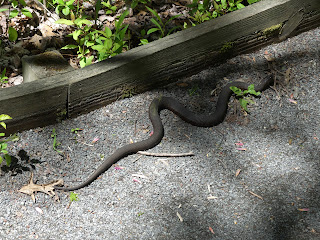
Image
Last year I went to Great Swamp National Wildlife Refuge in mid-April and saw a bunch of Northern Watersnakes ( some apparently mating ). This year I didn't get up there until almost a month later and only saw 3 individuals. That's still more than I'm likely to see in most places, but I suspect this was past their peak time when they're driven both to seek sunlight and to breed, both of which probably bring them out into the open. Although I doubt they're as common as our garter snakes , I think I've seen more of our watersnakes . These 2 types of snakes are in the same subfamily  so perhaps it's unsurprising that they're both considered semiaquatic and both give birth to live snakelets . I suspect that if a Northern Watersnake invited a Common Garter Snake over for lunch, the garter snake would be happy with the menu (mostly amphibians). Though most of the individuals I've seen were at Great Swamp, I've seen them at a Sourland Mountain Preser...

Eastern Garter Snake

Image
Here's an Eastern Garter Snake I encountered in May. Though it's possible to see quite a few Northern Watersnakes if you live near water, the Eastern Garter Snake is probably the most encountered snake in New Jersey, Connecticut, and probably most of the northeast. They get their name from garters , bands used primarily to hold up socks/stockings, presumably by someone who thought these striped snakes resembled some striped garters they saw/owned. Though I thought the term Garter Snake referred to a single species, it appears that both the Common Garter Snake (of which the Eastern Garter Snake is a subspecies) and the very similar looking Ribbon Snake are both snakes in my area that are in the genus that comprises the Garter Snakes. This video says that I've got a Common Garter Snake rather than a Ribbon Snake because of stripes under the mouth in my snake. Another good video for Garter Snake fans is here . Although you should consider Garter Snakes to be harmless, th...

Eastern Garter Snake

Image
Here's a (no doubt young) Eastern Garter Snake I met last month. They are considered one of our most common snakes.  When working at Nokia, I would see them fairly frequently. Unfortunately they liked to sun themselves in the parking lot where there was a fairly high chance of getting run over. I'd try and scare them off the asphalt, though I suspect they'd return there after I was gone. (They understood they needed to warm up but didn't understand the dangers of vehicles.) I'm afraid I scared this individual who was sunning itself on the top of some greenery but slithered someplace safer when my camera and I came by. It ultimately swam into a hiding place in the water. I know they can't breathe in water, though they probably can stay underwater for at least a couple minutes. And it's possible there was an air pocket in it's hiding space. Although they're in a different genus, the Garter Snakes are considered to be closely related to the water snak...

Northern Watersnakes Mating

Image
Here are pictures of Northern Watersnakes mating. (They are a subspecies of the Common Watersnake .) Generally speaking the females will grow larger than the males. I'm assuming these snake tangles all have 1 female and 1+ males. Ultimately all this romance should lead to the females giving birth to little snakelets ; Northern Watersnake females don't lay eggs but practice ovoviviparity . Though these snake babies get to meet their mother, that's generally the end of the relationship; the mother doesn't actively raise her young. In this first picture I was initially wondering if this was just one (long) snake, but eventually noticed two heads in there. April 14, 2021 at Great Swamp Photo 121032715, (c) jpviolette, some rights reserved (CC BY-NC) This seemed to be the most populated coil, with 4 different snakes tangled together. April 14, 2021 at Great Swamp Photo 121033742, (c) jpviolette, some rights reserved (CC BY-NC) Here's another pair, much less spread out. A...