Posts

Showing posts with the label american toad

Mating Toads

Image
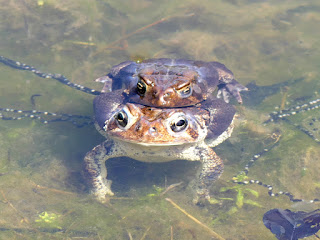
In yesterday's post I mentioned that I heard American Toads as they were advertising their availability (and perhaps desirability) during their mating season. Today's picture actually shows the toads while mating. When I 1st saw the pair, I thought maybe I was seeing the same toad's face twice, once with it reflecting off the water. But upon closer inspection, the toad on the top is clearly smaller than the one on the bottom, and both heads are out of the water. Among toads (and many turtles, and some raptors) the females are noticeably larger than the males, as is true in this case. And despite the closeness of this pair, most toad reproduction happens quite a bit differently than (for example) human reproduction. In most of our toad species (you can read about other varieties here ) the female releases her eggs directly into the water, and the male (at approximately the same time and place) releases his sperm into the water, hopefully resulting in many of those eggs bei...

Toads in Breeding Season

Image
I have to admit I wasn't sure what I was seeing at a Sourland Mountain Preserve pond around mid-April. Although I frequently see toads (both American and Fowler's ), I usually see them dry and away from water; seeing these toads all glisteny in the water did have me wondering if I was seeing a frog instead. Still, our toads begin life in the water, and that's also where their parents "got together". And on this day the pond was a regular Toad Single's Bar of toads looking to breed [1]. I also have to admit that although iNaturalist has IDed them as American Toads, looking at them right now it's difficult to make a case distinguishing them from Fowler's Toads. Still: The views don't give a good view of the number of warts/blotch on their backs, And the views also aren't ideal for telling whether the ridge between the eyes and their (protruding) paratoid glands touches the glands. In my defense, to get those better views I probably would have ne...

Fowler's Toad

Image
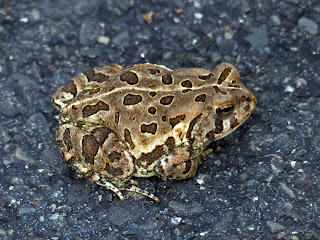
Toads are always a welcome amphibian encounter when outdoors, so I was happy to meet this Fowler's Toad . I don't run into a lot of them a lot, though I suspect they'll sometimes catch some valuable sunlight by venturing out onto trails and roads.  I've gone into details on identifying these toads, so read this if you're trying to distinguish Fowler's Toads from their very similar American Toad cousins. If you can't get a good look and need to guess, I do think there are more Fowler's Toads in this area; the actuarial tables suggest that you saw a Fowler. But don't feel too cocky; there are plenty of American Toads around too. While this is clearly an adult toad, I did meet a young toadlet a year or so ago. As is typical, the toad started off like it was going to hop away, but then stopped and let me get pictures. July 2, 2022 at Duke Farms Photo 221312132, (c) jpviolette, some rights reserved (CC BY-NC)

American Toad

Image
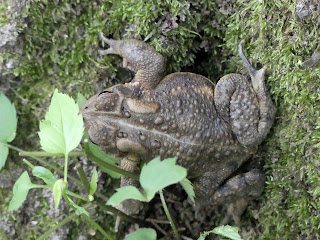
Here's an American Toad I met a couple months ago. Or at least I'm pretty sure it's an American Toad. Despite providing what looks like a pretty clear picture of the toad, nobody on iNaturalist has confirmed (or refuted) my contention that this is an American Toad. The only other contender in NJ for an ID is the Fowler's Toad . While I have better head shots of this toad, the view below is probably the one that best distinguishes its species. First I need to tell you what the parotoid glands are. These are the pair of light-colored bulges above the shoulders and behind the eyes. Overall they're probably a little smaller but longer than the toad's eyes. They store toxins that the toad can secrete to make themselves bad-tasting and somewhat poisonous. (They might be the reason we humans don't often eat toads.) Though both species of toad has parotoid glands, in the American Toad the glands do not touch the ridges behind the toad's eyes. And it looks to m...