Posts

Showing posts with the label great black digger wasp

Organ-pipe Mud Dauber Wasp

Image
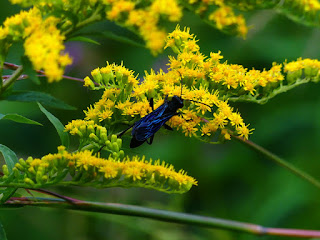
Here's an Organ-pipe Mud Dauber wasp I met back in August. Their iridescent blue wings make them a strong candidate for Shiny Insect of the Week. They get the "mud dauber" part of their name by building nests for their offspring from mud and get the "organ pipe" part of their name from the shape of those nests: vertical "pipes" adjacent to one another. When I first saw this black-bodied, blue-winged wasp, I thought of the Great Black Digger Wasp . I think the biggest difference you might be able to see is that the Organ-pipe Mud Dauber has white on the lower part of their back legs, something you shouldn't see in the Great Black Digger Wasp. On iNaturalist they do list the Great Black Digger Wasp as being an insect that can be mistaken for an Organ-pipe Mud Dauber. Note the mud on the ground. Since it's the females that gather the mud, this is presumably a female. She's probably looking at the mud thinking "this will do nicely". ...
Great Golden Digger Wasp

Image
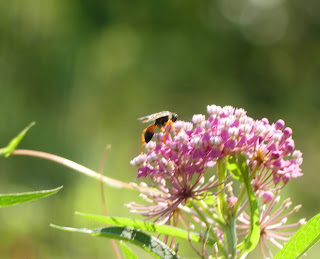
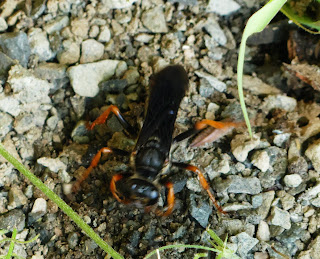
Meet a Great Golden Digger Wasp . The picture is over 3 years old, but I wanted to do my area's 3 related wasps in a little series. They are related to both the Great Black Digger Wasp and the Katydid Wasp . These guys seem to have very similar lifestyles to their 2 relatives; all three paralyze insects to use as food for their eggs, and all three sustain themselves on nectar/pollen when adults. And all three eat orthoptera (grasshopper/cricket/katydid) insects. Another thing all three of these species have in common is that they're known to be victims of interspecific   kleptoparasitism , where after paralyzing their prey and attempting to bring it back to a nest, they're harassed by birds until they drop their prey and allow the bird to take it. (More noticeable versions of kleptoparasites are Bald Eagles that steal fish from Ospreys, or lions that take over a hyena kill.) It is a little interesting that 3 related species are filling such similar environmental niches, t...

Katydid Wasp

Image
Here's a Katydid Wasp I met. This wasp is in the same genus as (and is thus a fairly close relative to) the Great Black Digger Wasp I showed yesterday . The orange on the legs guarantee that this is not a Great Black Digger Wasp. Despite the common name of Katydid Wasp, it sounds like their favorite prey is the Carolina Leaf-roller , a cricket. I'm not saying they wouldn't use katydids, and katydids/grasshoppers/crickets are all related, but the name might be suboptimal. Some documentation suggests this is (or was) a more southern species, though I don't think they're uncommon around here. I think they've got very similar lifestyles to the Great Black Digger Wasp. After breeding, the female will go looking for probably anything small enough in the orthoptera order (basically those grasshoppers/crickets/katydids mentioned earlier), paralyzes it with its stinger, carries the paralyzed insect to a nest, and lays an egg on it. She repeats this process for each egg...

Great Black Digger Wasp

Image
Here's a Great Black Digger Wasp I met. I don't see a lot of these guys, though they're apparently widespread and can be found across most of the contiguous US states. They're relatively large, and mostly black though with iridescent blue on the wings. The females can sting, though this is primarily used on other insects. They are one of a genus of wasps that start life eating paralyzed insects like katydids that their mom left for them. After growing into an adult, they leave this cuisine and live off of pollen and nectar for the rest of their lives. They are probably helpful to gardeners in that they not only eliminate some plant-eating insects but also function as pollinators. They are in the thread-waisted wasp family. August 18, 2020 at Duke Farms