Posts

Showing posts with the label hoverfly

Tufted Globetail

Image
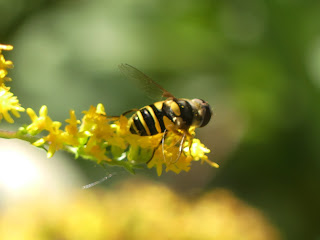
Here's a Tufted Globetail from last spring. They are hoverflies in the globetail genus , which gets its name because the males have tails (actually abdomens) that end in little globes. (In this species the tail is more "thick and rounded" rather than a globe.) If this individual was a female, the abdomen would have ended in more of a point. I generally expect these flies to have more prominent black stripes on the abdomen, though I'm not sure how much variation they can have. If you were thinking this was a wasp, the hoverfly is doing its job; most hoverflies are wasp/bee mimics who "impersonate" stinging insects to get some of the protection their stinging look-alikes command. Although they can be found throughout most of North America, they're especially prevalent in Canada and the northern US. Hoverflies are also called "flower flies" (also syrphids) because as adults they're basically pollinating insects who hang around flowering plan...

Praying Mantis Eats Lunch

Image
I've got another Tenodera picture for you. As a reminder, Tenodera is the genus that contains 2 related and similar species of praying mantis, the Chinese Mantis and the Narrow-winged (aka Japanese) Mantis . I'll use the Tenodera name just because I can't tell what the species is. Although I showed you another Tenodera just over a week ago, I wanted to show another today because: They're big, photogenic insects. This one is eating lunch. So what's for lunch? It's hard to say. My first thought, which could be accurate, that this is a bumble bee . The only reason I'm waffling on that is that usually bumble bees have fairly prominent antennae, and I don't see that in this picture. Of course they could have been broken off or even eaten by the mantis, but some of the hover flies are bee mimics so I wouldn't rule them out either. Note that the mantis has actually torn its meal in 2; presumably this is the best way to eat these insects. (Certainly the ...

Margined Calligrapher Fly

Image
Here's a small fly that's generally considered beneficial, the Margined Calligrapher . (Or maybe I should say  Margined Calligrapher . ) Similar to their Eastern Calligrapher cousins, they are hover flies that mimic bees to appear more dangerous than they actually are. As adults they're harmless pollinators, though in their wild and crazy youth they were known to attack small invertebrates like aphids. Usually the little tip at the end of the abdomen has more black on it. I've read that some relatives will look lighter if it was warm during their pupal stage; perhaps this fella pupated during a warm stretch? June 8, 2022 at Duke Farms Photo 209834396, (c) jpviolette, some rights reserved (CC BY-NC)

Yellow-spotted Falsehorn

Image
Here's a belligerent wasp that you wouldn't want to meet, right? Wrong! This isn't a wasp at all but a non-stinging hoverfly , more precisely the Yellow-spotted Falsehorn. Note that I won't be able to tell you a lot about this fly since it's one of those species (and genii) that doesn't have a lot written about it (at least online). What I can tell you is that, like some other hoverflies like the Eastern Calligrapher and the Transverse-banded Flower Fly , these flies are bee/wasp mimics. In the insect world if you're not going to be dangerous yourself, it pays to at least look dangerous, and these guys do it by looking like someone who could sting you. And like the other hoverflies, as adults they do like their nectar. As kids (larvae) these flies bore into and eat wood, though it sounds like they mostly go after rotting wood/logs; it's unclear that they're much of a threat to healthy trees. The falsehorn flies shouldn't be confused with the ho...

Transverse-banded Flower Fly

Image
Where there are flowers, these Transverse-banded Flower Flies can sometimes be seen. Like all syrphid flies (aka flower flies and hover flies), these are true flies (unlike fireflies, who are secretly beetles, or butterflies or dragonflies, that are completely different insects).  If you have a garden and hate being stung, these flies are right up your alley. As adults they're all about nectar, pollen, and honeydew, are incapable of stinging, and apparently don't bite. And while butterflies also meet those criteria, these flies have an additional benefit. As kids (aka larvae) they'll eat some garden pests like aphids. They are also a classic example of Batesian mimicry since they look dangerous but aren't. I'm not exactly sure who they're trying to mimic though: Their color and shape could fool a predator into thinking they're bumblebees . Their color and lack of fuzziness could fool a predator into thinking they're yellowjackets . Perhaps they're...

Eastern Calligrapher

Image
Meet an Eastern Calligrapher , an insect I probably haven't shown you before. (At least I hope it's an Eastern Calligrapher; some of its relatives look similar.) Eastern Calligraphers are part of a very large group of insects sometimes called hover flies (the males will hover around, either defending a territory from other males or just hoping to get the attention of a female), sometimes called flower flies (the adults feed off of the nectar and pollen of flowering plants), and sometimes called  syrphid flies (pronounced SUR-fid, which appears to come from Greek and Latin words loosely meaning "descended from gnats"). These flies have a waspy look, are considered wasp mimics, and since they can't sting, they're a good example of Batesian mimicry . Notice though that as flies, they have only 1 pair of wings whereas wasps, bees, and most flying insects have 2 pairs of wings.  They're considered pollinators , though they're probably not as effective as...

Monarch and Associate

Image
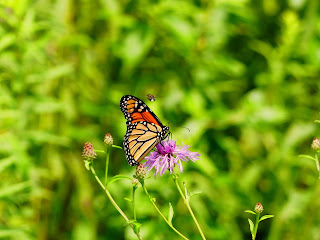
Here's a Monarch Butterfly picture I took with a photobombing insect. August 15, 2020 at Negri Nepote Native Grassland Preserve What is the 2nd insect? It's hard to say. The wings are moving too fast to tell much from them. The face doesn't look bee-like to me; I thought the face looked a little like a dragonfly, though when I posted it online someone else nominated a hoverfly . Both these theories make a certain amount of sense. I definitely saw dragonflies nearby, and they could be looking to make a meal out of one of the smaller pollinators hanging around flowers. (I suspect that a Monarch would be a little large for most dragonflies to attack.) As for hoverflies, they're also called "flower flies", and would be interested in some of the same flowers that attract Monarchs. We all recognize bees as important pollinators, and many also recognize butterflies as pollinators, but some flies and wasps are also important in getting plants pollinated. I tried expa...