Posts

Showing posts with the label european paper wasp

Metric Paper Wasp

Image
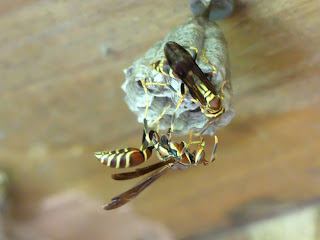
Here's a Metric Paper Wasp I met last summer. Despite their name, these wasps are not a meter in size; they're about an inch in length. 😀 These wasps are umbrella wasps , and I've talked about other umbrella wasps before: Dark Paper Wasps Guinea Paper Wasps European Paper Wasps The European Paper Wasp is an invasive species that's known to replace our Dark Paper Wasp, but they're probably a bit of a threat to outcompete our Metric Paper Wasps too. Like most of their relatives, Metric Paper Wasps are eusocial : Females cooperatively raise their young. Multiple generations live together in a nest. Dividing labor between reproductive and non-reproductive members of a nest. It sounds like a colony starts each spring with 1 or more "foundresses" who were fertilized before winter. (Though there can be multiple foundresses, there's typically an alpha foundress that takes charge and who does most of the egg-laying.) They lay eggs that develop into female wor...
Dark Paper Wasp

Image
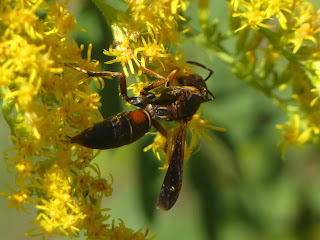
Bees aren't our only pollinators, as this Dark Paper Wasp demonstrates. The paper wasps are generally considered less aggressive than yellowjackets and hornets  but will sting if they get the impression they or their nests are threatened. Though named the Dark Paper Wasp, its darkness varies geographically. Generally speaking, well north of me (southern Canada or northern New York/New England) the yellow stripes will be on a black abdomen, while south of me (southern US) they tend to look more reddish. These wasps are considered eusocial : they cooperate in raising young, multiple generations live together, and there's some specialization of duties. They're not as eusocial as some insects where soldiers, foragers, and tending to their young are distinctive jobs. Their lifecycle is basically like this: At the end of summer, males and reproductive females grow to adulthood. This generation of males/females breed. The males then die while the new females congregate someplac...

European Paper Wasp

Image
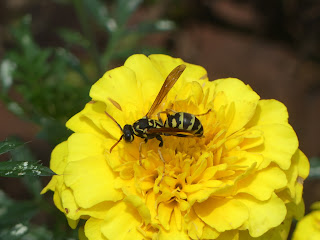
Here's another invader insect, the European Paper Wasp . Despite the name, its home range really extends from Europe to North Africa to China. It somehow invaded the US in the 1980s and is growing in numbers since then. These guys are true paper wasps , another sibling group to the yellowjackets and hornets . Technically the term paper wasp is misleading since other types of wasps (like those yellowjackets and hornets) make papery nests, but that remains their common name. Unlike many other paper wasps, it doesn't rely on caterpillars as food for their larvae; their larvae will eat other (chewed up) insects as well. Being a non-fussy eater is very helpful if you're suddenly living in a new part of the planet without familiar food sources. I suspect that's part of the reason it's been successful here. Despite growing in numbers, I don't (yet) see them a lot. Or maybe I do; they're pretty easy to mistake for our yellowjackets. I'm told to look for orangis...

Guinea Paper Wasps

Image
This summer I spotted some Guinea Paper Wasps . Based on the name, I thought the might be an invasive species from Guinea , or a namesake lik e  Equitorial Guinea ,  Guinea-Bissau ,  Papua New Guinea , or  Western New Guinea . But it turns out they are a native species, and it's surmised that the name came from this locality in Virginia or this other locality in Virginia . (They're more American than any Europeans, or any other humans.) These wasps are considered paper wasps  since they make nests by chewing up wood and other tough plant fibers to make their papery nests. (Paper wasp isn't a great taxonomic term though, since some of their close relatives make mud nests while some distantly related wasps make paper nests.) They are eusocial insects, meaning they collectively share in the raising of young, a nest supports multiple generations, and the nest has a hierarchy of roles. Unlike some eusocial insects though, there's no apparent anatomic difference be...