Posts

Showing posts with the label pearl crescent

An Older Pearl Crescent?

Image
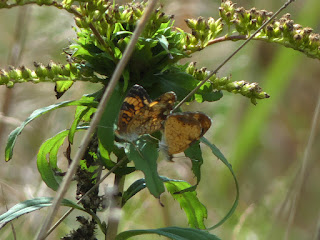
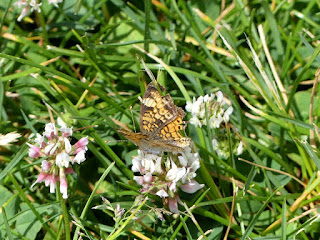
This Pearl Crescent has some wing damage (especially to the left front wing); I was wondering if this could be an older individual who hibernated as a caterpillar before resuming life last spring. Apparently that's what a Pearl Crescent does if it hatches when temperatures are beginning to get cold.  On the other hand, the wing coloring doesn't look too faded, suggesting that the butterfly isn't especially old. (I think I'm talking myself into this being a butterfly that hatched earlier in the spring as opposed to last fall.) Of course, age is relative as the Pearl Crescent lives a much shorter life than ours: They hatch about 1 week after their egg is laid. They spend about 2 weeks chowing down on plants as caterpillars, with some of our asters being favorite foods. Then it's time to metaphorize ; they go into a chrysalis for 1-2 weeks. When they emerge as butterflies, they can live as long as 2 months, though most probably don't last that long. May 18, 20...
Vivid Pearl Crescent

Image
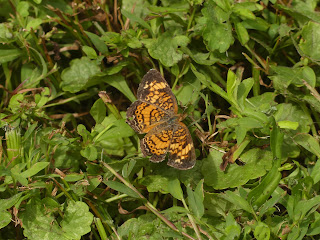
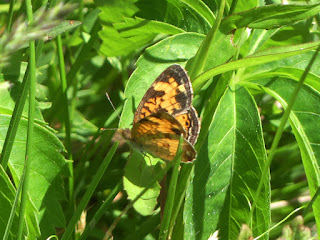
Here's another of our small-but-showy Pearl Crescent butterflies, and its orange-and-black coloring shows up pretty well against the verdant green spring flora in the picture. (I think a lot of animals look better with the bright green background.) Though a little too small to get a lot of attention, they are 1 of the easiest butterflies around here for you meet; they're super abundant . And they're super abundant because they're doing a lot of this . May 14, 2023 at Duke Farms Photo 292808045, (c) jpviolette, some rights reserved (CC BY-NC)

Pearl Crescent Omnipresence

Image
I've neglected this blog recently; the past few days have been busy: In preparation of the approaching Duke Farms Butterfly Count, on Thursday I was "scouting" the property so I could alert the counters to concentrate on the more promising areas. On Friday I was helping the Raritan Headwaters Association to remove invasive plants around some bush/tree plantings at the Fox Hill Preserve. On Saturday I spent a couple hours at Duke Farms at their Outdoor Education station (primarily) talking to people about fireflies, then did some more "butterfly scouting". On Sunday we had the actual Duke Farms Butterfly Count, which left me a little worn out after 6 hours walking around the property. On Monday morning, I did my usual Steward Volunteer assignment, in this case helping to remove mostly invasive plants around one of their containment fences. We encountered a lot of the "usual suspect" butterflies on Sunday; I suspect the most abundant butterfly we found w...

Mating Pearl Crescents

Image
On the same trip to Fairview Farm when I met the Ruby-throated Hummingbird and the Snowberry Clearwing Moth , I also met more common fauna. One interesting encounter was either 1 or 2 pairs of mating Pearl Crescent butterflies. (By my standards, this was a fairly successful outing.) When butterflies/moths (and some other insects) mate, they face away from each other with the ends of their abdomens (temporarily) attached. The attachment is fairly robust; they can fly off without disengaging [1]. Though we have smaller butterflies than the Pearl Crescents (e.g. Eastern Tailed-blues , Spring/Summer Azures, American Coppers ), Pearl Crescents are small enough that it's not easy to tell them apart. When I saw mating pairs a few minutes apart, I was suspicious they might have been the same mating pair. I don't think they look identical, but I also wasn't able to get the same views of them. Of course, the Pearl Crescent is a very common butterfly, so the idea that I encountered ...

Pearl Crescents

Image
Here are a couple Pearl Crescents , fairly small and common butterflies here in New Jersey. At least they're supposed to be Pearl Crescents. There theoretically could be Northern Crescents around here too, though that species is generally considered to be only in northern NJ. The Northern Crescent wasn't even considered to be a species until the 1980s [1]; before that they were just considered to be Pearl Crescents. When research showed that the butterflies we now consider to be Northern Crescents could hybridize with Pearl Crescents but their offspring had lower survivability they were spun off into a separate species. This is another example of where the line between species is subtle, and even debatable. Or it could also be a Tawny Crescent . Tawny Crescents are also considered to be a very similar and more northern species, considered extirpated in NJ, so theoretically I can discount them entirely when doing identifications. I'm not certain they can hybridize with th...

Lupine Bugs

Image
Here's some bugs I've shown you before, Lupine Bugs . Though they have a reputation for eating legumes, a scat feast isn't unheard of. August 25, 2022 at Duke Farms Photo 229695847, (c) jpviolette, some rights reserved (CC BY-NC) If you're thinking "why not show nature's beauty instead of scat-eating bugs", well look who else was dining on the scat. They were butterflies, Pearl Crescents to be precise. Scat may not be nature at its finest, but to many invertebrates they are a valuable food resource. With the exception of blooming native flowers, scat is probably one of the most common places to see various species hanging out together (mostly) peacefully. August 25, 2022 at Duke Farms Photo 229695884, (c) jpviolette, some rights reserved (CC BY-NC)

Orange Overload

Image
If you like your colors between red and yellow on the visible light spectrum , orange you going to be glad to see this post. Amidst the vibrantly orange Butterfly Milkweed there are 3 primarily orange butterflies: Just right of center and probably the reason I noticed the activity is a Monarch butterfly. My recollection is that these milkweeds were pretty far out into a meadow, and I didn't notice the Great Spangled Fritillary until I got my binoculars on them. This butterfly is just to the left of the Monarch. But it wasn't until I got home and processed the photos that I realized there was also a Pearl Crescent in there too, a little to the left of the Great Spangled Fritillary. Generally speaking, I don't see open hostility between most pollinators. It's not at all uncommon to see butterflies, bees, wasps, and other pollinators near one another and (mostly) going about their own business. There are other instances though when I'm not sure what's going o...

Mudpuddling Pearl Crescents

Image
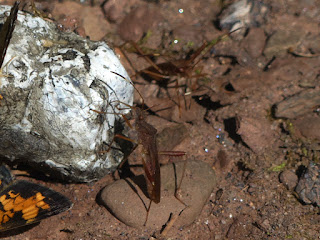
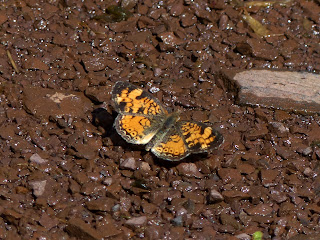
Here's another example of mudpuddling butterflies, in this case Pearl Crescents . And as I've shown before, animal scat can be more nutritionally beneficial than mud, containing a concentration of minerals unlikely to be found anywhere. Mudpuddling seems to be mostly a male activity. You might think this is because they need more nutrition to fight off other males looking to mate, but in many cases their motivation is more fatherly; males will frequently pass these nutrients as a " nuptial gift " to females during mating [1]. Another interesting thing about mudpuddling is that the activity draws other butterflies in. Apparently a spot perceived to be good for mudpuddling is sufficiently valuable to butterflies that if they see others using the spot they are likely to check it out themselves. Sometimes a good spot will attract dozens of butterflies, maybe spanning a few different species. August 15, 2021 at Duke Farms Photo 152591517, (c) jpviolette, some rights reser...

Pearl Crescent

Image
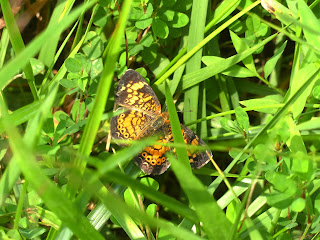
Here's a Pearl Crescent butterfly I saw hiding in the grass, perhaps also catching some rays. Though I consider them fairly small butterflies, they usually tower over Eastern Tailed-blues, and Spring and Summer Azures. These guys would be a very tough ID if their Northern Crescent cousins lived down here. The 2 butterflies look quite similar, especially when individual variation is considered, but the Northern Crescent would be a bit out of range for the places I go. Somewhat surprisingly, these 2 butterflies generally don't hybridize where their ranges overlap, even though to us they look awfully similar. Another similar butterfly is the Silvery Checkerspot . Though my field guides suggest they could be in my area, the NJ chapter of the North American Butterfly Association's webpage doesn't mention them. Besides possibly being outside my area, the Silvery Checkerspot is a somewhat larger butterfly; I suspect the size alone would alert me that it's not a Pearl Cre...

Great Spangled Fritillary on Wild Bergamot

Image
It seems like if you want to attract butterflies, you should get some Wild Bergamot ; here's yet another butterfly attracted to this wildflower: a Great Spangled Fritillary . These are one of my favorite butterflies. Their orange-and-black coloring and relatively large size make them easy to spot and fairly easy to identify. Probably the easiest butterfly (in my area) with which to mistake the Great Spangled Fritillary is the Aphrodite Fritillary , which has a black spot near the base of the forewing that the GSF lacks, and which is generally smaller. (My pictures don't show that spot, but the fritillaries I was seeing were almost the size of the Monarchs. I don't think an Aphrodite would ever get that large.) People sometimes see a Pearl Crescent and wonder if it's a baby GSF, but of course butterflies don't grow that way. They're pretty much at their full size when they emerge from their chrysalis. (I will admit that it's a little hard to see the pattern ...

Pearl Crescent Graybeard

Image
Here's a Pearl Crescent butterfly that's clearly seen better days. Some of the color has faded, its wing pattern no longer looks sharp, and there's also some parts of the wing missing. While many butterflies only live as adults (this excludes egg/larva/chrysalis stages) for 2-4 weeks, this webpage suggests that Pearl Crescents live much longer than that, 6-12 months. (I wonder if that lifespan variation differs with location; it's easy to imagine them living longer in southern regions.) Though far from our smallest butterfly, the Pearl Crescent's wingspan is only about an inch. I suspect that if they were the size of Monarchs, they'd elicit almost as many "oo's and ah's" as their larger relatives. May 31, 2021 at Duke Farms Photo 133215618, (c) jpviolette, some rights reserved (CC BY-NC)

Pearl Crescent

Image
Here's a Pearl Crescent butterfly stopping not to smell the flowers but to drink them, or at least their nectar. And while drinking all day long may have negative connotations for humans, the butterfly community endorses drinking heavily during daylight hours. And at least I think it's a Pearl Crescent; while the North American Butterfly Association says that's our only crescent butterfly , my field guides suggest the very similar Northern Crescent and Tawny Crescent might show up in New Jersey too. May 14, 2021 at Fairview Farm Photo 132038975, (c) jpviolette, some rights reserved (CC BY-NC)

Mud-puddling

Image
Here are a pair of butterflies, a Common Buckeye and a Pearl Crescent , mud-puddling on dung. Though the name mud-puddling conjures up a dirty activity, insects that do this are looking for nutrients that are more abundant on scat or, less easily noticed, areas with urine. Sometimes you'll even see them mud-puddling on rotting fruit or decaying animals. A good mud-puddling location is a good place to find a bunch of butterflies congregating together. Even a small flower patch is more dispersed than fox dung, so the action is sometimes concentrated into a very small area.  I'm not exactly sure how butterflies find a good mud-puddling location in the first place, but there's some evidence that once a butterfly finds a good location the other butterflies (even of different species) take notice and join in. Naturalists have been known to put a fake butterfly in a location in order to convince other butterflies to check the location out. August 15, 2020 at Negri Nepote Native ...