Posts

Showing posts with the label cabbage white

Butterflies Mistaken For Moths

Image
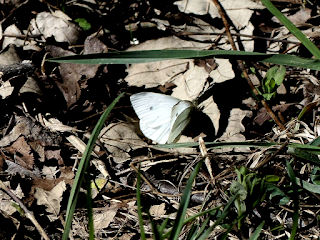
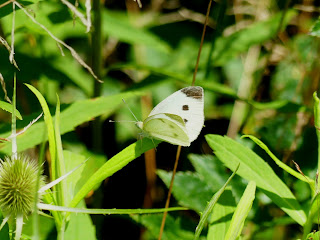
Here are a couple of butterflies without fancy patterns or flashy colors that occasionally are mistaken for moths . They are a Clouded Sulphur and a Cabbage White , which are in the white and sulphur genera respectively, and both of which are in the same family of butterflies .  As smallish and somewhat plain-looking butterflies, you might not be surprised to learn they're somewhat related. The female Clouded/Orange Sulphurs can look virtually white, making the family resemblance even stronger. While I'm treating butterflies and moths as different groups under the lepidopterans , they're not exactly radically different groups. It's certain that butterflies evolved from moths ( when and why discussed here ), and so there's some reason to consider butterflies to be a subset of moths. This isn't too different from the people who consider birds/dinosaurs to be types of reptiles [1]. June 15, 2023 at Sourland Mountain Preserve Photo 300993980, (c) jpviolette, so...
Eastern Tailed-blue

Image
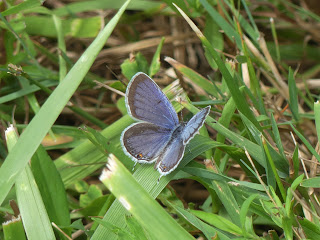
Here's a pretty good shot of an Eastern Tailed-blue , though you could be forgiven for thinking they're more of a violet-blue in color. Although you can quibble with the shade of blue, the blueness that's there says that this is a male; the females tend to look gray instead. In flight you'll see this blue coloring flashing since the underwing is mostly a slightly speckled white. (The underwing also has a little orange spot, though I doubt you'll pick that up in flight. You can see what the underwings are like in the picture here .) They can be confused with the Spring/Summer Azures . The best ways to distinguish the Eastern Tailed-blue from them are: The azures don't have the little "tails" on their rear wings. When their wings are up, the azures shouldn't show the little orange markings of an ETB. (Distinguishing the Spring Azure from the Summer Azure is something I can only do based on the season.) Although neat looking, these are pretty small b...

Look At Me!

Image
Though most of the time my problem with taking animal pictures is getting an animal that doesn't want its picture taken to cooperate and stay still long enough for me to aim and focus. But once in a while the opposite problem occurs, where I'm trying to take one picture and something seemingly photobombs the picture. This happened twice a couple weeks ago. Sometimes the photobomb is a momentary inconvenience, but all too often the activity leads to the original subject and the photobomber fleeing from camera range. In this 1st one, I intended to get a picture of a Cabbage White butterfly on what I believe to be Birdsfoot Trefoil . Although I didn't think the trefoil was particularly popular with the pollinators, at least one butterfly was checking it out when another flew in. In this case the photobomb was probably about romance; the one with 2 dark smudges on the forewings is a female while the intruder with 1 smudge spot on its forewings is a male. (I have no idea if the...

Cabbage White Butterflies Mating

Image
This summer I caught these 2 Cabbage White butterflies mating. It's fairly common to see butterflies mating. It might look to us like 2 butterflies trying to ignore each other by looking in opposite directions, but they are one of the insects that breeds in this position. (I think flies and true bugs generally do something similar.) I'm assuming that the male is the one on the leaf since I think the females are usually an off-white color, but I'm not sure about that. You're supposed to be able to see 2 spots on each forewing of the females and only 1 spot on the each forewing of the male, which would suggest the opposite gender identifications. (Note that spots on the back wings are less reliable for identification. I wish I had an open-wing view of these butterflies.) July 14, 2021 at Duke Farms Photo 148187498, (c) jpviolette, some rights reserved (CC BY-NC)

Cabbage White Butterfly

Image
Here's a Cabbage White Butterfly I met. I'm not exactly sure what they're eating this time of the year (I doubt if farmers have their cabbage crop coming up yet), but they do eat a lot of plants in the cabbage/mustard family of plants. Right now they're dominating the butterfly scene around me. I've seen dozens of them, and maybe 3-4 of everything else. Despite having a fairly plain look, these are considered butterflies as opposed to moths. Still, these two insects are obviously related, and some people that appear knowledgeable consider all butterflies to be moths rather than a distinct group of insects. (Admittedly butterflies and moths have a common ancestor.) April 3, 2021 at Duke Farms Photo 120284772, (c) jpviolette, some rights reserved (CC BY-NC)

Mating Cabbage White Butterflies

Image
I've seen in movies where a character is given a Rorschach test and wants to give a harmless interpretation for the image, they'll claim it looks like "two butterflies mating". But how many people know what mating butterflies even look like? I've seen butterflies (and other insects) mating on a fair number of occasions, and below is a pair of Cabbage Whites mating. During mating, their abdomens are attached though their wings usually cover this up. Typically if it looks like two butterflies are standing back-to-back and touching, there's a pretty good chance they're mating. (More info here .) It's neat to see but difficult to photograph, but sometimes one will fly off while they're still attached. (I suspect I may have spooked some of them into flight myself.) August 15, 2020 at Negri Nepote Native Grassland Preserve August 15, 2020 at Negri Nepote Native Grassland Preserve

Cabbage White

Image
Here's a White Cabbage butterfly. It's original home is considered to be the eastern Mediterranean region, but as its host plants have thrived and traveled the world due to us humans, this butterfly has followed along with those plants. And there are a lot of those host plants. As caterpillars these guys eat plants in the mustard/cabbage family , which consists of cabbage and other cultivars of the same species (broccoli, cauliflower, kale, Brussels sprouts, collard greens, et al), radishes, turnips, and some watercress and yellowcress plants. (I didn't see the invasive  Garlic Mustard  on the list.) It's little wonder that we see a lot of these butterflies most years; they picked good host plants. They have a larger relative, the Large White , but (so far) that butterfly hasn't found its way over to North America.