Posts

Showing posts with the label instar

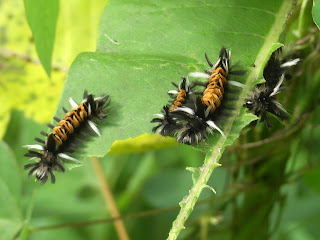
Tussock Moth Herd

Image
Some caterpillars are usually seen in large numbers (like Armyworm Moth caterpillars and Eastern Tent Caterpillars ), while most are more solitary. The Milkweed Tussock Moth caterpillars (more about them are here ) seem to be slightly social. I'll sometimes see them alone, but more often I'll see them in groups of 2-9 members. In the 1st picture below, you can see there is a clear size difference in some of these individuals. I'm almost certain the little one in the middle is in an earlier instar than the others (though they lack the colorful tufts of fuzz in their earliest instars). August 31, 2021 at Washington Valley Park Photo 167477945, (c) jpviolette, some rights reserved (CC BY-NC) In the picture below, it's clear that these caterpillars don't require a lot of personal space. August 31, 2021 at Washington Valley Park Photo 167477979, (c) jpviolette, some rights reserved (CC BY-NC)

Monarch II - The Caterpillar Awakens

Image
Here's the second Monarch Butterfly I got a picture in 2020, spotted about a half hour after the first. Yesterday I talked mostly about what Monarchs eat; today I'm going to go over their complicated life cycle. All Monarchs begin life as an egg. Their mother will lay an egg on a milkweed plant. I think they usually lay a single egg on the underside of a milkweed leaf. This probably helps protect the egg from rain, and maybe excessive sunlight. This probably also helps hide the egg from predators and parasites. (Though Monarchs eventually become poisonous through eating the poisonous milkweed, the egg hasn't eaten anything yet.) The mother Monarch can lay anywhere from 300-1100 eggs all told, though she lays her eggs one at a time and almost certainly avoids laying multiple eggs on the same leaf to prevent her kids from competing against each other. After hanging out on the leaf for 3-8 days, the egg hatches and a very small translucent green caterpillar emerges and begins...