Posts

Showing posts with the label eastern tiger swallowtail

A Butterfly and Bee at Lunch

Image
Butterfly Milkweed isn't just of butterflies, proven by both an Eastern Tiger Swallowtail and a bumblebee both stopped by for lunch. Butterfly Milkweed is like Cheers for thirsty pollinators, where lots of colorful, diverse characters drop by to wet their whistles. If anything, the "clientele" on these flowers is more diverse than the personalities at a bar; between butterflies, bees, moths, wasps, flies, beetles, etc. are far less closely related than the humans in a bar. July 6, 2023 at Scherman Hoffman Wildlife Sanctuary Photo 301262427, (c) jpviolette, some rights reserved (CC BY-NC)

Large and Small Butterflies

Image
Butterflies were still a little hard to find in early May; here's an Eastern Tailed-blue and an Eastern Tiger Swallowtail I met back then. These are both fairly abundant butterflies in New Jersey. Even though we have more Eastern Tailed-blues in a typical summer, I suspect the average New Jerseyan thinks the Eastern Tiger Swallowtail is more common. This is mostly due to their much more conspicuous size - they're among our largest butterflies - but the contrasting yellow-and-black coloring also gets attention. The Eastern Tailed-blues, on the other hand, are pretty small, and with their wings up they mostly look they appear off-white with some black specks. This might not constitute camouflage, but it's not as attention-getting. And while the male Eastern Tailed-blue below is a purplish-blue, the females are more of an earth-toned gray . Finally, habitat is also a factor. I usually see Eastern Tailed-blues close to the ground while Eastern Tiger Swallowtails are often fo...

Eastern Forktail

Image
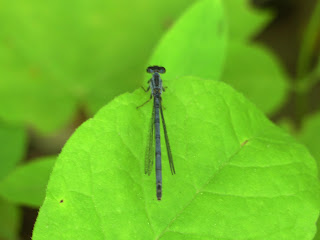
Though some of the larger damselflies (like the Ebony Jewelwing ) are easy to spot by anyone paying attention, I'll frequently see some smaller ones like this Eastern Forktail . Unfortunately the small size of most forktails makes it easy to lose sight of them, especially when they're not moving. They get the forktail name because for most of these species the males have a slightly forked tip at the end of their abdomens but given their small size this characteristic probably won't be easily spotted if you run across one. This is a heteromorphic female forktail, which my field guide [1] defines as a "dull morph in female odonates with 2 color morphs". Some other Eastern Forktails are considered andromorphic, defined as "bright (usually male-like) morph in female odonates with 2 color morphs". These terms are apparently only used when females have 2 different morphs; if a species has no colorful morph in the females they aren't all called heteromorp...

Monarch

Image
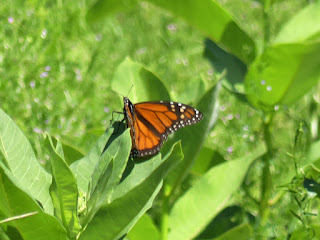
Monarch butterflies are back, though they may not be easy to spot/identify. Though this is my 1st decent (non-blurry) picture of them this season, I've almost certainly been seeing solitary ones fluttering around since mid-May. The main problem right now is that there aren't a lot of flowers in bloom, and many butterflies don't sit still unless there's some nectar for them to slurp up. There is quite a bit of Foxglove Beardtongue in bloom, though this plant seems more popular with bumblebees. Monarchs and many other butterflies (I'm pretty sure I've seen glimpses of Eastern Tiger Swallowtails too) seem to be flying maniacally over the meadows looking for the few nectar sources available to them. But things are changing. Monarchs somewhat surprisingly will visit the non-native Red Clover , and that's in bloom already. Our milkweeds and dogbanes have just started to bloom, and Monarchs (among many other pollinators) love that stuff. Pretty soon there ought t...

Spicebush Swallowtail

Image
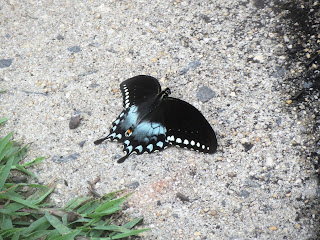
Butterfly season is ramping up. A couple weeks ago I met this Spicebush Swallowtail , a butterfly I've talked about here and here . This was easily my earliest sighting of this butterfly in a season, with May 18 being over a month earlier than my June 22 sighting in a previous year. Looking at iNaturalist sightings by other people, this isn't a shocking sighting even though the Spicebush Swallowtail observations usually peak in July/August. In the 1st picture we get a pretty good look at the tops of the wings, though I'd argue this isn't the best view for identifying a Spicebush Swallowtail. Looking at this I'd be inclined to think the spots would be more yellow on a Black Swallowtail , and that a black morph Eastern Tiger Swallowtail usually shows the typical stripy pattern you'd find on a regular yellow morph except that the pattern would be dark black on light black; the uniform black with the white spots would have me leaning towards a Spicebush. May 18, 2...

Black Swallowtail

Image
At the tail end of April I saw my first Black Swallowtail - the New Jersey state butterfly [1] - of the season. In my area they're neither rare nor common, maybe like friends you run into a few times a year. As I've mentioned before , the Black Swallowtail isn't the only swallowtail butterfly that's black, but it might be the blackest. Though the Black Swallowtail is usually a little smaller than black morph Eastern Tiger Swallowtails and Spicebush Swallowtails , the rich black color that sets off its yellow spots frequently has me suspicious that I'm seeing a Black Swallowtail even before I get a close look at it. (I could theoretically encounter various other swallowtail butterflies too, though it doesn't happen much.) April 30, 2022 at Duke Farms Photo 197665584, (c) jpviolette, some rights reserved (CC BY-NC) [1] It's also the state butterfly of Oklahoma. Oklahoma and New Jersey probably don't share a lot in common, but taste in butterflies is appa...
One Species, Two Morphs

Image
Sometimes members of the same species can look quite different, usually due to sexual dimorphism. For the female Eastern Tiger Swallowtail though, butterflies of the same sex can also look very different. Here is the dark morph of the Eastern Tiger Swallowtail. All dark morphs are females, and this morph is usually seen later in the season, August and onward. It actually has the underlying pattern that the yellow morph Eastern Tiger Swallowtails (see below) has, but instead of a black-on-yellow pattern the dark morph is more like a dark-black-on-light-black pattern. The dark morph is considered to be participating in Batesian mimicry , since they resemble the poisonous Pipevine Swallowtail . July 28, 2021 at Sourland Mountain Preserve Photo 148654982, (c) jpviolette, some rights reserved (CC BY-NC) I didn't see a yellow morph female Eastern Tiger Swallowtail on this trip, but the yellow morph female Eastern Tiger Swallowtail looks fairly similar to the males. They're yellow-an...
Butterflies

Image
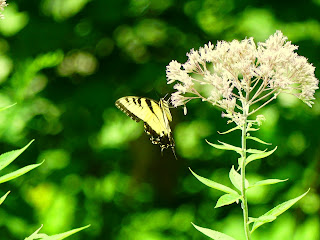
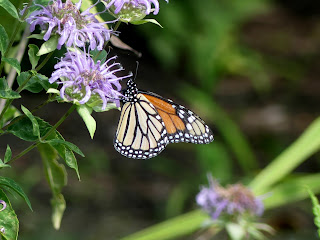
In case you're thinking that the Plainsboro Preserve is all about the dragonflies I've been posting, there was also some butterfly action there too. First I met a Monarch butterfly getting a sip of nectar from what looks like Wild Bergamot , a very popular drinking spot for the pollinator community. July 23, 2021 at the Plainsboro Preserve And a little afterwards, I met this Eastern Tiger Swallowtail at another pollinator "watering hole", one of the Joe Pye Weeds . July 23, 2021 at the Plainsboro Preserve Photo 148594293, (c) jpviolette, some rights reserved (CC BY-NC) That pretty much wrapped up this trip to the Plainsboro Preserve, where I got lots of dragonfly pictures, a few butterfly pictures, and also got a slightly uncommon bird.

Black Morph Eastern Tiger Swallowtail

Image
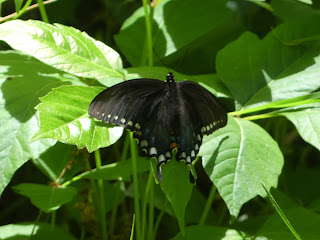
This was a black morph Eastern Tiger Swallowtail I met last summer. Though all male and most female Eastern Tiger Swallowtails have a yellow-with-black-stripes look, some of the females are mostly black. At a glance the black morph Eastern Tiger Swallowtails may look uniformly black, but if you get a good look at them you can see they have the same black stripes as the yellow ones. They actually have translucent black where their relatives have yellow, and the black stripes stand out pretty well in the right lighting. In my area we have 2 similar swallowtails, the Spicebush Swallowtail and the (slightly smaller) Black Swallowtail , and neither would show black stripes on a "light black" background. (They also have other pattern differences.) July 22, 2021 at Fairview Farm Photo 148401095, (c) jpviolette, some rights reserved (CC BY-NC) July 22, 2021 at Fairview Farm Photo 148401067, (c) jpviolette, some rights reserved (CC BY-NC)
Eastern Tiger Swallowtail Wings

Image
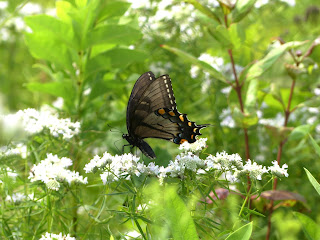
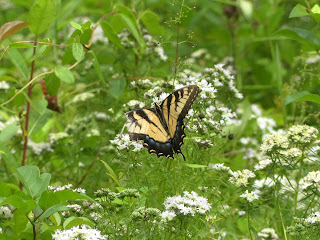
These Eastern Tiger Swallowtails will never get their National Geographic moment, where they're photographed in the perfect position, with the perfect background, and in the perfect lighting. These guys have escaped some predicament or another with substantial wing damage. I don't really know what causes this damage. While I initially suspected the wings tore as they escaped from a predator, a lepidopterist felt that plant thorns were a more likely culprit. July 18, 2021 at Scherman Hoffman Wildlife Sanctuary Photo 148189056, (c) jpviolette, some rights reserved (CC BY-NC) July 18, 2021 at Scherman Hoffman Wildlife Sanctuary Photo 148189418, (c) jpviolette, some rights reserved (CC BY-NC)
Eastern Tiger Swallowtail

Image
This Eastern Tiger Swallowtail dropped by to imbibe a bit of nectar back in July, allowing me to get a couple pictures. This is perhaps the largest of the commonly spotted butterflies here in New Jersey; large individuals can even be giant sized (or at least about the size of the Giant Swallowtail ). They do have some look alikes , though I suspect that in my area if you see any butterfly that looks like this, you've got an Eastern Tiger Swallowtail. My guess is that this fella was drinking nectar from a Wild Bergamot , a native wildflower that's very popular within the pollinator community. Though you can find these butterflies in the middle of a meadow, females lay eggs on trees so edge areas are probably a little better area to find them. July 18, 2021 at Scherman Hoffman Wildlife Sanctuary July 18, 2021 at Scherman Hoffman Wildlife Sanctuary Photo 148187961, (c) jpviolette, some rights reserved (CC BY-NC)
Eastern Tiger Swallowtail

Image
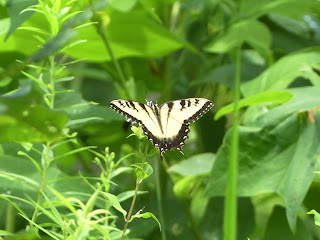
Let's go for 4 butterflies in a row; here's an Eastern Tiger Swallowtail I met at Sourland Mountain Preserve last month. I'm pretty sure I've seen them earlier than this date, though this was my first picture of the Eastern Tiger Swallowtail this season. These butterflies are fairly common around here since their caterpillars eat plants in the rose and magnolia families, fairly common plants. Up here they go into a dormant state during winter, and if all goes well resume their lives in the spring. This guy appeared to be mudpuddling, the term used when butterflies try and get nutrients like sodium and amino acids from mud, scat, or other sources. May 27, 2021 at Sourland Mountain Preserve Photo 133210510, (c) jpviolette, some rights reserved (CC BY-NC)

Eastern Tiger Swallowtail

Image
Here's an Eastern Tiger Swallowtail I met. Notice that the right "tail" of the wing has been torn off. I'd like to tell you "you should've seen the other guy" as though this was incurred in a fight with a rival, but I doubt there's a butterfly with the arsenal to do anything like this. For that matter, it's unclear that any of our arthropod predators (e.g. robberflies, dragonflies, mantises, centipedes, spiders) would do this sort of damage; I suspect that this is the sort of damage you would get from a bird beak. (A bat might also do this, though I wouldn't expect this butterfly to be active at night when bats are most active.) August 18, 2020 at Duke Farms

Spicebush Swallowtail

Image
Here's a Spicebush Swallowtail that was living near my apartment. This is one of our black swallowtail butterflies that are not the Black Swallowtail . Here's a good article on distinguishing our most common  swallowtails. If you don't remember all of that, don't worry. I suspect that most of these guys would be flattered if you merely recognize them as swallowtail butterflies . The Spicebush Swallowtail is actually easier to identify with the wings up. There you'll see a row of orange spots interrupted by a blue swoosh mark; no other similar-looking butterfly has that blue swoosh. From this angle, I'd look at the row of yellow spots at the edge of the wing. Black Swallowtails would have 2 rows. If this were a dark morph Eastern Tiger Swallowtail , even this row of spots would be virtually missing. And a Pipevine Swallowtail wouldn't have those spots at all. The host plant for their caterpillars is - wait for it - the Spicebush . Sometimes these names actu...

Eastern Tiger Swallowtail

Image
Here's another Eastern Tiger Swallowtail . I've talked about them before and will again since they're fairly common butterflies around here. Probably because they use magnolia and cherry trees as host plants, I see these guys more often in "edge" habitats, where woods (with their host plants) meet meadows (where there's more flowers/nectar). It's also possible to catch them mud-puddling from time to time at the edge of water. August 15, 2020 at Negri Nepote Native Grassland Preserve

Eastern Tiger Swallowtail

Image
I haven't shown an Eastern Tiger Swallowtail in a while; below is one encountered at the Duke Farms butterfly count.  This is one of the larger and most distinctive butterflies in my area; the only butterfly it looks like on close observation is the Canadian Tiger Swallowtail , and we probably only get the occasional stray down here. Another relative, the Western Tiger Swallowtail , is also very similar but even less likely to be seen this far east. Though these are recognized as separate species, it's obvious they're closely related to the extent they can interbreed. There is even a hybrid population between the Eastern and Canadian Tiger Swallowtails that's now recognized as a separate species, the Appalachian Tiger Swallowtail . It's a little unclear to me whether they should be different species or different subspecies . July 25 at Duke Farms