Posts

Showing posts with the label transverse-banded flower fly

Yellow-spotted Falsehorn

Image
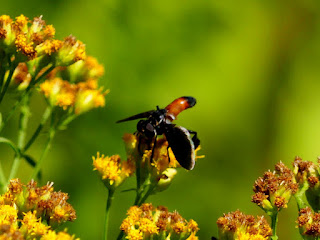
Here's a belligerent wasp that you wouldn't want to meet, right? Wrong! This isn't a wasp at all but a non-stinging hoverfly , more precisely the Yellow-spotted Falsehorn. Note that I won't be able to tell you a lot about this fly since it's one of those species (and genii) that doesn't have a lot written about it (at least online). What I can tell you is that, like some other hoverflies like the Eastern Calligrapher and the Transverse-banded Flower Fly , these flies are bee/wasp mimics. In the insect world if you're not going to be dangerous yourself, it pays to at least look dangerous, and these guys do it by looking like someone who could sting you. And like the other hoverflies, as adults they do like their nectar. As kids (larvae) these flies bore into and eat wood, though it sounds like they mostly go after rotting wood/logs; it's unclear that they're much of a threat to healthy trees. The falsehorn flies shouldn't be confused with the ho...
Transverse-banded Flower Fly

Image
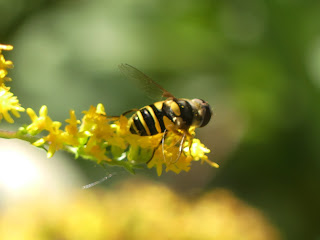
Where there are flowers, these Transverse-banded Flower Flies can sometimes be seen. Like all syrphid flies (aka flower flies and hover flies), these are true flies (unlike fireflies, who are secretly beetles, or butterflies or dragonflies, that are completely different insects).  If you have a garden and hate being stung, these flies are right up your alley. As adults they're all about nectar, pollen, and honeydew, are incapable of stinging, and apparently don't bite. And while butterflies also meet those criteria, these flies have an additional benefit. As kids (aka larvae) they'll eat some garden pests like aphids. They are also a classic example of Batesian mimicry since they look dangerous but aren't. I'm not exactly sure who they're trying to mimic though: Their color and shape could fool a predator into thinking they're bumblebees . Their color and lack of fuzziness could fool a predator into thinking they're yellowjackets . Perhaps they're...

We're the Flies

Image
Yesterday's post was about insects that are not flies but have "fly" in their names, potentially confusing their place in taxonomy. Today I'm going to show some of the true flies ( order Diptera ) out there. Note that I encounter lots of members of the true flies of which I don't have pictures. Gnats are awfully small and frequently in flight. And when I'm meeting mosquitoes and deer flies, I'm usually trying to swat them before getting bitten rather than trying to photograph them. Finally, I've just had trouble confirming IDs for many crane flies. Having said that, hopefully this will give you some sense of the diversity of this group of insects. Let's start with bristle flies  (aka Tachinid flies), though the first doesn't look as bristly as the second. As larva, these flies generally grow by slowly eating another insect species; as adults many are pollinators. Sometimes they're considered beneficial because they help control destructive...