Posts

Showing posts with the label american robin

Veery Best Thrush?

Image
Here's another Veery from last spring. Veeries are in a fairly good-sized family of birds, the thrushes . Some of the other thrushes look somewhat similar, some rendition of brown on top and whitish below: Hermit Thrush Swainson's Thrush Wood Thrush Other relatives are red-breasted, making them a little easier to identify: American Robin Eastern Bluebird  And then there are birds that sound like they're related to the thrushes, but are actually a type of warbler : Northern Waterthrush This is the complicated world of the birds. May 18, 2023 at Willowwood Arboretum Photo 292813063, (c) jpviolette, some rights reserved (CC BY-NC)
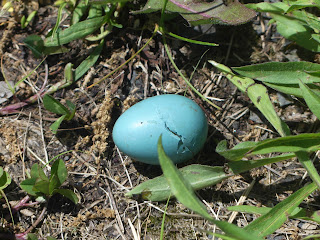
American Robin Egg

Image
It's never a good sign to see a mostly-intact American Robin egg on the ground. While finding half an eggshell leaves open the possibility of a successful hatching and the shell falling from a nest, it's clear that no baby robin came out of this cracked but largely intact shell. Exactly what happened is unclear. Perhaps a predatory bird broke into the egg, ate the contents, then discarded the shell. Although I don't think American Robins are the most common targets of brood parasitism, I can't rule out that a Brown-headed Cowbird chick hatched 1st and tossed out the other eggs to get all the food/nutrition the parents could provide. Conventional parasites and diseases no doubt take a toll. And although robin nests tend to be fairly sturdy cups, it's not impossible that bad weather knocked the egg out of the nest. This is a reminder that many eggs don't hatch and many nestlings don't survive to adulthood. Though many birds have the potential for explosive p...

Eastern Kingbird - Majestic or Tyrannical?

Image
Behold the majesty of the Eastern Kingbird ! This King of the Birds surveys its kingdom from its branch throne. Unfortunately for the Kingbird, many birds do not recognize its authority . In the bird world, they're probably considered more tyrants than kings however. Although they're on the small side (quite a bit smaller than American Robins and Northern Mockingbirds ), they're surprisingly willing to "mix it up" and attack far larger birds like crows, hawks, or herons [1] that they consider (perhaps correctly) to be a threat. This tyrannical behavior apparently gave them the "king" part of their common name [2] and the name of their family of birds, the tyrant flycatchers .  May 14, 2023 at Duke Farms Photo 292808121, (c) jpviolette, some rights reserved (CC BY-NC) [1] This doesn't seem to be a suicide mission. My guess is that their quickness and maneuverability usually saves them from dying in these encounters. [2] Though kings and tyrants aren...
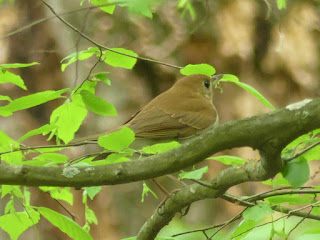
A Veery Cool Bird

Image
You knew I needed to do a pun on the Veery's name, didn't you? These birds sound like they're saying "veer", hence their name. You can kind of interpret this as Thrush Week, since this is the 3rd thrush I'm featuring this week. And while the American Robin and Eastern Bluebird are distinctive and colorful enough that misidentifications are rare, the Veery, Swainson's Thrush , Wood Thrush , and Hermit Thrush are all mostly earth-toned above and white-with-some-speckles below. If you're not good with bird vocalizations and don't get a pretty good look at the last 4, identification can be difficult [1]. May 12, 2023 at Lord Stirling Park Photo 282422617, (c) jpviolette, some rights reserved (CC BY-NC) [1] And don't let the names fool you. It's not a Wood Thrush just because you saw it in the woods, and it's not a Hermit Thrush just because it was alone when you saw it.
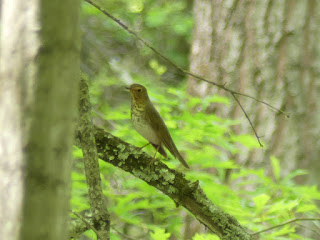
Swainson's Thrush is Lichen That Branch

Image
This Swainson's Thrush (perhaps due for a renaming) was perched on a fairly heavily lichened branch. Though there are a lot of thrushes around here, American Robins and Eastern Bluebirds are the ones I see the most (though I have met some Hermit Thrushes  on occasion). This is another bird that's not easily identified, mostly because there are other thrushes that look pretty similar. I think you're supposed to identify the Swainson's Thrush based on a little more light coloring around the eyes and a back that's slightly grayer than similar thrushes. In the foreseeable future, you won't see Swainson's Thrushes around because ... they're in line to have their name changed . The American Ornithological Society wants to rename all birds named after people. Though the subject came about due to some birds named after unsavory characters, it was also noticed that while names like Red-winged Blackbird tells you a lot about the bird's appearance [1], name...

Wading Lesser Yellowlegs

Image
Before leaving shorebirds for a while, here's another of our Lesser Yellowlegs I saw among 5-6 spring migration shorebirds (most of whom were Solitary Sandpipers ). I'm a little surprised I got an ID on this 1 since it's in deep enough water that it's not possible to evaluate how "leggy" it is, an important differentiator between Lesser Yellowlegs and Solitary Sandpipers. I suspect that the ID was due to: Solitary Sandpipers usually have duller yellow legs than the Lesser Yellowlegs. Solitary Sandpipers generally have a more prominent white eye ring than the Lesser Yellowlegs. In this case we had to rely on subtly subjective clues to get an identification. They are described by All About Birds as having a size between an American Robin and an American Crow . Considering I spot them pretty easily, I thought I'd find that they were much closer in size to crows than robins, but instead they're only slightly longer and heavier than our robins, and m...

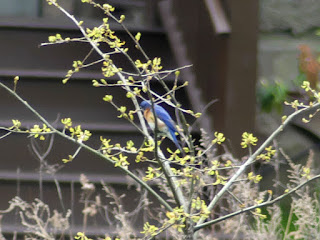
Foraging Bluebird

Image
I got this somewhat obstructed picture of an Eastern Bluebird this spring. While the bird seemed to be awfully interested in this tree, I have to confess I'm not certain what had gotten his attention: I know squirrels and birds will sometimes eat the buds off of trees; it's possible that's what's going on here. My understanding is that bluebirds - like their bigger American Robin cousins - are omnivorous, preferring to eat bugs when they're available but willing to go vegetarian when bugs are scarce. Bugs > Buds > Nothing. This looks like a smallish opposite-branching tree; I'm suspicious that it's a dogwood tree. When I asked the internet whether birds eat dogwood buds, I found about a bajillion gazillion articles about birds eating dogwood berries, and a couple broken links about them eating dogwood buds. (Thanks a lot, internet.) And of course trees - especially native ones - are home to insects, so it's possible that our bluebird friend has f...

Lone Solitary Sandpiper

Image
During the spring quite a few birds migrate through New Jersey including but not limited to shorebirds like this Solitary Sandpiper . But it's not just New Jersey that's flyover country for these birds; other than a few that overwinter in southern Texas, the lower 48 states are all basically just used during migration. This bird was no doubt hoping to get a bite to eat as it journeyed north to its mostly Canadian breeding grounds. As their name implies, they're frequently seen alone. Though they mostly eat small invertebrates, I wouldn't be surprised if things like tadpoles and small fish get eaten if the opportunity presents itself. Without a strong beak or talons to tear stuff up, they probably only eat what they can swallow whole, and their options are presumably much more limited than those of a much larger bird like a Great Blue Heron . The sandpipers are a fairly large family of birds distributed across the world and consisting of 13 genera. Many of the species d...

Female Brown-headed Cowbird

Image
Like quite a few birds, this bird is easier to identify when spotted with her significant other ; she's a Brown-headed Cowbird . Due to their tendency to be monogamous plus plain old birds-of-a-feather behavior, I usually see them with prominently brown-headed males around, greatly improving my confidence in IDing them. My understanding is that Brown-headed Cowbirds are the only obligate brood parasites in my area. Obligate brood parasites have essentially lost all their parenting skills, and thus if they were ever unable to fool other birds into raising their young, they would (almost certainly) go extinct [1]. There are, however, other brood parasites in New Jersey. These are called facultative brood parasites, and these birds will usually raise their own offspring, but will also engage in brood parasitism. (Exactly when birds perform facultative brood parasitism seems variable; one source said it occurred when resources were scarce while another said it occurred when resource...

Post-burn Foraging

Image
These two birds (and other birds) were foraging in a Duke Farms meadow after a controlled burn had been done (probably weeks before). You can still see blackened plants out in the meadow, though also some green suggesting grow-back was already occurring. I'm not sure what effect a controlled burn has in the short term for birds. I'm sure some arthropods and seeds burned. On the other hand I'd imagine some arthropods will begin to move in, and certainly the burn increased visibility for foraging birds. Though I'm uncertain what the short term effects are, long term these controlled burns are probably the most natural way to retain a meadowland [1]. The 1st bird is the frequently-seen American Robin . March 24, 2023 at Duke Farms Photo 269154677, (c) jpviolette, some rights reserved (CC BY-NC) Not far away was the easily-recognized Northern Cardinal . March 24, 2023 at Duke Farms Photo 269154677, (c) jpviolette, some rights reserved (CC BY-NC) [1] Left to its own devices,...
American Robin Among Goblin Balls (aka Sweetgum Seed Balls)

Image
Last March I spotted this American Robin foraging among goblin balls. I have to confess that prior to writing this I've never referred to American Sweetgum seed balls as "goblin balls", though the sharp spikes on sweetgum seed balls do seem like the sort of things that mischievous goblins might put out to annoy/vex us. And this article on sweetgums suggests this is a valid term for them (but rest assured that arborists are convinced that goblins are not involved in the production or distribution of these things). Though sweetgum isn't the favorite wood of woodworkers, these seed balls are probably the main reason this tree isn't terribly popular in yards. For those who like to walk barefoot, these seed balls constitute a minefield of pain [1]. Although our robins are unlikely to eat the seeds in these seed balls [2], some of our birds will eat them. These mostly seem to be stouter-billed birds like sparrows, cardinals, and finches, with American Goldfinch bein...

Male/Female American Robins

Image
American Robins exhibit subtle sexual dimorphism. Though there are some other subspecies that can complicate the issue, here in NJ the males have darker brown and brighter orange than the females. Another complication is that immature males also resemble the females; it's safer to identify a mature male while distinguishing immature males and mature females is going to be more problematic. This looks to me to be a good example of a mature male. The head's pretty dark while the breast/belly are a fairly bright orange. April 18, 2023 at Duke Farms Photo 272140697, (c) jpviolette, some rights reserved (CC BY-NC) The robin below has lighter head coloring and paler orange. This picture was taken in March, and they ought to have adult plumage after a year, so I suppose it's possible this is a male born in 2022 that hasn't quite gotten its adult plumage. If the bird is over a year old though, we could safely claim her as a female robin. March 20, 2023 at the Raritan Water Pow...

Another Winter American Goldfinch

Image
Here's another American Goldfinch I encountered last winter. Though the eye-popping neon-yellow breeding plumage isn't there, this 1 is more easily recognized as a goldfinch because he's still probably the yellowest bird around. (The previous winter goldfinch I showed was probably a female.) As fairly committed vegetarians, American Goldfinch probably adjust better to wintertime foraging when insects are scarce. Aside from the cold, their biggest complaint about winter might be that they get sick of hearing their American Robin and Northern Cardinal neighbors whining about how they'd love a fat caterpillar or a juicy moth for months on end. January 26, 2023 at Duke Farms Photo 263364365, (c) jpviolette, some rights reserved (CC BY-NC)

Northern Mockingbird

Image
Here's a Northern Mockingbird taking in the scenery from a low perch. I've talked about their mimicry and eating habits in prior posts, which suggests I see/hear them a lot. Today I'm going to write this stealing information from a book I borrowed from the library: What It's Like to Be a Bird - Sibley. Apparently mockingbirds will "attack" people, at least if you define an attack as "making a lot of noise and flying towards you only to veer off before getting to you". I've personally been attacked like this by Red-winged Blackbirds , Tree Swallows , and even an American Robin , but never by a mockingbird [1]. In virtually every 1 of these situations the attacking birds were trying to harass me into leaving an area, almost certainly because they perceived a threat to their nest or a fledgling. One foraging tactic they (and some other birds) use to find food is " wing flashing ". Here's the way it works. The bird lands someplace t...

American Robin

Image
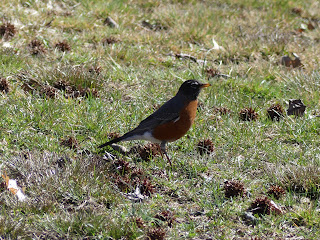
Here's someone that almost everyone living in the lower 48 US states knows, the American Robin . Though common, there's a lot you might not know about them: They're named after but are not particularly close relatives of the European Robin . The term "robin" has been used in the names of quite a few unrelated birds. They are related to our thrushes, including the bluebirds. Though associated with migration - their scientific name is Turdus migratorius - they can be found year round in many areas, including NJ. (It's unclear whether we have the same robins here all year round, or if the ones we see in the winter spend the summer up north and the ones we see in the summer head south for the winter. I'm betting that both occur.) They're opportunistic omnivores. In the summer their favorite foods consist of invertebrates, but in the winter they'll switch to berries. The orange-red plumage reminded Native Americans of fire, and they're sometimes con...

Juvenile Eastern Bluebirds

Image
While Eastern Bluebirds are spotted in central NJ fairly often, this time I got a picture of juvenile Eastern Bluebirds. Though there's some blue plumage that's come in, they have the white speckles of a juvenile. Their thrush cousins, the American Robin , also look speckly as juveniles; presumably this is better camouflage than adult plumage. Though they have a fair number of thrush relatives, their closest relatives, the Western Bluebird and the Mountain Bluebird , live on other parts of the continent. One of the biggest challenges for bluebirds is to find a place to nest. As cavity nesters, nesting boxes are a good substitute for the tree cavities that used to exist when this area was mostly forest. Duke Farms provides nesting boxes for bluebirds, and my understanding is that the bluebirds on the property successfully raised an above average number of kids this summer.  July 6, 2022 at Duke Farms Photo 221313845, (c) jpviolette, some rights reserved (CC BY-NC)

American Robin with Prey

Image
Here's an American Robin I saw a couple week's back. I'm not sure if this will be a meal for the robin or if it'll feed some nestlings back at home. Many times it's difficult to figure out exactly what a bird is eating, but "earthworm" looks like the obvious answer here. Contradicting the old adage that "the early bird gets the worm" this picture was taken mid-afternoon. But assuming this robin is raising kids, this is a reminder that feeding them is pretty close to a fulltime job. Though we think of robins as cute little birds that sing a lot, to some parts of the animal world they are feared predators. (I'm reminded of an old Far Side cartoon where a bunch of worms were watching a horror film called (something like) "Night of the Robin".) May 31, 2022 at Washington Valley Reservoir Photo 205019508, (c) jpviolette, some rights reserved (CC BY-NC)
Northern Waterthrush

Image
A couple weeks ago I ran across a bird I don't usually see, a Northern Waterthrush . At least I'm pretty sure that's what it was; the Louisianna Waterthrush is an awfully similar bird. With a name like "waterthrush", you're probably thinking that this bird is related to thrushes like the American Robin ... but you'd be wrong. The waterthrushes (both Northern and Louisianna) are a type of warbler . Though the "thrush" part of their name is a little misleading, the "water" part is a more helpful description of the bird; they are usually found around still waters. There's a pretty good chance that this waterthrush was just passing through during migration. It looks like northwestern NJ is just barely in their breeding range. Still, we're probably close enough to their breeding range that if a male/female pair met here, they might consider staying. (We are more firmly in the breeding range for the Louisianna Waterthrush, though ...

Baltimore Oriole

Image
A couple weeks ago at the Plainsboro Preserve I was told that orioles were out and about. I didn't see many of them but did get a picture of one male Baltimore Oriole vocalizing (as they are wont to do) near the top of a tree. At a glance you might see an orange breast/belly with a dark head/back/wings and think you're seeing the far more common American Robin . But with a clear look you'll see that their orange is a bit brighter/lighter, that they have no white eye ring, and they have a bit of white on their wings. (Robins also outweigh Baltimore Orioles 2-1, though as I've mentioned before it's not always easy to judge the size of a bird at distance.) Similar to the Northern Flicker and the Eastern Towhee , there is some debate on where to draw the line between species. The Baltimore Oriole is clearly related to the Bullock's Oriole , and there was a time they were considered the same species, called a Northern Oriole . Genetic analysis convinced ornithologi...

Brown Thrashers

Image
A couple weeks ago I encountered 2 (presumably) different Brown Thrashers ; at least I saw them almost 2 hours apart and a healthy walk away from each other. Because I don't see them very often I wasn't sure who I was seeing, but the leading candidates were the Brown Thrasher or the Wood Thrush . When I looked at the pictures at home and looked them up in my field guides, the long tail, streaky rather than spotty marks on the breast/belly, and lack of lines near the eye convinced me that I had Brown Thrashers. (Brown Thrashers are also quite a bit larger than Wood Thrushes, though without a "reference bird" like an American Robin nearby it's kind of hard to judge size.) Brown Thrashers are one of our general-purpose mimics, and it's believed that they have an even larger repertoire of songs than their Northern Mockingbird relatives. While the Northern Mockingbird will usually mimic a sound 3 times, the Brown Thrasher will mimic it only twice, making it possi...