Posts

Showing posts with the label little wood satyr

Satyrs of the Little Wood Kind
Image
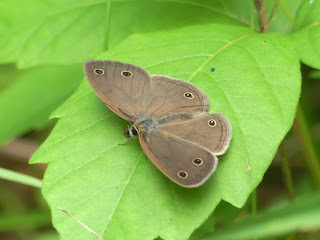
Here are some Little Wood Satyrs from last year. You could quibble with the name: They aren't horse/man hybrids exhibiting loutish behavior ; they're actually butterflies . 😉 They're not made of wood. (Admittedly they do prefer wooded areas though.) Though they're a lot smaller than you and I (unless my readership includes small arthropods), there are a lot of smaller butterflies that don't have the "little" modifier in their name. (And it's not like we have similar-but-larger Giant Wood Satyrs flying around here.) Though far from being the "flashy dressers" of the butterflies, the contrast of the eyespots with their grayish-brown wings probably makes them good-looking in an understated way. June 21, 2023 at Fairview Farm Photo 301211200, (c) jpviolette, some rights reserved (CC BY-NC) June 21, 2023 at Fairview Farm Photo 301211416, (c) jpviolette, some rights reserved (CC BY-NC)
Satyr and Brown

Image
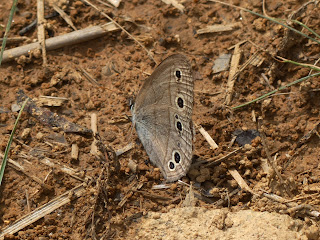
Here's a Little Wood Satyr and Appalachian Brown from last June. "Satyr and Brown" aren't a law firm; they are a couple of moderately closely related butterflies collectively in the satyrini tribe . Note that in human groups I would expect a tribe to be a wider set of relations containing multiple families, but in taxonomy it's the opposite; the family is the wider group and can contain multiple tribes. So the Little Wood Satyr and Appalachian Brown are more closely related than some butterflies in their family. Although the spots on the wings and (to a lesser extent) the lines on the wings allow us to distinguish between these butterflies, I suspect you can see a resemblance. Besides the similar background color and general wing shape, just having spots and lines (even if the spots and lines differ a bit) is suggestive of a relationship. These family members could dine together, at least as adults. Both tend to avoid nectar and gravitate towards foods like sap ...

Little Wood Satyr

Image
Satyrs may have started out in Greek mythology, but these days you can find them in modern lepidoptery. Here are a couple of Little Wood Satyrs I saw at 2 different locations on the same spring day. Many of the satyrines (aka "browns") abstain from nectar-feeding altogether as adult butterflies, preferring sap, rotting fruit, and other organic juices. Little Wood Satyrs break with their brethren species in this regard, and thus can sometimes be found on flowers. They're also known to feed off aphid honeydew  [1]. As caterpillars the satyrines tend to chow down on grasses and sedges; perhaps the butterfly in the 1st picture is reminiscing about a memorable meal from its childhood? Or regretting that it's now completely unable to consume blades of grass? May 18, 2023 at Fairview Farm Photo 292810726, (c) jpviolette, some rights reserved (CC BY-NC) May 18, 2023 at Willowwood Arboretum Photo 292813027, (c) jpviolette, some rights reserved (CC BY-NC) [1] Given their ta...
Little Wood Satyr

Image
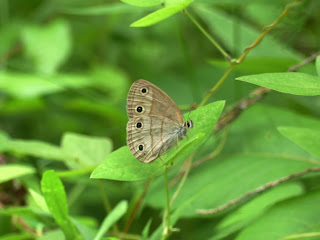
Here's the 1st Little Wood Satyr I photographed this season. Though there is a perception that "butterflies are colorful" and "moths are drab looking", the truth is more complicated. Though satyrs/nymphs like this Little Wood Satyr may have neat looking eyespots (those spots on the wings that might fool predators into thinking they're eyes), you can't really call them colorful. And there are certainly some moths more colorful than this. Skippers are another group of butterflies that are generally earth-toned. (I've talked a little about the butterfly/moth distinction here , and Little Wood Satyrs here .) These butterflies are pretty widespread; though this one was found at the Plainsboro Preserve, I've also seen them at Murray Hill , Washington Valley Park , Duke Farms , Fairview Farm , and other wooded places. June 1, 2022 at the Plainsboro Preserve Photo 205019765, (c) jpviolette, some rights reserved (CC BY-NC)

Little Wood Satyr

Image
I met this Little Wood Satyr this past July at Washington Valley Park. Although NJ doesn't have - as far as I know - the nymphs and satyrs of Greek mythology, they do have nymphs and satyrs of modern lepidoptery.  As caterpillars, these butterflies feast on various grasses. Most of their relatives are green as caterpillars, but the Little Wood Satyr is brown during their caterpillar phase. One thing they'll drink as adults is aphid honeydew . Is it possible that they could be one of the few beneficiaries of the Spotted Lanternfly , and prolific producer of honeydew? There are at least 2 taxonomic issues relating to the Little Wood Satyr: They seem to breed readily with a butterfly found in the south, the Viola's Wood Satyr ; are they the same species? They frequently have 2 broods that occur too close together for the 1st brood to be the parents of the 2nd brood; some people think these 2 broods might be 2 different but nearly identical species. Currently Little Wood Sa...

Little Wood Satyr

Image
Here's a Little Wood Satyr . Though not especially colorful, they are considered to be butterflies. (In a closer picture you could probably see a "clubbed" antenna, which is a pretty good indicator that this is a butterfly.) The butterfly/moth distinction is something people argue about. Clearly moths and butterflies are related, and some people consider the term "butterfly" to be artificial and unnecessary. I usually differentiate them for reasons both scientific and social. Butterflies do seem to form a clade (suggesting they all belong to a valid taxonomic group of some sort), and many lepidopterists that are amazing at identifying butterflies can't in general identify most moths.