Posts

Showing posts with the label grass skipper

Broad-winged Skipper

Image
Here's one of our larger but fairly nondescript grass skippers, the Broad-winged Skipper . In theory when the wings are up you should see light brown wings with a light line going front-to-back and with a light spot above and 1-2 light spots below that line. (With a little additional imagination, this is sometimes described as a light cross symbol.) As you can see in my picture, those light marks can be pretty subtle. You can probably make out what I'm talking about, but as field marks go they don't necessarily jump out at you. July 31, 2022 at Duke Farms Photo 222579090, (c) jpviolette, some rights reserved (CC BY-NC) And although they're more colorful in this wings-down position (common among grass skippers ), it's still not a slam dunk to ID this butterfly. On the left it looks like the front wing is up with the rear wing down. This pattern is similar to other skippers like the Zabulon Skipper , though I'd expect the dark border to be narrower on a Zabulon. O...

Horace's Duskywing

Image
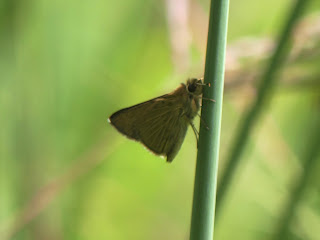
Here's a Horace's Duskywing from last summer. Unless it's a Juvenal's Duskywing ; together they comprise another pair of very similar and related butterflies. But let's go with the Horace theory. Like a lot of skippers , the duskywings are difficult to identify because they're fairly similar. They differ from a lot of the skippers I see by being spread-winged skippers , who are much more inclined to hold their wings down when at rest than the grass skippers . I initially thought this butterfly might have been named after Horace Waller , a lepidopterist and anti-slavery activist alive around the time of the discovery of this butterfly, but apparently many of the duskywings are named after Roman poets like Horace . As caterpillars these butterflies feed on oaks. They also survive the winter as caterpillars and are probably ready to enter their chrysalis stage as soon as spring arrives. August 5, 2021 at Duke Farms Photo 148952672, (c) jpviolette, some rights res...

Swarthy Skipper

Image
Here's a Swarthy Skipper from last summer. Why swarthy ? From this view where you see the underside of the wings, it looks like a fairly light brown butterfly. If you see the top view of the wings though, you should see more of a dark gray or light black color. So this fella might have a swarthy side that you just can't see in this picture. These guys are, like a lot of the skippers I see, a grass skipper , meaning that they use some type of grass as host plants when they're caterpillars. Though most sources say they'll only use Little Bluestem  [1] grass as a host, at least one suggested they'll also use some other unnamed grasses. The Swarthy Skipper was first documented as a species in 1824 by the French entomologist Pierre Andre Latreille  [2]. AFAIK Latreille never journeyed to America, so I'm assuming someone sent him butterflies (he also documented our Tawny-edged Skipper ) and other insects to him in France where he determined which ones were new specie...

Least Skipper

Image
Meet a Least Skipper , no doubt named for its small size, though the Southern Skipperling is a little smaller. (My guess is that the person naming the Least Skipper were unaware of the Southern Skipperling, a species common from South Carolina to Texas but unlikely to be seen elsewhere.) These guys are considered grass skippers  due to them eating grass during their caterpillar youth. Of course, grass skipper caterpillars aren't like having a cow or a goat; I doubt you'd ever notice the grass they eat. In keeping with their smaller size, they have a rep for nectaring on smaller flowers than other skippers. July 28, 2021 at Sourland Mountain Preserve Photo 148655212, (c) jpviolette, some rights reserved (CC BY-NC)

Peck's Skippers

Image
Who is Peck, and why does he have a skipper? These are just two questions surrounding this pair of Peck's Skippers . Peck's Skippers are grass skippers , named because the females lay eggs on various types of grass, and as caterpillars they eat those grasses. The females are darker, so I wouldn't be surprised if the one in the front is a female being courted by the male in the back. They were named after William Dandridge Peck , an American naturalist considered to be the first native-born American entomologist. This butterfly wasn't (as fair as we know) his favorite butterfly; it was named after him as an honor rather than because of a personal connection to it. July 27, 2021 at Washington Valley Park Photo 148653335, (c) jpviolette, some rights reserved (CC BY-NC)

Sachem

Image
Here's one of our skipper butterflies, the Sachem . The males have a fairly distinctive dark square mark on the wing when seen from above. This is a female though, so that clear field mark isn't present here. My Eastern Butterflies field guide suggests looking for the white mark on the forewing that's closest to the head, while my Field Guide to Butterflies of North America seems to say that the dark patch a little in front of the white spot is what we should look for. (I wonder if the latter dark patch is the female's equivalent of the male's more distinctive dark mark.) The skippers are going to be an identification challenge; there are a lot of them, many look similar, and the distinguishing features can be fairly subtle. The Sachem is considered a grass skipper , but apparently it's mistaken for some of the branded skippers , so apparently they look a little more like their more distant relatives than some of their closer relatives. August 19, 2020 at Finder...

Peck's Skipper

Image
Here's a Peck's Skipper . Though not particularly colorful, Peck's Skipper (and all skippers ) are considered to be butterflies. (The clubbed antenna is usually a good indicator of butterfly-ness.) Peck's Skipper is in the Grass Skipper subfamily ; as caterpillars they eat grasses or sedges. Most of the skippers are small, earth-toned butterflies. The yellow patch where the middle one juts further to the back is considered to be a good way to identify this particular skipper. They were named after the guy considered to be the first native born American entomologist, William Dandridge Peck . July 25 at Duke Farms