Posts

Showing posts with the label spring azure

Summer Azure

Image
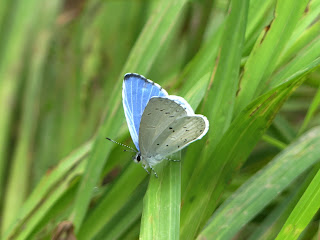
Here's a Summer Azure showing how they got the azure part of their name. (Since this picture is from June, I'm considering it to be a Summer Azure rather than a Spring Azure.) Though I'm sure I benefited from particularly favorable lighting, this picture shows off the blue you can see when they open their wings. (I wish I had gotten a fully-open wing shot, but this was the best I could do.) This is a butterfly that would probably impress people more if they were larger and thus harder to overlook. Similar to birds, I'm fairly confident that the brightness of the blue in this picture indicates this is a male; generally I'd expect females to be drabber in color. This individual also has a more vibrant look than their distant cousins, the Eastern Tailed-Blues . June 20, 2023 at Washington Valley Reservoir Photo 301112499, (c) jpviolette, some rights reserved (CC BY-NC)

Azure Butterflies

Image
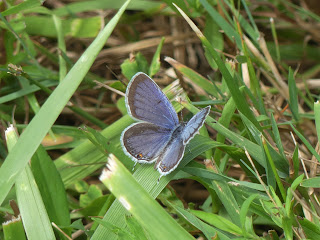
There are lots of butterflies in NJ that look similar [1] though most of the time there are subtle differences that allow them to be identified (even if it requires getting a better look than the butterfly provides to you). But I'm not confident this can be done with the Spring Azure ,  Summer Azure , Lucia Azure , and Appalachian Azure . They (and other) species are small butterflies with light, speckled underwings with (at least for males) bluish-purple upperwings, and without the "tails" and orange spots associated with Eastern Tailed-blues .  Although today these butterflies seem to be recognized as separate species in a Spring Azure Complex  (where a complex is a set of related species that are difficult to differentiate) there have been times in the past when they were all considered one species with different broods and with regional variations.  Having said that, some lepidopterists appear to have detected subtle physical differences between Spring and Summ...

Eastern Tailed-blue

Image
Here's a pretty good shot of an Eastern Tailed-blue , though you could be forgiven for thinking they're more of a violet-blue in color. Although you can quibble with the shade of blue, the blueness that's there says that this is a male; the females tend to look gray instead. In flight you'll see this blue coloring flashing since the underwing is mostly a slightly speckled white. (The underwing also has a little orange spot, though I doubt you'll pick that up in flight. You can see what the underwings are like in the picture here .) They can be confused with the Spring/Summer Azures . The best ways to distinguish the Eastern Tailed-blue from them are: The azures don't have the little "tails" on their rear wings. When their wings are up, the azures shouldn't show the little orange markings of an ETB. (Distinguishing the Spring Azure from the Summer Azure is something I can only do based on the season.) Although neat looking, these are pretty small b...

American Copper

Image
Since I've been showing Great Spangled Fritillaries this week, for Throwback Thursday let's dip into the photography archives to show a cool-looking butterfly from the past, an American Copper  (aka Common Copper). While the name might make you think I'm talking about a member of a US constabulary , the coppers are a subfamily of generally small butterflies. Though one source claimed they are an introduced species, most sources suggest it's more of an international butterfly than an invasive one. Similar to the Red Admiral and Painted Lady , it appears to be native to not just North America but also Eurasia and much of Africa. Though the species may be found across much of the world, its numerous subspecies tend to be more localized. Though it's a fairly colorful butterfly it's easy to overlook due to its diminutive size. If you're familiar with the Spring/Summer Azures , they're approximately that size. When I got my pictures, I wasn't sure what ...