Posts

Showing posts with the label hooded merganser

Hooded Merganser Crests

Image
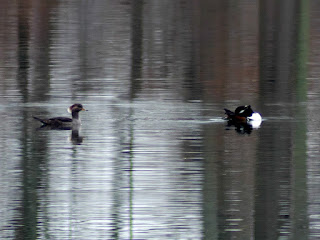
Here are a couple pictures of Hooded Mergansers , male and female. The males are black and white around the head and neck while the females have more "earth tone" coloring. In the 1st picture, the male has a large, almost circular white patch on the side of his head, and in the 2nd picture the male has more of a white line on the side of his head. While sometimes there's simply variation in individual plumage that can account for different appearances, and other times there are subspecies where whole populations look quite different from each other, but neither of these is what's going on here. Male Hooded Mergansers can raise their crests to present a large white circle, or they can lower them to present a smaller white line. Generally speaking, male Hooded Mergansers can go from 1 look or the other in seconds, making them the quick-change artists of the waterfowl world. The strikingly different appearance of a raised versus lowered crest of Hooded Mergansers somet...
Buffleheads

Image
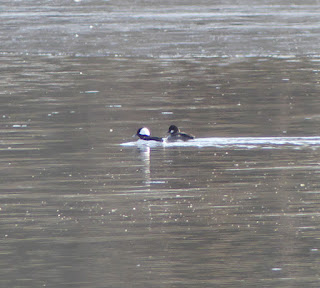
Here are some more winter ducks that you shouldn't expect to see when things warm up: Buffleheads . They're not around my area in big numbers, and most of my pictures were taken in the fall of 2020. They're small ducks [1] that are mostly black and white, so at a distance they probably blend in inconspicuously with Ring-necked Ducks and Hooded Mergansers , though their closest relatives in this area is the Common Goldeneye . The females have black heads and back with a white patch around their cheeks. A male without its breeding plumage looks similar, though the white patch is a bit larger. A male in breeding plumage though has that white patch expanding to cover pretty much all of the back of the head. These are considered one of our most monogamous ducks, so barring a death there's a pretty good chance these 2 were a couple. February 17, 2020 at Washington Valley Park Photo 66501906, (c) jpviolette, some rights reserved (CC BY-NC) [1] The only native duck that's ...

Hooded Merganser Couple

Image
Here's a pair of Hooded Mergansers , a duck I've talked about before but don't frequently see.  I suspect they got the "merganser" part of their name because the females have a frizzy look similar to the Common Merganser . Despite frizziness and the name, Common Mergansers and Red-Breasted Mergansers are not closely related to the Hooded Mergansers.  Technically "merganser" is derived from "mergus" (meaning waterfowl) and "anser" (meaning goose), making the term a little inappropriate for all 3 species (since they're all waterfowl, but they're ducks rather than geese). Like many (but not all) ducks, these ducks are sexually dimorphic, with males and females having much different plumage. Here's a pretty good look at the female. January 4, 2023 at Duke Farms Photo 251773997, (c) jpviolette, some rights reserved (CC BY-NC) And here's a better picture of the male. Perhaps because there's no male competition around, ...

Ring-necked Ducks

Image
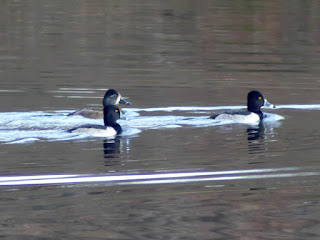
This was the 2nd picture I got this past season of Ring-necked Ducks . (The 1st picture wasn't a good but you can look at it if you want to.) You might be thinking "I don't see any rings on the necks - this must be a misidentification", buf  if you were close enough you would see a ring around the neck (even though it's difficult/impossible to see from a distance). This is certainly one of those instances where the bird got its common name from someone seeing the bird up close, and they almost certainly got that close look because the bird was dead. I was (mildly) victimized by these ducks being named after such a subtle physical trait. Years ago when I saw them, got some pictures, and attempted to identify them, I got to a webpage listing the names of all the ducks in my area. As I went down the list, I skipped right over the link for Ring-necked Ducks because I felt certain there was no ring around their neck. This led me to erroneously believe that the best fi...

Hooded Merganser

Image
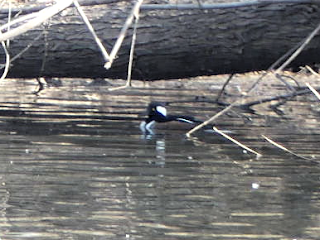
Here's a Hooded Merganser I met a couple months ago. (Admittedly the meeting was at quite a distance.) This is a male; the females have the same body shape but have coloring in the light brown and tan. Though they're supposed to be in my area year round, I've only spotted them in the colder months: November - March. Despite the name, the Hooded Merganser isn't considered a close relative of the Common Merganser; they're in different genera. I'm more likely to mix them up with the Bufflehead since both ducks have large white spots behind their eyes (though the Bufflehead wouldn't have the brown lower on the body). I would have expected ducks to be pairing up around March, though this fella's closest companion was a male Wood Duck, with some Canada Geese a little further away. I don't see a lot of these ducks (iNaturalist lists them as "vulnerable"), so maybe he simply hasn't found a mate yet. March 9, 2021 at the Raritan River Greenway ...