Posts

Showing posts with the label sparrow

Eastern Towhee

Image
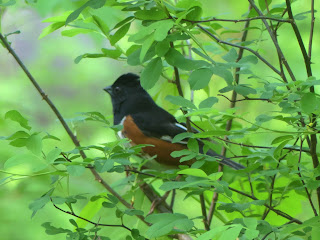
Normally when performing my Steward Volunteer tasks at Duke Farms I'm a little too preoccupied to get many nature pictures, but I believe someone on the team noticed this Eastern Towhee moving around in the greenery. With black plumage on the head/neck/back, I believe this is another male Eastern Towhee . My guess is that the males, out looking to woo females, is intentionally more conspicuous, and that's why I notice them more. While most people associate sparrows as being little brown birds, towhees tend to be a colorful exception. May 15, 2023 at Duke Farms Photo 292808324, (c) jpviolette, some rights reserved (CC BY-NC)
A Ubiquity of Dark-eyed Juncos

Image
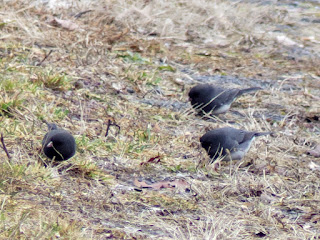
Though I think I've heard them recently, I haven't seen Dark-eyed Juncos recently. If they're still down here, they're no doubt planning their northward migration to their breeding grounds. Since we probably won't see these guys for a while, let's admire these little dudes through pictures. I think their manners are a little better when they forage in the wild than they do when I've fed them at my patio . On my patio there are lots of attempts to intimidate one another while feeding, but on a trail where food is far less plentiful they seem to all be pecking around the area without conflict. I suspect that when foraging in the wild any food they find just gets immediately eaten, leaving nothing to fight over. I called them a ubiquity of Dark-eyed Juncos. Though this webpage doesn't address a group of juncos directly, they do suggest "ubiquity", "host", "quarrel", and "tribe" as collective names for sparrows . Sin...

Eastern Towhee Breeding Season

Image
Here's another bird that I'm seeing and hearing quite a bit of lately, presumably signaling their breeding season too: the Eastern Towhee . The towhees are our largest sparrows , and the Eastern Towhee is also one of the most distinctively colored sparrows too, making them easier to ID than the sparrows that are a variation of the little brown bird. My field guide says that they're singing things like "jink denk te-e-e-e-e-e" and calling things like "chewink" or "zhwink", but to me I'm hearing it more like a lispy "thweet". And I've been hearing quite a bit of it over the last couple weeks. Yesterday I talked about how the Northern Flicker used to be considered 2 different species but are now considered 1. That theme is reversed with the Eastern Towhee, which along with the similar-looking Spotted Towhee used to be considered the Rufus-sided Towhee. The Spotted Towhee is lives out west but will interbreed with the Eastern T...

Field Sparrow

Image
Unsurprisingly I met this Field Sparrow in a field, or at least a grassy area mowed through a field. A pinkish bill (which doesn't show up great in the picture), white eye-ring, and uniform breast plumage help us identify these sparrows from most its sparrow relatives. (Do not identify every sparrow you see in a field as a Field Sparrow.) Unlike some birds, Field Sparrows are committed to their fields, and don't adapt to urban or suburban life. When fields disappear, their habitat shrinks. This is believed to be the primary reason their populations are declining. Field Sparrows are unfortunate victims of Brown-headed Cowbirds . The cowbirds are obligate brood parasites , meaning that over time they've lost the ability to raise their own young. Instead, they sneak their eggs into the nests of other birds (including but not limited to the Field Sparrow). The cowbird egg gets cared for by the other bird parents, generally hatches first and either pushes the other eggs out of ...