Posts

Showing posts with the label violet dancer

Violet/Variable Dancers

Image
 I saw a bunch of Variable Dancers 1 day last summer. Perhaps if you heard that someone saw variable dancers, you might think they saw several dancers of different abilities. But in the naturalist world it means damselflies, and in my area the Variable Dancers are likely to be Violet Dancers  [1]. Here are 2 of the male and (presumably) 1 of the female Violet Dancers. While some young adult odonate males look similar to females until pruinose builds up on their abdomen/thorax, it sounds like the violet color of the males does not come from pruinose. I believe this means that brown individuals like the 1 in the last picture are always going to be females rather than a mix of males without their mature coloring plus females. July 3, 2023 at Washington Valley Park Photo 301258933, (c) jpviolette, some rights reserved (CC BY-NC) July 3, 2023 at Washington Valley Park Photo 301259599, (c) jpviolette, some rights reserved (CC BY-NC) July 3, 2023 at Washington Valley Park Photo 3012...

Variable Dancer

Image
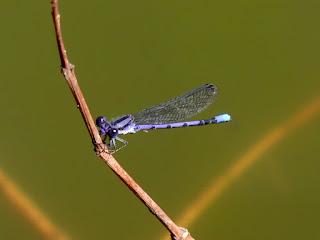
Here's a Variable Dancer I met late last spring. This is 1 of the few odonate species that consists of subspecies due to both geography and appearance. Since females would have black lines on her abdominal segments, I believe this to be an immature male. And given the relatively clear wings and that he was living in NJ, I suspect that when fully mature he'll turn out to be 1 of our Violet Dancers , 1 of the 3 subspecies of Variable Dancer. June 1, 2022 at the Plainsboro Preserve Photo 205020761, (c) jpviolette, some rights reserved (CC BY-NC)

Violet Dancer

Image
Ponds can be a great place to find dragonflies and damselflies. At the Sourland Mountain Preserve, I've had a lot of success getting pictures of them around a pond adjacent to the parking lot. Here's another place that can be good for spotting them: the Duck Pond at Duke Island Park . (Technically I suspect that the best thing about looking for them at these locations primarily because you've got easy access to the pond shore. In many places following the shoreline is difficult, perilous, or outright banned.) While there in early September, I met one of my favorite damselflies, a Violet Dancer . As frequently happens in the animal world, we know this is a male because only the males have the shockingly bright purple coloring. This little fella took a good picture staring up at me. September 1, 2022 at Duke Island Park Photo 238904748, (c) jpviolette, some rights reserved (CC BY-NC)

Blue-fronted Dancer

Image
After all my talk about blue dragonflies, you'll all be excited to know that today I'm talking about something much different: blue damselflies like this Blue-fronted Dancer . 😁 The 1st thing to look at when identifying these guys is to look at how they hold their wings. If the wings were held at the same height as the abdomen, we'd have to rule out a lot of bluets . But this damselfly is holding its wings completely above the abdomen, something you normally see only in dancers and sprites . seriously cutting down the number of damselflies you need to consider. The next most important thing to consider is that the thorax is almost completely blue, with only a small number of very thin black lines going from front to back. Relatively few damselflies look like that. Finally the front segments of the abdomen are almost entirely black, with only the last 3 being blue. That's generally considered to be the clincher for a Blue-fronted Dancer. Apparently it's much trick...

Violet Dancer

Image
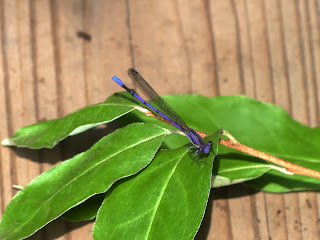
Here's another Violet Dancer damselfly. I've discussed them before , where I mentioned that they are a subspecies of the Variable Dancer . I do wonder if in 100,000 years or so, the subspecies of Variable Dancers will become different enough that they're considered separate species. I did like this picture. The violet coloring on the green leaves really stand out ... and it sorta looks like he's giving me a big, toothy grin. July 22, 2021 at Fairview Farm Photo 148400697, (c) jpviolette, some rights reserved (CC BY-NC)

Violet Dancer

Image
I know I posted a Violet Dancer picture fairly recently , but I liked the way this picture came out. You can see the vibrant color, and the little fella is even looking at the camera. The Violet Dancer isn't actually a species; it's a subspecies of the Variable Dancer . Generally I'm in favor of using subspecies when different populations of a species look quite a bit different from one another, and that's the case for the Variable Dancer. The Black Dancer and the Smoky-winged Dancer do look quite a bit different from the Violet Dancer despite being able to breed with one another. Dancers were named by people impressed with their flying skills; it is highly unlikely that one will dance the Hokey Pokey with you. June 17, 2021 at the Plainsboro Preserve Photo 141974717, (c) jpviolette, some rights reserved (CC BY-NC)

Violet Dancer

Image
Here's a Violet Dancer I met earlier in the year at the Plainsboro Preserve. The dancers aren't dragonflies; they're damselflies. Like most damselflies, they have very thin abdomens and they hold their wings straight up when at rest. And while many odonates like to rest on higher perches, the dancers seem to prefer resting on the ground instead. Numerous places consider this to be our best-looking damselfly, almost certainly because of the almost unique light purple coloring of the males. Though they're a little on the small side, their color can get the attention of the careful observer. Though my field guide says they're uncommon, I've seen them at least 8 times over the last 4 years, and I've seen them in at least 5 different locations.  June 17, 2021 at the Plainsboro Preserve Photo 141958266, (c) jpviolette, some rights reserved (CC BY-NC)