Posts

Showing posts with the label eastern towhee

Eastern Towhee

Image
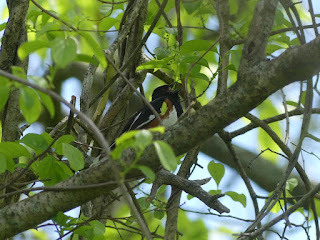
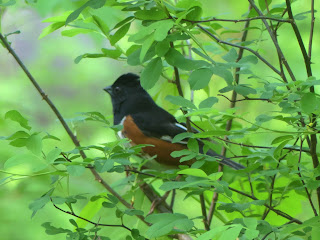
Normally when performing my Steward Volunteer tasks at Duke Farms I'm a little too preoccupied to get many nature pictures, but I believe someone on the team noticed this Eastern Towhee moving around in the greenery. With black plumage on the head/neck/back, I believe this is another male Eastern Towhee . My guess is that the males, out looking to woo females, is intentionally more conspicuous, and that's why I notice them more. While most people associate sparrows as being little brown birds, towhees tend to be a colorful exception. May 15, 2023 at Duke Farms Photo 292808324, (c) jpviolette, some rights reserved (CC BY-NC)
Chipping Sparrow

Image
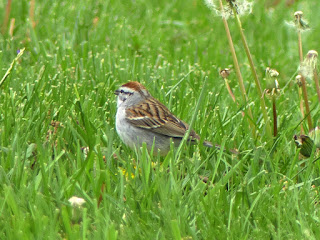
Here's a Chipping Sparrow , a bird I see the most around May (this picture was from early May of 2023) but will encounter sometimes in the summer. My guess is that this is because we're on the southern part of their summer range, and in the early spring I'm seeing at least some individuals who are passing through New Jersey on their way further north. In the summer I'm probably only seeing the Chipping Sparrows that have chosen to breed here. Though not our most distinctive sparrow (that's probably the showy Eastern Towhee ), these crisp-looking little birds with the rufus caps generally stand out from the "little brown birds". Their closest relatives that are commonly found in New Jersey are the Field Sparrows . Chipping and Field Sparrows aren't extremely common here, but it's also not hard to run across a few of them. Chipping Sparrows frequently sing a chi-chi-chi-chi song which led to their name. May 3, 2023 at Duke Farms Photo 278557367, (c)...

Eastern Towhee

Image
In mid-April at Duke Farms I was hearing and (to a lesser degree) seeing Eastern Towhees a lot, and I was fairly confident that their mating season was underway (article here ). So why was I hearing this fella singing in mid-June? First - like many passerines - these birds will have 1-3 broods in a season; it's possible that breeding season started over for some birds. (Once laid, Eastern Towhee eggs take up to 13 days to hatch and another 12 days for the hatchlings to fledge. Assuming the parents watch over their fledglings for a couple weeks and it seems plausible that they could be looking to raise another family around 2 months after the 1st set.) Second, Eastern Towhees tend to be somewhat territorial, so it's possible this little fella was staking its claim to this part of the woods. June 14, 2022 at Washington Valley Park Photo 210216990, (c) jpviolette, some rights reserved (CC BY-NC)

Baltimore Oriole

Image
A couple weeks ago at the Plainsboro Preserve I was told that orioles were out and about. I didn't see many of them but did get a picture of one male Baltimore Oriole vocalizing (as they are wont to do) near the top of a tree. At a glance you might see an orange breast/belly with a dark head/back/wings and think you're seeing the far more common American Robin . But with a clear look you'll see that their orange is a bit brighter/lighter, that they have no white eye ring, and they have a bit of white on their wings. (Robins also outweigh Baltimore Orioles 2-1, though as I've mentioned before it's not always easy to judge the size of a bird at distance.) Similar to the Northern Flicker and the Eastern Towhee , there is some debate on where to draw the line between species. The Baltimore Oriole is clearly related to the Bullock's Oriole , and there was a time they were considered the same species, called a Northern Oriole . Genetic analysis convinced ornithologi...

Eastern Towhee Breeding Season

Image
Here's another bird that I'm seeing and hearing quite a bit of lately, presumably signaling their breeding season too: the Eastern Towhee . The towhees are our largest sparrows , and the Eastern Towhee is also one of the most distinctively colored sparrows too, making them easier to ID than the sparrows that are a variation of the little brown bird. My field guide says that they're singing things like "jink denk te-e-e-e-e-e" and calling things like "chewink" or "zhwink", but to me I'm hearing it more like a lispy "thweet". And I've been hearing quite a bit of it over the last couple weeks. Yesterday I talked about how the Northern Flicker used to be considered 2 different species but are now considered 1. That theme is reversed with the Eastern Towhee, which along with the similar-looking Spotted Towhee used to be considered the Rufus-sided Towhee. The Spotted Towhee is lives out west but will interbreed with the Eastern T...

Eastern Towhee

Image
If you're walking through or near woods and hear someone singing, it might be a good thing to get out the binoculars and scan the trees. I was at Fairview Farm when I overheard this Eastern Towhee singing his heart out. Some people think their song sounds like they're singing "drink your tea", despite the fact that tea is typically unavailable while walking through the woods. The black on the head/back/wings identifies this as a male; if the black was a dark brown it'd be a female. If he finds a companion, they could raise two broods this year. (In the south they sometimes do 3 broods.) Eastern Towhees are a kind of sparrow. Their nearest relative is the similar-looking Spotted Towhee , with whom they'll sometimes hybridize. You probably don't need to know how to tell them apart though since the Spotteds are rarely east of western Iowa/Missouri. May 14, 2021 at Fairview Farm Photo 132039121, (c) jpviolette, some rights reserved (CC BY-NC)