Posts

Showing posts with the label dogbane leaf beetle

Two Different Poisonous Beetles
Image
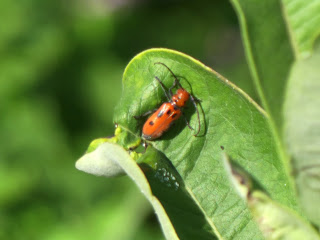
Here are a couple of beetles that are poisonous to eat, at least to birds and us mammals. I'm not sure they're poisonous enough to kill most birds, though it'll probably be sick for a while. [1] They acquire their poisonous nature from eating milkweeds / dogbanes , 2 related and poisonous plants. But don't go tearing out any milkweeds/dogbanes from your yard; the plants are environmentally beneficial and are perfectly harmless if you don't swallow a bunch of it. [2]  If you're going to ingest potentially dangerous chemicals to acquire a poisonous nature yourself, you want to advertise yourself as poisonous. Both these beetles advertise this visually, but they do it in different ways. The Red Milkweed Beetle has the more conventional advertisement; similar to Monarch butterflies and Large/Small Milkweed Bugs, their red coloring warns off at least some of their predators. The Dogbane Leaf Beetle is a bit more creative, and possibly even more eye-catching; their ...
Dogbane Leaf Beetles Mating

Image
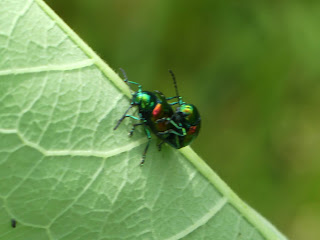
I caught these Dogbane Leaf Beetles mating last July.  Considering that I don't see lots of Dogbane Leaf Beetles (though they do have their hotspots), I have caught them mating fairly often. Note that they (and at least some other beetles) mate in this position, very different from the butterflies/moths/flies that I've seen, but similar to the way mantises and grasshoppers breed. When they're not breeding, there's probably not a good way for us humans to differentiate between the sexes of Dogbane Leaf Beetles. July 14, 2021 at Duke Farms Photo 148187776, (c) jpviolette, some rights reserved (CC BY-NC)

Dogbane Leaf Beetle

Image
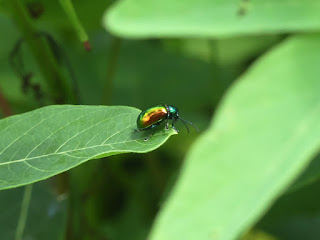
Here's yet another Dogbane Leaf Beetle , one of my favorite beetles. I've talked about them before, though this fella might have been about to perform one of its predator-evasion techniques. As vegetarians, they're not particularly fierce, so they defend themselves in 3 ways: Because they eat poisonous plants (dogbanes and milkweeds), they are somewhat poisonous themselves. While many aposematic insects signal being poisonous with red/orange coloring (e.g. Monarch butterflies, Large and Small Milkweed Bugs, Red Milkweed Beetles), the Dogbane Leaf Beetle might be advertising the same thing through its shiny coloring. Presumably also because of their poisonous diet, they can also spray a predator with some noxious chemicals. But when all else fails, they'll look to escape by going to the edge of a leaf and jumping off, hopefully into grass or leaf litter than they can hide in. I suspect this little fella miscalculated the threat of me and my camera, and was thinking of ...

Swamp Milkweed Leaf Beetle

Image
Meet a Swamp Milkweed Leaf Beetle !  When I saw this beetle, my first thought was that this was some sort of ladybug; aphids love eating milkweed, and ladybugs love eating aphids. Of course, I didn't see aphids on this milkweed, but I just chalked it up to a ladybug that was performing due diligence, making sure this milkweed didn't have a meal. But apparently this is a completely different type of beetle, one that eats the milkweed plant itself. Though their most frequently used common name seems to imply they exclusively feed on Swamp Milkweed, they will actually eat most (all?) of our milkweeds, and their second most frequently used common name is actually the broader Milkweed Leaf Beetle. Though they have a different look, they're related to another eater of poisonous plants, the Dogbane Leaf Beetle . Note the red coloring. As an eater of a poisonous plants, this beetle is trying to advertise to predators that it too is poisonous. This is known as aposematism . Milkweed...

Dogbane Leaf Beetle

Image
Here's one of my favorite beetles, the Dogbane Leaf Beetle . If you like shiny things, you're going to love Dogbane Leaf Beetles. They're almost like jewelry for plants. These guys are one of those insects that will feed on both dogbanes and milkweeds; in fact I suspect this little fella is probably on a Common Milkweed. (The leaves look a little large for a dogbane.) Both dogbane and milkweed (two types of plants in the  Apocynaceae family ) have a sticky, poisonous latex-ish substance you can see if you break a leaf. Many insects that eat these plants end up being poisonous, or at least foul-tasting, to eat. And most of these signal their poisonousness to potential predators by flaunting red/orange coloring (e.g. Monarch Butterflies, Large and Small Milkweed Bugs). It's likely that the Dogbane Leaf Beetle accomplishes the same thing with its shininess - predators are able to distinguish them from tastier, more nutritious insects. They do look a little like an invasive...