Posts

Showing posts with the label common whitetail

Female Common Whitetails

Image
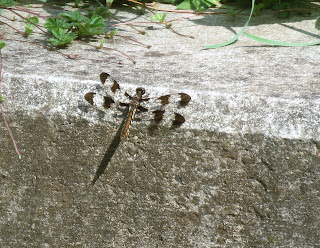
Why were there a bunch of male Common Whitetails around on this day (see this post )? It's because this is also where the female Common Whitetails were. These particular females probably weren't looking for companionship, at least when they were photographed. My understanding is that she'll usually find a territory she likes over water and mate with its corresponding male while hovering over the water. They'll probably head to water every couple of days for the purpose of breeding. I read she'll lay up to 1000 eggs each time she breeds. Certainly she needs to lay a lot of eggs; it's estimated that 99.9% of the eggs she lays won't reach adulthood. June 29, 2023 at Sourland Mountain Preserve Photo 301252225, (c) jpviolette, some rights reserved (CC BY-NC) June 29, 2023 at Sourland Mountain Preserve Photo 301252261, (c) jpviolette, some rights reserved (CC BY-NC)

Male Common Whitetails

Image
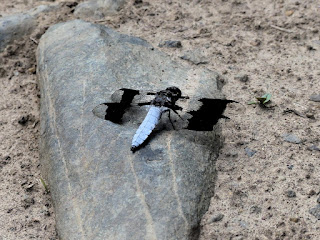
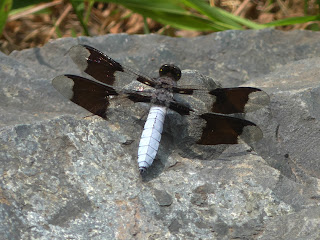
I met a lot of Common Whitetail dragonflies on this day; here are some of the males. I'm not convinced I've got anything new to say about these robust-looking dragonflies with the sometimes blindingly white pruinose abdomens, but they photograph pretty well so here are some more. I guess I'll remind you though that scale matters. While to us they're interesting looking but (essentially [1]) harmless flying insects, if you were small enough they would be terrifying predators. June 29, 2023 at Sourland Mountain Preserve Photo 301249848, (c) jpviolette, some rights reserved (CC BY-NC) June 29, 2023 at Sourland Mountain Preserve Photo 301250020, (c) jpviolette, some rights reserved (CC BY-NC) June 29, 2023 at Sourland Mountain Preserve Photo 301250043, (c) jpviolette, some rights reserved (CC BY-NC) [1] On a butterfly count 1 of the participants complained about being bitten by a dragonfly. He seemed to resent them after this so I didn't ask if this was a justified bit...
Mourning Cloak Views

Image
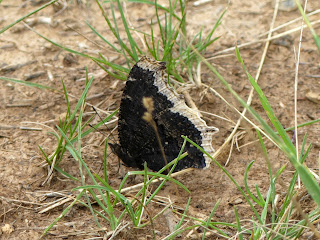
While immature and sexually dimorphic species can look different (see Common Whitetails and Eastern Pondhawks ), sometime butterflies like the Mourning Cloak can present a different look just by repositioning its wings. (Other species that can do this include - but are not limited to - Red Admirals and Question Marks .) The 1st picture is their camouflage look, and while it doesn't blend in too well in this sandy soil, it can be quite a bit harder to spot them in leaf litter or against the bark of some trees. Though there's a light colored trim at the edges, they resemble something drab with a rough texture. June 15, 2023 at Sourland Mountain Preserve Photo 300991453, (c) jpviolette, some rights reserved (CC BY-NC) But then the butterfly opened its wings, allowing us a view of its rich brown wings with light spots highlighted by a black background and with almost a gold trim on the edges. And the wings that appeared to have a rough texture with the wings up suddenly seem to...

Three Different Common Whitetails, Three Appearances

Image
Here are 3 different-looking Common Whitetail dragonflies, all ones I met late last spring. The 1st picture is of a mature male, easily noticed by that prominent white tail (really the abdomen) that provides the species with its common name. But also look at the wings. There's a bit of black where the wings attach to the thorax, then it's basically clear (if a little veiny), followed by large black patches before turning clear again at the ends. June 15, 2023 at Sourland Mountain Preserve Photo 300989072, (c) jpviolette, some rights reserved (CC BY-NC) Next observe the female of the species [1]. First notice the lack of a pure white abdomen, which is the most obvious clue that this is something a little different. But there's also wing differences. While the black strip close to the thorax surrounded by transparent wings are still present, note that the black patch further out on the wing is smaller and doesn't span the entire wing. And while this is followed by more w...

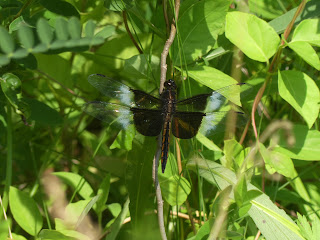
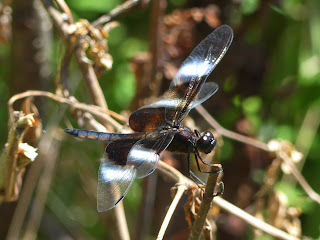
Male Widow Skimmer

Image
As with most gender-inspired species names, the names don't actually change with the gender, so this is a male Widow Skimmer and not a Widower Skimmer [1]. These are 1 of my favorite dragonflies : They'll perch so you can get a picture most of the time. The males are very distinctive with wings that are black near the base and (as they get older) with white patches before going translucent near the ends [2]. White pruinose on the abdomen is also frequently present as they get older, though not in the individual below. Though far from a griffinfly , they're big enough to spot if you're looking for this sort of animal. June 13, 2023 at Washington Valley Park Photo 300987064, (c) jpviolette, some rights reserved (CC BY-NC) [1] Similarly, male Painted Lady and American Lady butterflies are not called Painted Gentlemen and American Gentlemen. [2] Despite their distinctiveness, I'm pretty sure I originally would confuse them with the Common Whitetail .
Common Whitetail Resting Before Battle

Image
Here's one of our male Common Whitetail dragonflies taking a breather on some vegetation protruding from Dukes Brook. He'll probably be busy later defending his area of the brook. This wasn't the 1st Common Whitetail I photographed last year - this 1 from the day before was - but my understanding is that you can spot them around here as early as April, making them one of the earlier dragonflies to make the scene. (Certainly you shouldn't be seeing Autumn Meadowhawks this early.) Like many species of dragonfly, the males are not only aggressive towards males of their own species that could compete against them for a chance to mate, but will frequently also attack males of other species, especially if there's a vague resemblance between them. While this seems like a waste of energy, I guess when your only job is territorial defense, you don't want to take a chance that someone you thought was harmless turns out to be a breeding rival. May 26, 2023 at Duke Farms...

Perched Common Whitetail

Image
Here's 1 of our more common and distinctive dragonflies, a Common Whitetail . Though probably average-sized by length and wingspan, they're robust-looking and eye-catching enough that you might be fooled into considering them to be on the large side.  I think this is the 1st dragonfly I learned to recognize. Or at least the male Common Whitetails were; the females look quite a different from the males but look quite a bit like the Twelve-spotted Skimmer females. (I don't know if Common Whitetails ever double-date with Twelve-spotted Skimmers and the males forget which date is theirs [1].) Although I've heard of naturalists who've been bitten by dragonflies, we're not even close to what they consider to be prey. I didn't follow up with the bitee, but I've wondered whether he had been handling the dragonfly and the dragonfly took exception to this. May 25, 2023 at Duke Farms Photo 292816739, (c) jpviolette, some rights reserved (CC BY-NC) [1] On the othe...

End of the Trail

Image
A little over a week ago I did something at Sourland Mountain Preserve that I hadn't done before: I got to the end of its Texas Eastern Pipeline Trail all the way to Long Hill Road. This isn't an especially impressive hiking feat, but instead speaks to trail conditions: In the past there were spots where the vegetation would get pretty thick, enough that a machete would come in handy. And there were also spots where things would get wet enough that I wasn't sure I could wade through it even with my nearly knee-high rubber boots. But our surprisingly dry spring made these areas fairly easily passable. The trail is steep in parts, though near the end I seemed to be going up and down a lot. Besides getting to the end of the trail, it was a pretty good trip. Though most of the milkweed wasn't in bloom yet, a few early milkweeds and many of the dogbanes were in bloom, so there were lots of pollinators out there. And although there weren't a lot of odonates around, there...

Photobombing Dragonfly

Image
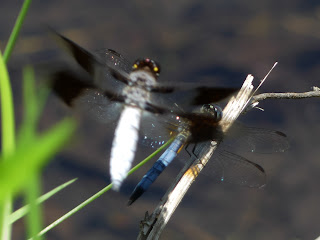
It looks like I was all lined up for an above average picture of a perching dragonfly when suddenly someone else jumped in front of the camera. You can see that the background dragonfly (probably a Blue Dasher ) was in focus but the intruder (definitely a Common Whitetail ) was a little too close. (The movement of being in flight probably also contributed to the blurriness.) These kinds of photobomb moments are pretty common for me, and are especially likely to happen: Among perched dragonflies, especially near water when males are trying to acquire/defend a territory. Among pollinators when a bunch of them are competing for the same flowers. At bird feeders when birds are both trying to feed themselves while depriving rival birds of an easy meal. A fair question is whether the Common Whitetail was attacking the Blue Dasher to get a meal. Dragonflies will eat other dragonflies, especially species smaller than themselves. And Blue Dashers are slightly smaller than Common Whitetails. But...

Common Whitetail and Widow Skimmer

Image
Here are a couple dragonflies I've talked about before , a Common Whitetail  (upper left) and a Widow Skimmer  (lower right), each perched next to one another overlooking a pond. They're both robust-looking dragonflies, and can look a little similar when the Widow Skimmer has more pruinose and thus has a while abdomen. (I suspect the Widow Skimmer is a little on the young side, and will eventually look whiter.) My recollection is that on this day there were a lot of dragonflies out there, mostly males flying back and forth, presumably trying to carve out an area that females will find appealing. But all that flying uses up energy, and so it's not uncommon for them to conserve energy by finding a perch where they can survey their territory. Though these guys are competitors for food, being separate species they don't compete for mates. Most of their aggression is spent on harassing/intimidating males of their own species, though occasionally they appear to have inter-spe...

Widow Skimmer

Image
I've mentioned in the past that the Common Whitetail was one of the 1st dragonflies I learned to recognize. Today's featured dragonfly - the Widow Skimmer - was probably one of the 1st dragonflies that I confused with the Common Whitetail. The males do have things in common: They're both robust-looking skimmer dragonflies. They both (when mature) have prominent white pruinose on their abdomens. They both have black spots on mostly translucent wings. And even though I could see that some of the dragonflies had wings with basal black spots rimmed with white while the other had black spots near the center of the wings, early on it was unclear whether these were variations within the same species versus different dragonflies entirely. Though the white on the wings indicates this is a male, there isn't a lot of white pruinose on the abdomen, suggesting this is a not-quite-mature male. (More discussion on males/females/juveniles is here .) June 8, 2022 at Duke Farms Photo ...

Look At Me!

Image
Though most of the time my problem with taking animal pictures is getting an animal that doesn't want its picture taken to cooperate and stay still long enough for me to aim and focus. But once in a while the opposite problem occurs, where I'm trying to take one picture and something seemingly photobombs the picture. This happened twice a couple weeks ago. Sometimes the photobomb is a momentary inconvenience, but all too often the activity leads to the original subject and the photobomber fleeing from camera range. In this 1st one, I intended to get a picture of a Cabbage White butterfly on what I believe to be Birdsfoot Trefoil . Although I didn't think the trefoil was particularly popular with the pollinators, at least one butterfly was checking it out when another flew in. In this case the photobomb was probably about romance; the one with 2 dark smudges on the forewings is a female while the intruder with 1 smudge spot on its forewings is a male. (I have no idea if the...

Eastern Pondhawk

Image
Here's one of the 1st Eastern Pondhawks I've seen this season. Like quite a few insects, they're light enough to safely land on pond scum. This was probably the 2nd and 3rd dragonfly I learned to identify, shortly after the Common Whitetail . Why do I say 2nd and 3rd? Well, originally I thought the blue males and the green females were separate species. But once I got identifications for them, I realized that those dragonflies I thought to be rivals might have been spouses. I haven't seen females out yet. My impression is that with some dragonflies the males emerge 1st, squabble over territory, and once their fighting has simmered down the females arrive on the scene. If you're wondering what the females (and immature males) look like, here's an old post  from a prior year. This spot also had Blue Dashers zipping around. I've heard different things about the way dragonflies of different species interact. Sometimes (especially if there's a substantial s...

Similar Dragonflies

Image
I remember when I first started taking pictures of wildlife, I encountered my first Widow Skimmer dragonfly and thought I was seeing another dragonfly I had learned about, the Common Whitetail . These dragonflies are about the same size, though the Widow Skimmer's wings can be a little longer. They both (in males) have a pruinose-white abdomen and have mostly translucent wings with prominent black spots. Nowadays I know that the location of the black spots on the wings are a significant difference, and that the white on the edges of the Widow Skimmer's black spots don't exist at all on the Common Whitetail. These dragonflies are fairly closely related, and both used to be in the Libellula genus before the Common Whitetail was reclassified into the Plathemis genus. (This sort of reclassification happens way more often than you might think, as we're constantly learning more about the flora and fauna around us.) Here's a Widow Skimmer, similar to who I saw those years...

Common Whitetails

Image
Not surprisingly in a dragonfly-rich environment, I met a couple Common Whitetails . Similar to the Slaty Skimmers, they are widespread because they're fairly flexible regarding habitat. I'm assuming the ones at my apartment complex use the Raritan River (about a mile away) for breeding. The adult males are pretty distinctive, with the spots on their wings and the sometimes vibrantly white pruinose on their abdomens. July 23, 2021 at the Plainsboro Preserve Photo 148592162, (c) jpviolette, some rights reserved (CC BY-NC) The females aren't as easy to identify. Apparently they look very similar to Twelve-spotted Skimmer females, with the main difference being the Common Whitetails have light yellow spots on the side of the abdominal segments while a Twelve-spotted Skimmer would have about the same color but it'd show up as a continuous line. July 23, 2021 at the Plainsboro Preserve Photo 148594024, (c) jpviolette, some rights reserved (CC BY-NC)
Eastern Pondhawks

Image
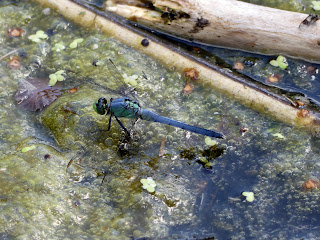
Let's show two of these guys today. They are a pair of Eastern Pondhawks I met about the same time a couple months back. The blue one is certainly a male. The green one is probably a female, though juvenile males of this species look an awful lot like females. As with many dragonflies, as the males age they become covered with pruinose, especially on the abdomen, but in Eastern Pondhawks you'll also see this on the thorax. In some species the pruinose is mostly white (like in Common Whitetails and Widow Skimmers), but in Eastern Pondhawks it's light blue. So while there's quite a bit of sexual dimorphism in mature Eastern Pondhawks, there's almost no sexual dimorphism amongst the juveniles. Finally, while it's possible that these 2 crazy kids might be a couple and have larvae together, it's at least possible the green one will eventually be a blue rival of the already-blue pondhawk. Presumed female Eastern Pondhawk June 17, 2021 at the Plainsboro Preserve P...

Juvenile Common Whitetail

Image
Though I've talked about them a lot, this was a pretty good picture of an immature male Common Whitetail . The coloring of the thorax and abdomen looks pretty much exactly like an adult female, but the dark spots on the wings are indicative of a male - this combination is probably a solid identifier of an immature male. Since these guys only live a few weeks as adults, I suspect that he'll be getting his white "tail" (really the abdomen) pretty quickly. Even if this guy doesn't father children (probably because something eats him before he gets the chance), he's gotten a lot further in life than most of his siblings. It's estimated that 99.9% die before emerging from their aquatic nymph stage of life. June 17, 2021 at the Plainsboro Preserve Photo 141958818, (c) jpviolette, some rights reserved (CC BY-NC)
Common Whitetail Dragonfly

Image
I was a little surprised that, until this late May trip to Sourland, I didn't get any pictures of the male Common Whitetail dragonflies this season. That ended on this trip, as I got reasonable photographs of 5 of them (which probably means I saw 2-3 times that many). These guys were all buzzing one another, trying to establish a territory that'll impress the females. Optimally they'll try and hold 30-100 feet of shoreline, though Sourland has a fairly small pond that makes for a lot of competition for that space. I'm sure I don't have a full appreciation about what's really going on among the dragonflies at the pond. The aerial battles among the males of a species are pretty clear, and males pursuing females is fairly straightforward, though I can only guess what the inter-species interactions are about. I'm fairly sure larger dragonfly species will prey on smaller dragonfly species, but evenly matched species could be ignored or could be subject to territ...

Common Whitetail

Image
This Common Whitetail is one of the first dragonflies I've spotted this year. The wing pattern (dark at the ends of the wings and the middle of the wings) suggest this is a female. When I took this a month ago it was quite a bit harder to find dragonflies around here, but if you're looking for them now they should be a lot easier to find (at least here in NJ).  I saw a bunch at the Sourland Mountain Preserve this week, though there was a lot of flying and not much perching, making the photography options a bit limited. April 30, 2021 at Duke Farms Photo 128320340, (c) jpviolette, some rights reserved (CC BY-NC)
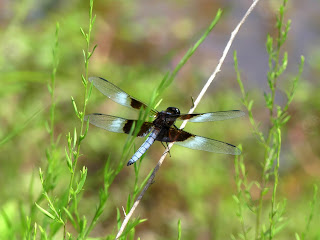
Common Whitetail Dragonfly

Image
Here's a Common Whitetail Dragonfly neighbor I met walking around my apartment complex. She was out catching some rays while probably keeping an eye out for a snack. The 3 dark spots on each wing guarantee this is a female as opposed to a juvenile male who hasn't gotten his pruinose yet. I am a little surprised to see dragonflies at my apartment complex since there's no year round water here. This species is supposed to be able to go through its nymph stage in puddles, and we probably had some puddles around in the spring. The other possibility is that she grew up a couple miles ago in the Raritan River; this species is considered to be a strong flier that could make that trip. August 19, 2020 at Finderne, NJ