Posts

Showing posts with the label milkweed tussock moth

Tussock Moth Herd

Image
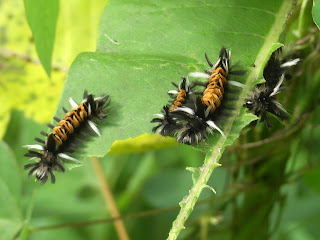
Some caterpillars are usually seen in large numbers (like Armyworm Moth caterpillars and Eastern Tent Caterpillars ), while most are more solitary. The Milkweed Tussock Moth caterpillars (more about them are here ) seem to be slightly social. I'll sometimes see them alone, but more often I'll see them in groups of 2-9 members. In the 1st picture below, you can see there is a clear size difference in some of these individuals. I'm almost certain the little one in the middle is in an earlier instar than the others (though they lack the colorful tufts of fuzz in their earliest instars). August 31, 2021 at Washington Valley Park Photo 167477945, (c) jpviolette, some rights reserved (CC BY-NC) In the picture below, it's clear that these caterpillars don't require a lot of personal space. August 31, 2021 at Washington Valley Park Photo 167477979, (c) jpviolette, some rights reserved (CC BY-NC)
Milkweed Tussock Moth

Image
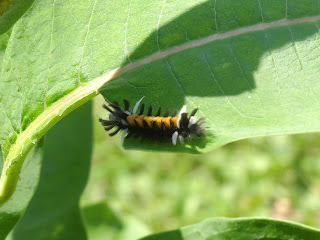
This is a fairly common caterpillar, though this was the first one I saw this summer. It's a caterpillar of the Milkweed Tussock Moth , one of the numerous denizens of our local milkweed plants . As moths, they're a little on the plain side, but as caterpillars they look a little like an arts-and-crafts project made from pipe cleaners. Like most insects that use milkweed as a host plant, they're somewhere on the bad-tasting/poisonous side of the edibility spectrum. The caterpillar's unique look makes it easy for would-be predators to identify them as poisonous.  Since they're also considered to be poisonous as adult moths, I'm a little surprised they don't have a more distinctive look as adults. Instead of appearance, they apparently signal their unpalatability by making distinctive sounding ultrasonic clicking noises that bats recognize. They don't normally compete directly with Monarch butterfly caterpillars because while Monarch caterpillars prefer y...