Posts

Showing posts with the label wild bergamot

Hummingbird Clearwing

Image
These are one of my favorite moths, the Hummingbird Clearwing : They're big enough to see without (much) difficulty. They're colorful enough to take a good picture. They can be found in places I go to find butterflies and other pollinators; I don't need to go someplace I wouldn't be anyway. If I mistake something else for the Hummingbird Clearwing, that something else is also pretty cool (usually an actual Ruby-throated Hummingbird or their Snowberry Clearwing moth cousins). Unfortunately this is the only picture I've gotten of them this season. I was scouting around Oak Meadow to see what was around a couple days before the annual Duke Farms Butterfly Count when I saw this one hovering around the Wild Bergamot . It's claimed that these moths are migratory but I haven't found anything on where they spend the winter. Their range goes pretty far into Canada, so it wouldn't surprise me if they overwinter here in NJ. If they do, their strategy is to be rea...
Butterflies

Image
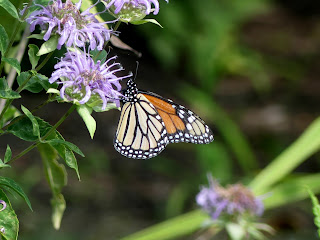
In case you're thinking that the Plainsboro Preserve is all about the dragonflies I've been posting, there was also some butterfly action there too. First I met a Monarch butterfly getting a sip of nectar from what looks like Wild Bergamot , a very popular drinking spot for the pollinator community. July 23, 2021 at the Plainsboro Preserve And a little afterwards, I met this Eastern Tiger Swallowtail at another pollinator "watering hole", one of the Joe Pye Weeds . July 23, 2021 at the Plainsboro Preserve Photo 148594293, (c) jpviolette, some rights reserved (CC BY-NC) That pretty much wrapped up this trip to the Plainsboro Preserve, where I got lots of dragonfly pictures, a few butterfly pictures, and also got a slightly uncommon bird.

Monarch on Wild Bergamot

Image
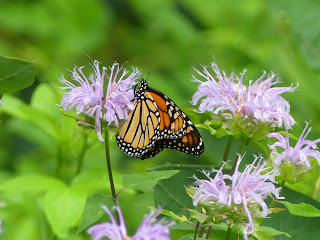
Monarchs , the King of the Butterflies, were also attracted to this Wild Bergamot patch. This was a great spot and day for pollinators; I got almost 40 pictures in a little over 2 hours. There is a feast-or-famine aspect to nature photography, and today was definitely leaning towards feast. Though I eventually saw a bunch of Monarchs, the ones I saw this day were among the first that I was able to photograph this year. After this, I started getting pictures pretty regularly. July 18, 2021 at Scherman Hoffman Wildlife Sanctuary Photo 148188503, (c) jpviolette, some rights reserved (CC BY-NC)

Great Spangled Fritillary on Wild Bergamot

Image
It seems like if you want to attract butterflies, you should get some Wild Bergamot ; here's yet another butterfly attracted to this wildflower: a Great Spangled Fritillary . These are one of my favorite butterflies. Their orange-and-black coloring and relatively large size make them easy to spot and fairly easy to identify. Probably the easiest butterfly (in my area) with which to mistake the Great Spangled Fritillary is the Aphrodite Fritillary , which has a black spot near the base of the forewing that the GSF lacks, and which is generally smaller. (My pictures don't show that spot, but the fritillaries I was seeing were almost the size of the Monarchs. I don't think an Aphrodite would ever get that large.) People sometimes see a Pearl Crescent and wonder if it's a baby GSF, but of course butterflies don't grow that way. They're pretty much at their full size when they emerge from their chrysalis. (I will admit that it's a little hard to see the pattern ...

Hummingbird Clearwing Moth on Wild Bergamot

Image
Here's a Hummingbird Clearwing Moth drinking from a Wild Bergamot (just in case you didn't believe the Silver-spotted Skipper or the Spicebush Swallowtail when they showed how delicious the flower's nectar is). While it's hard to get familiar with a lot of moths because many are noctural, or very small, or gray/brown without obvious patterns. These moths offer none of those obstacles, flying around in broad daylight, being larger than many insects, and having a fairly distinctive appearance. I've talked about these moths before , though I like the way you can see the proboscis in this picture. That's the appendage going from the front of the head down into the flower, and it's the means by which moths, butterflies, and some other insects can drink nectar from flowers. Note this allows them to drink from some narrow tubular flowers that might be inaccessible to them otherwise. July 18, 2021 at Scherman Hoffman Wildlife Sanctuary

Spicebush Swallowtail on Wild Bergamot

Image
If you didn't believe yesterday's Silver-spotted Skipper that Wild Bergamot has delicious nectar, then maybe you'll believe this Spicebush Swallowtail . I've talked about identifying these butterflies before; you can just about see the orange spots interruption on the left wing of this guy. Note that their name, Spicebush, has nothing to do with the flowers from which they'll drink nectar; most of the time, nectar is nectar. And although the flower's architecture and color could influence the pollinators it attracts, most pollinators (including the Spicebush Swallowtail) will go to an assortment of flowers. Instead, plant names in butterflies/moths are more likely to reflect the host plants they feed on as caterpillars. As caterpillars, these guys feed on spicebush and sassafras , 2 plants in the laurel family . Note that using multiple host plants from the same family is a very common theme among butterflies/moths: Monarchs like milkweeds, sulphurs generally...

Silver-spotted Skipper on Wild Bergamot

Image
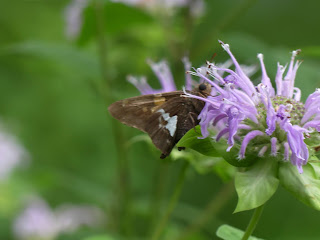
I encountered this Silver-spotted Skipper (butterfly) drinking nectar from a Wild Bergamot (mint). This is a fairly common sight. For a period of the summer, Wild Bergamot is a fairly prominent meadow wildflower, Silver-spotted Skippers are pretty common, and these skippers are attracted to colorful (blue, red, purple) wildflowers. I've talked before about Silver-spotted Skippers, so I'll mention a little about the Wild Bergamot: They're in the mint family , which also includes catnip and culinary herbs. The stems of mints tend to be squarish, to help you ID them. They're also called "bee balm", suggesting that they're popular with the bees, and thus tend to be nectar-rich. A relative, Scarlet Bee Balm , looks similar but is red. Scarlet Bee Balm doesn't seem to do well in my area - unlike Wild Bergamot I don't think I've seen it growing truly wild (though I've seen it in some Duke Farms flowerbeds where it's a little segregated from...

Eastern Tiger Swallowtail

Image
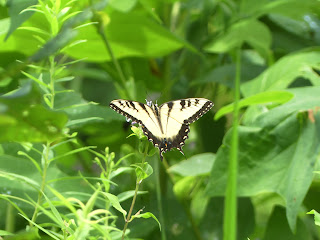
This Eastern Tiger Swallowtail dropped by to imbibe a bit of nectar back in July, allowing me to get a couple pictures. This is perhaps the largest of the commonly spotted butterflies here in New Jersey; large individuals can even be giant sized (or at least about the size of the Giant Swallowtail ). They do have some look alikes , though I suspect that in my area if you see any butterfly that looks like this, you've got an Eastern Tiger Swallowtail. My guess is that this fella was drinking nectar from a Wild Bergamot , a native wildflower that's very popular within the pollinator community. Though you can find these butterflies in the middle of a meadow, females lay eggs on trees so edge areas are probably a little better area to find them. July 18, 2021 at Scherman Hoffman Wildlife Sanctuary July 18, 2021 at Scherman Hoffman Wildlife Sanctuary Photo 148187961, (c) jpviolette, some rights reserved (CC BY-NC)