Posts

Showing posts with the label spicebush swallowtail

Eastern Tailed-blue

Image
Here's 1 of our Eastern Tailed-blue butterflies. Though I usually identify these butterflies by a little piece of their hind wings that sticks out a bit (aka "the tail") [1], in this particular picture the background makes this a little hard to see. The other field mark that differentiates this butterfly from the Azure Complex butterflies is a small orange spot on the underside of the hind wing, which you ought to be able to see in this picture. Given that sometimes part of the wings can be torn off, the orange spot is probably a slightly more reliable field mark, though it's easier for me to remember that Eastern Tailed-blues have "tails". Although being able to see that orange spot is good for identification purposes, the view of them with their wings up does have a downside. The primary way to identify a female from a male is if the top view of the wings is gray rather than a purplish-blue. I'm not aware of a way to tell the gender from this view; ...
Spicebush Swallowtail

Image
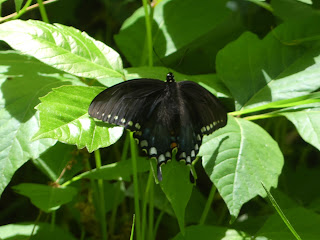
Butterfly season is ramping up. A couple weeks ago I met this Spicebush Swallowtail , a butterfly I've talked about here and here . This was easily my earliest sighting of this butterfly in a season, with May 18 being over a month earlier than my June 22 sighting in a previous year. Looking at iNaturalist sightings by other people, this isn't a shocking sighting even though the Spicebush Swallowtail observations usually peak in July/August. In the 1st picture we get a pretty good look at the tops of the wings, though I'd argue this isn't the best view for identifying a Spicebush Swallowtail. Looking at this I'd be inclined to think the spots would be more yellow on a Black Swallowtail , and that a black morph Eastern Tiger Swallowtail usually shows the typical stripy pattern you'd find on a regular yellow morph except that the pattern would be dark black on light black; the uniform black with the white spots would have me leaning towards a Spicebush. May 18, 2...

Black Swallowtail

Image
At the tail end of April I saw my first Black Swallowtail - the New Jersey state butterfly [1] - of the season. In my area they're neither rare nor common, maybe like friends you run into a few times a year. As I've mentioned before , the Black Swallowtail isn't the only swallowtail butterfly that's black, but it might be the blackest. Though the Black Swallowtail is usually a little smaller than black morph Eastern Tiger Swallowtails and Spicebush Swallowtails , the rich black color that sets off its yellow spots frequently has me suspicious that I'm seeing a Black Swallowtail even before I get a close look at it. (I could theoretically encounter various other swallowtail butterflies too, though it doesn't happen much.) April 30, 2022 at Duke Farms Photo 197665584, (c) jpviolette, some rights reserved (CC BY-NC) [1] It's also the state butterfly of Oklahoma. Oklahoma and New Jersey probably don't share a lot in common, but taste in butterflies is appa...

Black Morph Eastern Tiger Swallowtail

Image
This was a black morph Eastern Tiger Swallowtail I met last summer. Though all male and most female Eastern Tiger Swallowtails have a yellow-with-black-stripes look, some of the females are mostly black. At a glance the black morph Eastern Tiger Swallowtails may look uniformly black, but if you get a good look at them you can see they have the same black stripes as the yellow ones. They actually have translucent black where their relatives have yellow, and the black stripes stand out pretty well in the right lighting. In my area we have 2 similar swallowtails, the Spicebush Swallowtail and the (slightly smaller) Black Swallowtail , and neither would show black stripes on a "light black" background. (They also have other pattern differences.) July 22, 2021 at Fairview Farm Photo 148401095, (c) jpviolette, some rights reserved (CC BY-NC) July 22, 2021 at Fairview Farm Photo 148401067, (c) jpviolette, some rights reserved (CC BY-NC)

Spicebush Swallowtail on Wild Bergamot

Image
If you didn't believe yesterday's Silver-spotted Skipper that Wild Bergamot has delicious nectar, then maybe you'll believe this Spicebush Swallowtail . I've talked about identifying these butterflies before; you can just about see the orange spots interruption on the left wing of this guy. Note that their name, Spicebush, has nothing to do with the flowers from which they'll drink nectar; most of the time, nectar is nectar. And although the flower's architecture and color could influence the pollinators it attracts, most pollinators (including the Spicebush Swallowtail) will go to an assortment of flowers. Instead, plant names in butterflies/moths are more likely to reflect the host plants they feed on as caterpillars. As caterpillars, these guys feed on spicebush and sassafras , 2 plants in the laurel family . Note that using multiple host plants from the same family is a very common theme among butterflies/moths: Monarchs like milkweeds, sulphurs generally...

Spicebush Swallowtail

Image
Here's a Spicebush Swallowtail that was living near my apartment. This is one of our black swallowtail butterflies that are not the Black Swallowtail . Here's a good article on distinguishing our most common  swallowtails. If you don't remember all of that, don't worry. I suspect that most of these guys would be flattered if you merely recognize them as swallowtail butterflies . The Spicebush Swallowtail is actually easier to identify with the wings up. There you'll see a row of orange spots interrupted by a blue swoosh mark; no other similar-looking butterfly has that blue swoosh. From this angle, I'd look at the row of yellow spots at the edge of the wing. Black Swallowtails would have 2 rows. If this were a dark morph Eastern Tiger Swallowtail , even this row of spots would be virtually missing. And a Pipevine Swallowtail wouldn't have those spots at all. The host plant for their caterpillars is - wait for it - the Spicebush . Sometimes these names actu...