Posts

Showing posts with the label swallowtail butterfly

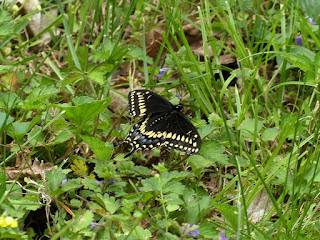
Black Swallowtail

Image
Here's someone I met last month at Duke Farms, a Black Swallowtail . This is the state butterfly of New Jersey, attaining that status about 5 years ago . Note that not all NJ butterflies that are black are Black Swallowtails; Spicebush Swallowtails, Pipevine Swallowtails, and some female black morph Eastern Tiger Swallowtails are common butterflies that are black. Still, the rich black and the bright yellow spots generally give these guys a different look than most of the others. As caterpillars these guys mostly eat foods in the carrot/parsley family. Some of these plants you can eat (including celery, dill, and fennel), and some plants you can't (the invasive Poison Hemlock and at least some of the native Water Hemlocks). So if one of their caterpillars invites you over for dinner, make sure you ask what they're serving. May 4, 2021 at Duke Farms Photo 128324584, (c) jpviolette, some rights reserved (CC BY-NC)
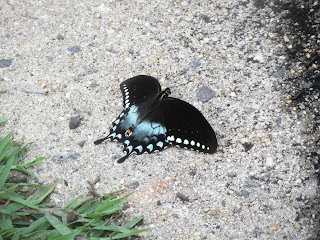
Spicebush Swallowtail

Image
Here's a Spicebush Swallowtail that was living near my apartment. This is one of our black swallowtail butterflies that are not the Black Swallowtail . Here's a good article on distinguishing our most common  swallowtails. If you don't remember all of that, don't worry. I suspect that most of these guys would be flattered if you merely recognize them as swallowtail butterflies . The Spicebush Swallowtail is actually easier to identify with the wings up. There you'll see a row of orange spots interrupted by a blue swoosh mark; no other similar-looking butterfly has that blue swoosh. From this angle, I'd look at the row of yellow spots at the edge of the wing. Black Swallowtails would have 2 rows. If this were a dark morph Eastern Tiger Swallowtail , even this row of spots would be virtually missing. And a Pipevine Swallowtail wouldn't have those spots at all. The host plant for their caterpillars is - wait for it - the Spicebush . Sometimes these names actu...

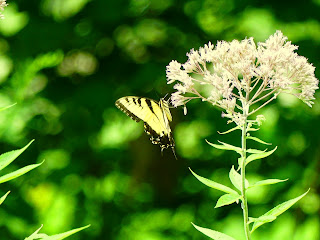
Eastern Tiger Swallowtail

Image
I haven't shown an Eastern Tiger Swallowtail in a while; below is one encountered at the Duke Farms butterfly count.  This is one of the larger and most distinctive butterflies in my area; the only butterfly it looks like on close observation is the Canadian Tiger Swallowtail , and we probably only get the occasional stray down here. Another relative, the Western Tiger Swallowtail , is also very similar but even less likely to be seen this far east. Though these are recognized as separate species, it's obvious they're closely related to the extent they can interbreed. There is even a hybrid population between the Eastern and Canadian Tiger Swallowtails that's now recognized as a separate species, the Appalachian Tiger Swallowtail . It's a little unclear to me whether they should be different species or different subspecies . July 25 at Duke Farms