Posts

Showing posts with the label differential grasshopper

Carolina Grasshopper
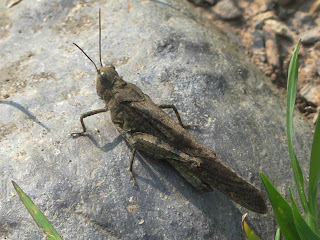
Image
I think this is a Carolina Grasshopper I met last summer, though I have to admit it doesn't look a lot different from the Sulphur-winged Grasshopper . At least it doesn't look like the Differential Grasshoppers .  Though it might surprise you to look at a stationary 1, these grasshoppers are frequently mistaken for butterflies when in flight. This is partly because they have a somewhat erratic flight like a fluttering butterfly and partly because their mostly-dark wings with light-colored edges reminds people of a Mourning Cloak butterfly. If you think you see a Mourning Cloak in flight but it completely disappears when it lands on the ground, you might be seeing a Carolina Grasshopper. As frequently happens, this species has a far wider range than the "Carolina" part of its name might lead you to believe. They can be found in most of the contiguous 48 US states and much of southern Canada. June 29, 2023 at Sourland Mountain Preserve Photo 301251109, (c) jpviolette,...

Purple Crownvetch

Image
Here's an invasive wildflower you can see in a lot of places, a Purple Crownvetch . I've discussed this wildflower before , so I'll just add a few more factoids: Like other legumes, they indirectly help restore nitrogen to the soil. That's due to a symbiotic relationship the plant has established with rhizobia , a bacteria that requires a host plant and converts nitrogen in the air into ammonia in the soil. It's slow to establish itself, but once it does its deep weeds, nitrogen fixing , and aggressive behavior make it very difficult to get rid of. It's unclear that any wildlife will eat it, though Differential Grasshoppers and a few others are suspected of giving it a try from time to time. One native wildflower suggested as an alternative, the Wood Vetch , is considered so flammable that it's recommended to keep it away from homes. (There might not be a great native alternative.) The "vetch" part of the name comes from a Latin word (vincire) me...

Differential Grasshopper

Image
Early last autumn I met this Differential Grasshopper . With pretty good size and vivid green coloring, these guys are fairly photogenic. Because they eat grains and other plants, they can be damaging to agriculture, but in our meadows they're a good food source for many of our birds. While many insects (most famously butterflies) undergo complete metamorphosis to transition from larvae to adults, grasshoppers are insects that have a different strategy. They hatch looking like tiny wingless adults, and then go through 5 molts, each time getting closer to the size/functionality of adults. They share this incomplete metamorphosis strategy with close relatives like katydids and crickets along with several other more distantly related insects like mantises, dragonflies, and damselflies. September 25, 2021 at Duke Farms Photo 168288306, (c) jpviolette, some rights reserved (CC BY-NC)